University of South Alabama Mobile
Why USA’s $459 Million in Combined Assets Hasn’t Stopped Rising Tuition
Despite $459 million in combined university and foundation assets, USA has raised tuition four years running. Here's why the money can't help.
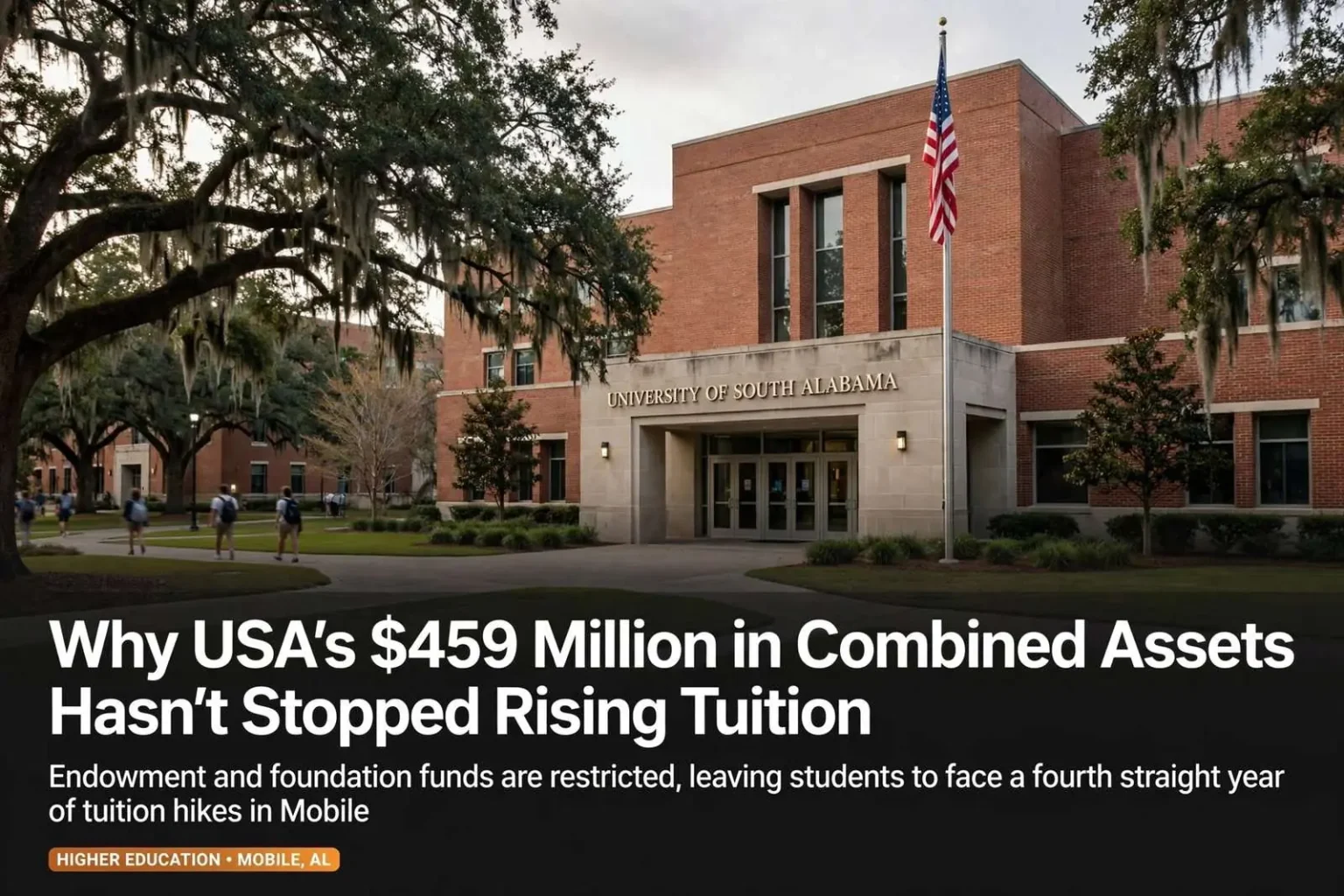
The University of South Alabama and the independent foundation that supports it together hold roughly $459 million in assets, yet that wealth has done nothing to slow a string of tuition increases that now stretches to four consecutive years, according to university financial officers in Mobile. The university’s own endowment stands at nearly $140 million, while the separately governed USA Foundation reports total net assets north of $319 million. On paper, that combined figure sounds like more than enough to cushion students from repeated cost hikes. In practice, neither pool of money was ever built to serve that purpose, and school leaders say tapping it to offset tuition simply isn’t how the funds are structured to work.
University trustees approved another tuition increase earlier this summer, marking the fourth straight year of hikes and pushing the cumulative increase since 2008 to roughly 40 percent. The timing has fueled questions from students and parents about why a school sitting on nearly half a billion dollars in assets can’t find room to hold the line on costs. Those questions have grown louder as families across the Gulf Coast weigh college bills against household budgets that have yet to fully recover from years of economic strain. In response, university officials have taken the unusual step of walking through, in detail, how the two pools of money are governed, what they can legally be spent on, and why neither functions as a slush fund for the operating budget.
A Question of Donor Intent
According to USA’s vice president for financial affairs, the answer comes down to donor intent. The university’s endowment, established in 2000 under the direct oversight of the Board of Trustees, was built almost entirely from gifts earmarked for specific purposes — endowed scholarships, named professorships, or particular academic programs. Only a small slice of what the university receives arrives as unrestricted money that can be freely applied to general operating costs such as keeping tuition flat. Every restricted dollar carries a legal obligation: once a benefactor directs a gift toward a nursing scholarship or an engineering professorship, the university is bound to honor that direction indefinitely, no matter what else is happening in the budget.
The university’s finance officer noted that if a donor specifically asked that a large gift be used to prevent a tuition increase, the university would honor that request. But donors overwhelmingly prefer their contributions fund long-term priorities like buildings or scholarships rather than offsetting a single year’s operating budget. That preference mirrors a pattern seen across American higher education, where benefactors gravitate toward gifts that carry their name, endure for generations, and can be pointed to on campus. A one-year tuition subsidy leaves no monument, funds no chair, and helps no student after the money runs out, which makes it a rare ask in the world of charitable giving.
Leadership at the USA Foundation offered a similar account of its own ledger. The foundation operates as a separate legal entity with its own governing board, existing to receive private gifts, invest them, and channel their benefits to the university. Its assets are not a discretionary reserve the campus can draw on at will; they are largely committed to the purposes for which the underlying gifts were made. Raiding that corpus to hold tuition steady would, foundation leaders argue, break faith with generations of donors and put the university’s fundraising engine at risk, since few benefactors would keep giving to a fund that gets raided whenever budgets tighten.
How Endowment Money Actually Works
Much of the confusion around the $459 million figure stems from a common misunderstanding of how endowments function. An endowment is not a checking account with a half-billion-dollar balance sitting ready for withdrawal. The bulk of it is permanent principal, invested to generate earnings, and universities typically spend only a small annual distribution from those earnings — a practice designed to preserve buying power across decades rather than cover any single fiscal year’s bills. Spending down the principal itself would provide temporary relief at best and permanently shrink future income at worst.
The restrictions run deeper still. Gift agreements frequently specify not just a purpose but mechanics: a scholarship may be restricted to students from a particular county, a professorship may be tied to a specific department, and the earnings on one gift may be legally inseparable from its original principal. Even when funds are technically available, swapping them into the operating budget can trigger compliance obligations, audit findings, and in some cases the return of gift money. University business officers across Alabama describe endowment accounting as among the most closely scrutinized areas of campus finance, precisely because every dollar arrives with strings attached.
The university’s endowment has another feature worth understanding: it was created relatively recently, in 2000, and nearly a quarter century of careful stewardship went into building it to its current size. Universities with century-old endowments benefited from generations of accumulated gifts and market growth; South Alabama has had to construct its base of private support in a much shorter window, in a region where philanthropic dollars are spread across many worthy causes. Officials note that comparing USA’s endowment to those of older, wealthier institutions misses the point — the question is never whether the number looks large on a brochure, but what share of it is unrestricted, liquid, and legally available for the budget problem of the moment.
That share, by every account the university has offered, is small. Unrestricted gifts — money a donor hands over with no stated purpose — make up a minor portion of annual fundraising nationwide, and South Alabama is no exception. The operating budget that determines tuition is instead driven by three main levers: state appropriations, enrollment and tuition revenue, and cost containment. When state funding stagnates and costs rise, tuition becomes the lever that moves, and no clause in a donor’s gift agreement allows a university to redirect a named scholarship fund to close that gap.
The State Funding Backdrop
Public universities across Alabama have told versions of this same story for years. State appropriations to higher education have historically swung with the economy, and when the Education Trust Fund contracts, campuses are left to absorb retirement costs, health insurance increases, building maintenance backlogs, and utility bills with fewer state dollars. Tuition and fees have been the pressure valve. South Alabama’s roughly 40 percent cumulative increase since 2008 tracks a pattern seen at public four-year institutions throughout the state and the Southeast, where the portion of a university’s budget covered by state support has steadily narrowed over the same period.
For Mobile’s regional university — the largest employer of its kind in southwest Alabama and a major pipeline for the area’s hospitals, schools, and engineering firms — the tuition debates of recent summers have been about more than balance sheets. Rising costs affect whether local students can afford to stay close to home for college, whether working families can send a second child to campus, and how much debt graduates carry into the Gulf Coast job market. University leaders are aware of that sensitivity; it is precisely why the recurring question about the $459 million in assets keeps coming up at trustee meetings and in conversations with parents.
What It Means for Students and Families
For students, the practical significance of donor restrictions cuts both ways. Restricted giving is what funds a large share of the scholarships that offset tuition increases for many South Alabama students — endowed awards built over decades by alumni, civic groups, and Gulf Coast families. Money that cannot be used to hold tuition flat can still, and does, reduce what individual students actually pay. University financial aid officers point out that endowed scholarships are among the most common restricted gifts the institution receives, and that the pool of such aid has grown along with the endowment itself since 2000.
Financial aid administrators also note that sticker price and net price are different numbers. Published tuition may rise in a given year, but federal aid, state grant programs, institutional scholarships, and endowed awards shape what a family ultimately pays out of pocket. That distinction offers little comfort to students who fall just outside scholarship criteria or to middle-income families who qualify for little need-based aid, and administrators acknowledge that the gap between published cost and affordability is a persistent challenge. It is the reason the tuition votes each summer draw the scrutiny they do.
Where the Pools Could Still Meet
University officials do not describe the situation as permanent. The finance officer’s comments about honoring a donor’s tuition-relief request point to one realistic path: a benefactor stepping forward with a large unrestricted or tuition-designated gift. Fundraising professionals call this capacity giving, and it is the explicit goal of the kind of comprehensive campaigns universities periodically launch. Until such a gift arrives, the money in the endowment and the foundation remains spoken for — committed by legal agreement to scholarships, professorships, programs, and facilities that benefit students in ways that never show up on a tuition bill.
There is also the slower route of growing the unrestricted share year by year. Annual funds, phone-a-thon programs, and alumni giving days typically produce the most flexible dollars a university receives, and even modest amounts add up across a base of thousands of South Alabama graduates living along the Gulf Coast. Development officers describe unrestricted annual gifts as the hardest money to raise and the most valuable to receive, because it is the only kind that can respond to whatever the budget needs most in a given year — including, in theory, moderation of a tuition increase.
The Ledger Explains the Decision
Strip away the confusion and the situation in Mobile is fundamentally an accounting story. One side of the ledger holds roughly $140 million in university endowment assets, nearly all restricted; the other holds more than $319 million in USA Foundation net assets, governed separately and committed to its own purposes. Between them sits an operating budget funded by tuition, state appropriations, and auxiliary revenue, and it is that budget — not the endowment — that sets what students pay each fall. When trustees approved the latest increase, they were balancing the operating budget they actually have, not the half-billion-dollar figure that draws headlines.
That explanation rarely satisfies the family opening a tuition statement, and university leaders concede the optics are difficult. But the alternative — liquidating restricted assets or breaking gift agreements to buy a single year of flat tuition — would trade a lasting problem for a temporary fix while damaging the university’s ability to raise private support at all. For now, the two pools of money will keep doing what their donors intended: funding scholarships, professors, buildings, and programs, one restricted dollar at a time, while tuition policy remains a function of the operating budget it has always been.
The conversation in Mobile is likely to continue each summer as trustees take up the budget cycle, and students and parents can expect the same two answers from the administration: donor intent governs the endowment, and the foundation answers to its own board. What may change is the fundraising push behind the unrestricted slice of giving — the one pool of money that could, someday, give the university room to hold the line on what students pay.