Former Mobile Judge Herman Thomas Disbarred in Florida
Former Mobile County Circuit Judge Herman Thomas was disbarred in Florida, another chapter in a saga that already cost him his judgeship and his Alabama law license after sensational allegations.
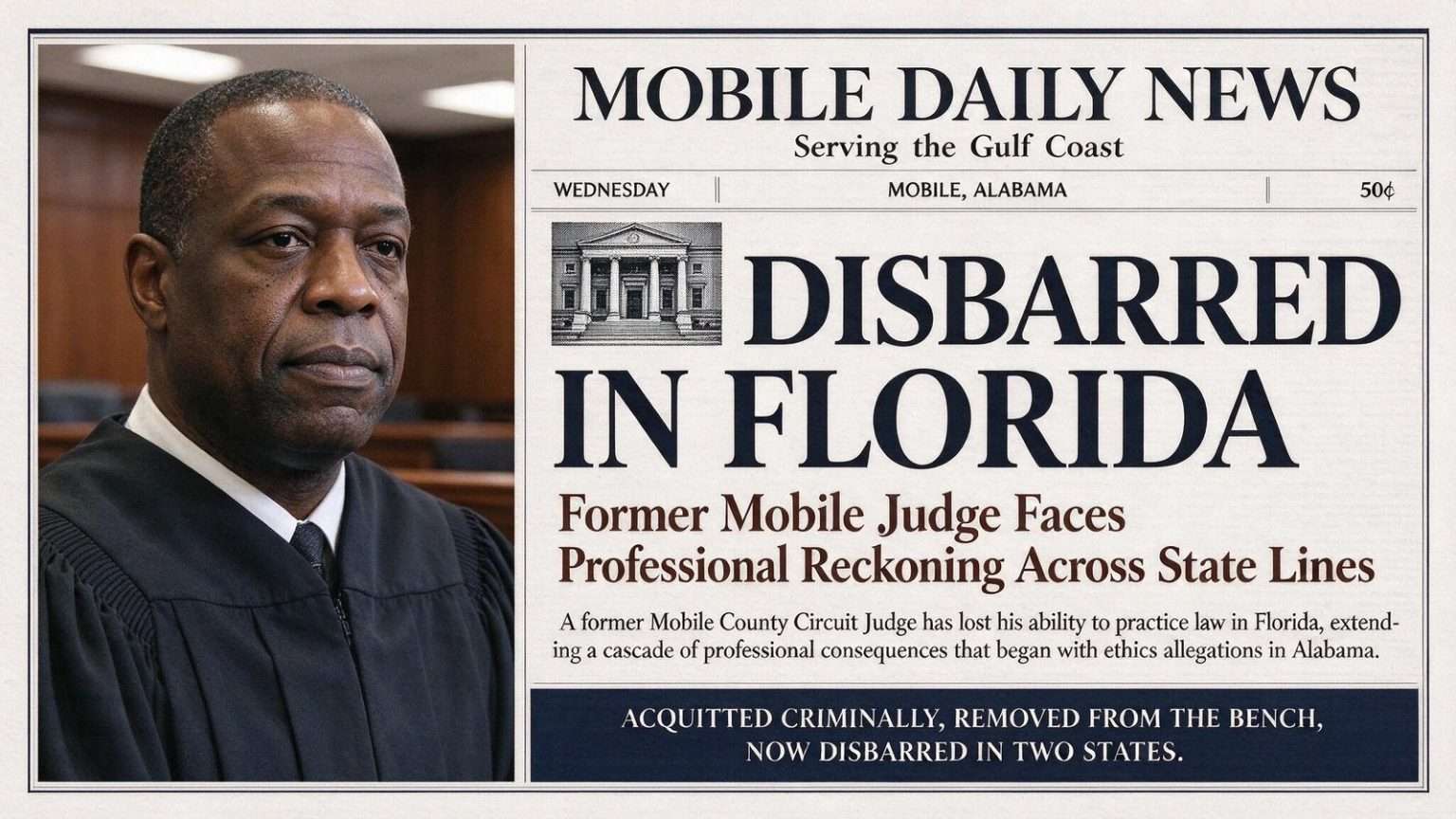
Former Mobile County Circuit Judge Herman Thomas was disbarred in Florida this week, extending the professional fallout from one of the most sensational judicial scandals in recent Mobile history. The action followed his earlier disbarment in Alabama and the loss of the judgeship that had once made him a prominent figure in the local courts.
With the Florida decision, Thomas is now barred from the practice of law in the two states where his legal career was built. The ruling closes the last widely used avenue for an Alabama-trained lawyer who once sat on the circuit bench presiding over the same courthouse where his case would later unfold.
A reciprocal action
Thomas had already been disbarred in Alabama in the wake of the allegations against him. The Florida disbarment amounted to a further closing of professional doors, the kind of reciprocal discipline that typically follows when an attorney loses the license to practice in one state and holds standing in another.
Reciprocal discipline is a routine mechanism of American legal regulation. Bar authorities in each state track disciplinary actions elsewhere, and when a lawyer is disbarred in a state where they hold a license, the second state’s bar typically opens its own file and imposes matching discipline after giving the lawyer a chance to respond. The process is not automatic in theory, but in practice, disbarment in one state almost always ends a legal career in the others — there is little a second bar can do differently with conduct its counterpart has already adjudicated.
For Thomas, the Florida action carried particular weight because of where his career reached beyond Alabama. Florida and Alabama share the Gulf Coast legal community, with Mobile lawyers routinely appearing in Pensacola’s federal courts and panhandle practitioners working Mobile cases, and the two states’ bars overlap in the maritime, personal injury and commercial practices that dominate the region.
With the Florida action, the avenues for Thomas to practice law narrowed still further. A disbarred attorney in both states has, in practical terms, no forum left in which to appear as a lawyer — though disbarment is not always permanent, and the bars of both states allow petitioners to seek reinstatement after lengthy periods, subject to proof of rehabilitation that rarely comes easily in cases of this profile.
The allegations at the center
The disbarments traced back to charges that had stunned the community. Thomas was accused of paddling young inmates in a spare courthouse office for his sexual gratification — lurid allegations that drew intense public attention and cast a shadow over the courthouse where he had presided.
The accusations placed the local judiciary under a harsh spotlight and raised difficult questions about oversight and accountability on the bench. For many in Mobile, the case had become shorthand for a betrayal of public trust by someone entrusted with dispensing justice.
The details were what made the case inescapable in a city the size of Mobile. Courtrooms are civic spaces — jurors, clerks, deputies and litigants pass through them daily — and the suggestion that a judge had used a private office in the building for purposes so far removed from the dignity of the bench was, for many residents, difficult to reconcile with the institution itself. The case dominated local news coverage for months and was discussed in bar association circles across the state.
Thomas had been, before the allegations, a rising figure in Mobile’s legal and civic life — a circuit judge whose position put him among the most visible officeholders in the county. The fall from that position was correspondingly steeper, and the questions the case raised about how a sitting judge could be monitored, disciplined and, ultimately, removed became part of the public conversation that followed.
Thomas had been, before the allegations, a rising figure in Mobile’s legal and civic life — a circuit judge whose position put him among the most visible officeholders in the county. The fall from that position was correspondingly steeper, and the questions the case raised about how a sitting judge could be monitored, disciplined and, ultimately, removed became part of the public conversation that followed.
Acquitted, but not spared
The outcome of the criminal case had not resolved the professional one. Thomas was acquitted of the criminal charges brought against him.
Yet an acquittal in a courtroom did not shield his career. He lost his judgeship through state judicial disciplinary proceedings, the separate track by which Alabama holds its judges to the standards of judicial ethics.
That divergence — cleared of crimes but removed from office and stripped of his law licenses — underscored a distinction that often confuses the public. Criminal courts and disciplinary bodies apply different standards and answer different questions. A jury’s reasonable doubt is not the same as a disciplinary panel’s judgment about fitness to serve or to practice.
The distinction rests on purpose as much as burden of proof. A criminal trial asks whether the state can prove, beyond a reasonable doubt, that a specific crime occurred. A disciplinary proceeding asks whether the record establishes that a lawyer or judge remains fit to hold the public’s trust — a question answered on a preponderance of the evidence, and one that weighs conduct, candor and credibility rather than only provable offenses. Alabama’s Judicial Inquiry Commission and its courts handle judges; the Alabama State Bar’s disciplinary system handles lawyers. Both can act on the same facts that a jury declined to convict on.
The practical effect in Thomas’s case was that two systems reached conclusions a criminal jury never had to reach. The judgeship was lost through the judicial track, the Alabama law license through the bar’s disciplinary process, and now Florida’s bar has completed the third formal verdict of unfitness. Each body examined the same allegations, applied its own standard, and each arrived at a sanction ending the career in question.
For the public, the case became a durable illustration of why acquittal and vindication are not synonyms. The constitutional protections that guard a defendant in criminal court — the highest burden of proof, unanimous juries, the government’s entire burden — simply do not operate in a licensing context, where the question is not whether the state can imprison a person but whether the profession will vouch for them.
A saga reaching its end
The Florida disbarment marked another, and perhaps among the final, formal consequences in a long-running matter that had moved through criminal court, the state’s judicial disciplinary system and the bar associations of two states.
Each stage had chipped away at the standing Thomas once held as a circuit judge. For a community that had followed the case from its shocking beginnings, the latest development offered a measure of closure, if not comfort.
The arc of consequences ran from the courthouse to the statehouse of professional regulation and across state lines: acquittal in criminal court, removal from the bench through Alabama’s judicial discipline, disbarment by the Alabama State Bar, and now reciprocal disbarment in Florida. Few cases in recent Mobile memory have traced the full length of that machinery, and the completeness of the professional collapse — judgeship gone, license gone, second license gone — stands as the case’s defining outcome.
What remains for Thomas is a record that follows him into any future proceeding. Both bars retain the power to consider reinstatement petitions in the distant future, but the burden such petitions carry — demonstrating fitness after discipline of this magnitude — has rarely been met in cases that began with this level of public attention.
The man who had once worn the robes of a Mobile County circuit judge now found himself barred from the practice of law in a second state, the reputation he had built in the local legal community reduced to a cautionary tale.
The case’s effect on Mobile’s legal institutions outlasted the headlines. The courthouse procedures, supervision practices and the willingness of young lawyers and jail staff to report what they saw all became part of the story’s legacy, and the disciplinary outcomes in two states are now part of the public record that any future conduct case will be measured against.
For Mobile’s bar and bench, the saga also demonstrated the machinery working as designed — slowly, publicly, and through several independent bodies at once. A criminal jury answered the criminal question. The judicial discipline system answered the fitness question. Two state bars answered the licensing question. None of them required the others’ permission, and none was bound by the others’ conclusions. That separation, confusing to the public during the case’s most sensational stretch, is what allowed the professional consequences to arrive in full even after an acquittal that might otherwise have ended the matter.
The Florida disbarment closes that sequence with the profession’s final word: whatever a jury decided, Herman Thomas will not practice law in either state where he built his career, and the courthouse scandal that began with allegations in a Mobile courtroom ends with his name removed from the rolls in two.