Mayor Unveils a Fresh Look for Mobile’s Historic Bienville Square
Mayor Sam Jones unveiled a series of city-funded improvements to Bienville Square, the historic heart of downtown Mobile, including new security cameras, renovated restrooms and a restored fountain.
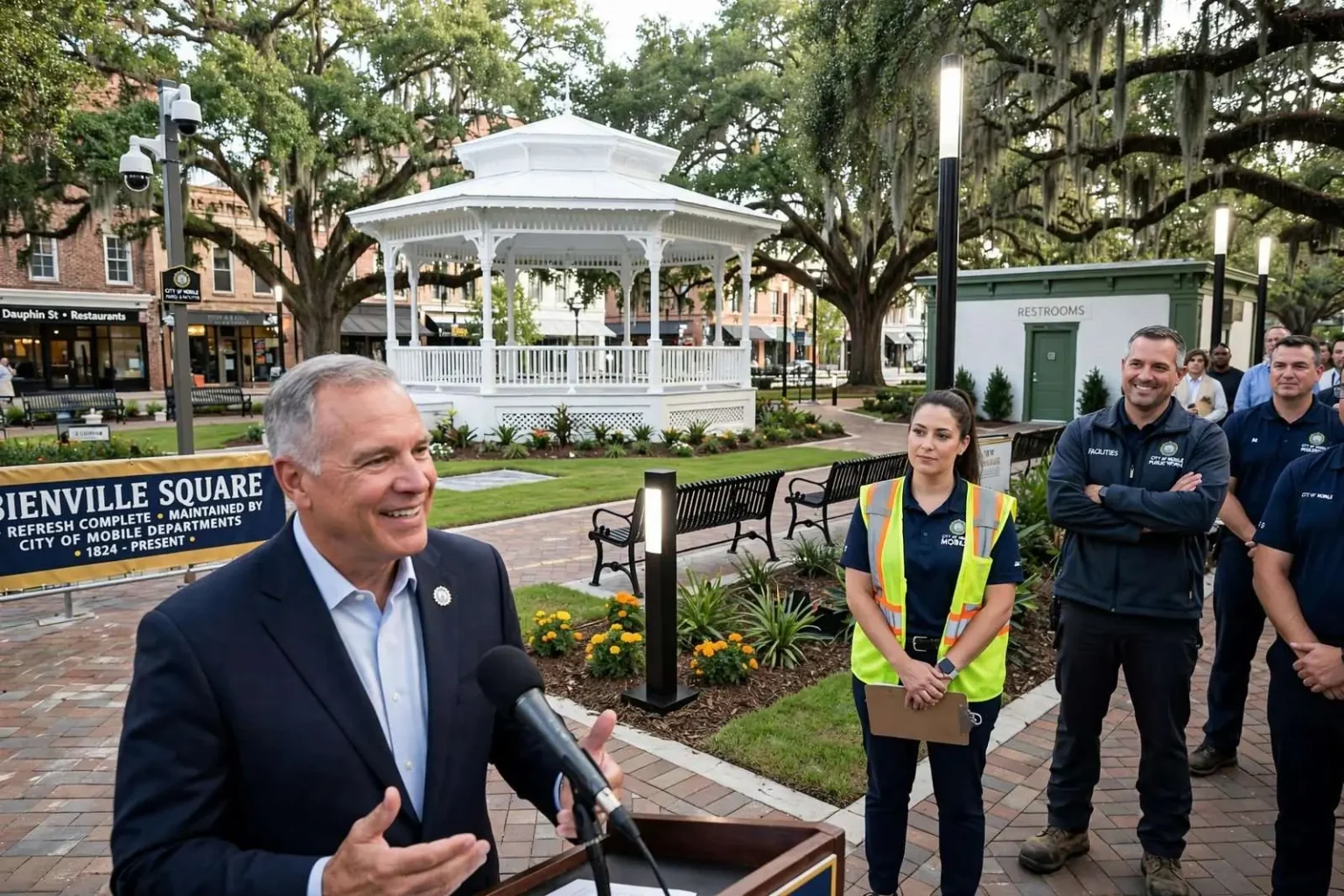
Bienville Square, the leafy center of recreational and civic life in the heart of downtown Mobile, was getting a facelift. Mayor Sam Jones unveiled a set of improvements to the historic square, which dates back to 1824, and made a point of noting that the work had been carried out entirely by city departments.
“First impressions are important. Bienville Square is the first public venue that most folks see when they come into downtown Mobile. We want it to be friendly and inviting,” the mayor said. “Another great thing about the changes we are announcing today is that the work was done solely by city departments.”
For a downtown that leaned on its historic charm to draw residents and visitors, the square’s condition carried symbolic weight. Improving it was as much about civic pride as about maintenance. The five-block stretch of Dauphin Street nearby had become the city’s entertainment corridor, and the square sits at the front door of a downtown that Mobile has spent years working to revive — restaurants, offices, churches and festivals all counting on the public spaces between them to look like a city worth visiting.
The in-house approach mattered almost as much as the work itself. By using city crews — parks, facilities, engineering and police — the city completed the project without outside contracts, a point the mayor emphasized at a time when every department budget was being scrutinized. The result, he noted, was a fuller refresh of the square at a cost the city could absorb with the staff it already had.
What changed
The improvements touched nearly every corner of the square. The city installed four security cameras networked to the Police Department’s Special Events precinct on Dauphin Street. Positioned to view activity along St. Joseph and St. Francis streets, the cameras would also capture any irregularities in the newly renovated restrooms.
Those restrooms received a complete renovation — the first in more than a decade — with state-of-the-art cooling and heating systems, new flooring, tiles and lighting, and updated fixtures. Restroom conditions are among the most common complaints at any heavily used public park, and their state sets the tone for whether families will spend a full afternoon at an event or leave early. The overhaul brought the facilities up to the standard the square’s calendar of events demands.
Crews repainted the exterior of the restrooms and the bandstand, recoated the bandstand floors, landscaped and re-sodded the area around the bandstand, and repainted all the benches in the square. The bandstand is the square’s stage — the platform from which concerts, speeches, ceremonies and festival programs run — and its condition is visible in every photograph taken on the grounds. Fresh floors and paint, framed by new sod and landscaping, restore the visual centerpiece of the park.
The bench work, small as it sounds, is the improvement most residents touch directly. A square’s benches carry its daily life — lunch crowds from downtown offices, parents watching children, festival-goers resting between stages — and peeling, weathered benches read as neglect no matter how well the grass is cut.
Brighter and safer after dark
Lighting got a notable upgrade. Instead of the familiar yellowish halo, city crews installed bright white lights on poles throughout the square and lining the walkway to the restrooms. The change aimed to make the space feel more secure and welcoming in the evening hours.
“It is our goal to restore the Square back to a point where citizens and tourists will feel safe, be comfortable and enjoy the entire area,” the mayor said.
The lighting change does more than brighten the grounds. Clearer white light renders faces and colors accurately, which makes the security cameras more effective and makes pedestrians more willing to use the walkways after sunset. For a square that hosts evening events through much of the year, and that sits along routes downtown workers walk daily, the difference between a yellowish murk and a clean white glow is the difference between a park that empties at dusk and one that stays in use.
The new cameras tie into the same Police Department infrastructure that covers the city’s largest gatherings. The Special Events precinct on Dauphin Street handles the detail work for Mardi Gras, festivals and downtown events, and networked cameras give officers in that precinct a live view of the square without adding patrols. City officials have described the camera network as an extension of existing downtown coverage rather than a new program — an incremental addition to how the area is already policed.
A square with deep roots
Bienville Square takes its name from Jean-Baptiste Le Moyne, Sieur de Bienville, the French colonial founder of Mobile, and its 1824 designation makes it one of the oldest public squares in the city. Generations of Mobilians have gathered on its grounds for everything from patriotic rallies and wartime ceremonies to festival crowds and weekday lunch breaks, and the large oaks that shade its corners have watched the downtown around it grow, decline and begin to grow again.
The square’s long history is part of why its condition draws attention. Historic public spaces in Southern cities carry both practical and symbolic loads: they are places to gather, and they are the backdrop a city shows the world. Mobile’s downtown revival — the restaurants and lofts that have followed the entertainment corridor, the convention traffic at the nearby civic facilities, the cruise terminal on the river — all depend on the public realm between the buildings feeling cared for.
City officials framed the project in exactly those terms. The square anchors a district where private investment has been arriving steadily, and the mayor’s office has argued that public spaces must keep pace with it. A renovated bandstand, clean restrooms, fresh benches and white light are, in that argument, economic development by other means: the small things that decide whether a visitor who parks downtown for an evening comes back.
The completed work list — cameras, restrooms, bandstand, benches, landscaping and lighting — represents a full circuit of the square rather than a single showcase project. City departments handled the different pieces in sequence: the facilities trades on the restrooms and fixtures, the parks crews on the sod, landscaping and paint, the engineering and police functions on the cameras and lighting. That sequencing matters in a public park that never closes; the square stayed in use while the work moved around it.
What it means for downtown
The announcement lands in a downtown that has been working for years to change what an evening there feels like. The Dauphin Street corridor draws crowds for its bars and restaurants, the city’s festival calendar fills the squares and streets through the winter and spring, and the historic districts around the central business district have steadily gained residents. Public parks sit at the center of that equation. They are where event crowds spill, where families go between destinations, and where a downtown’s upkeep is most visible.
For the neighborhoods surrounding downtown, the square’s condition is a daily fact of life rather than a talking point. Residents walk through it, children play on its grounds, and churches and community groups use it for gatherings throughout the year. The renovation of the restrooms alone changes how those visits go — the difference between planning an afternoon around inadequate facilities and simply using the park as it was intended.
The mayor’s emphasis on first impressions speaks to the audiences the city most wants to reach: the convention visitor walking from the civic facilities toward Dauphin Street, the cruise passenger boarding downtown, the family deciding whether downtown Mobile is where they want to spend a Saturday. The square is on the path for nearly all of them, which is why the city treated its condition as a priority despite tight budgets.
The all-city-departments approach also sets a template. Municipal park projects are typically described in terms of contracts and outside construction, and many cities have little choice but to bid such work out. Mobile’s ability to complete a full refresh of a landmark square in-house demonstrates the value of maintaining skilled municipal crews even in lean budget years — a capacity that city officials argue pays for itself in projects like this one.
City officials have indicated that the square will remain in active use for the full calendar of events that fills the park each year, from the large festivals that bring tens of thousands into downtown to the regular weekday rhythm of lunch crowds and evening walkers. The improvements are meant to serve that whole spectrum: the cameras and lighting extending the hours the square feels safe, the restrooms and bandstand supporting the events that fill it, and the landscaping and benches restoring the day-to-day polish that makes the park a place people choose rather than merely pass through.
For now, the work stands as both a maintenance project and a statement: that Mobile’s oldest public spaces are assets worth the labor of the departments that serve them, and that the front door of downtown will be kept friendly and inviting.