University of South Alabama Mobile
USA President Explains Why Tuition Has Climbed 40 Percent Since 2008
USA's president says the school can't absorb more budget cuts, explaining why Mobile's university has raised tuition roughly 40 percent since 2008.
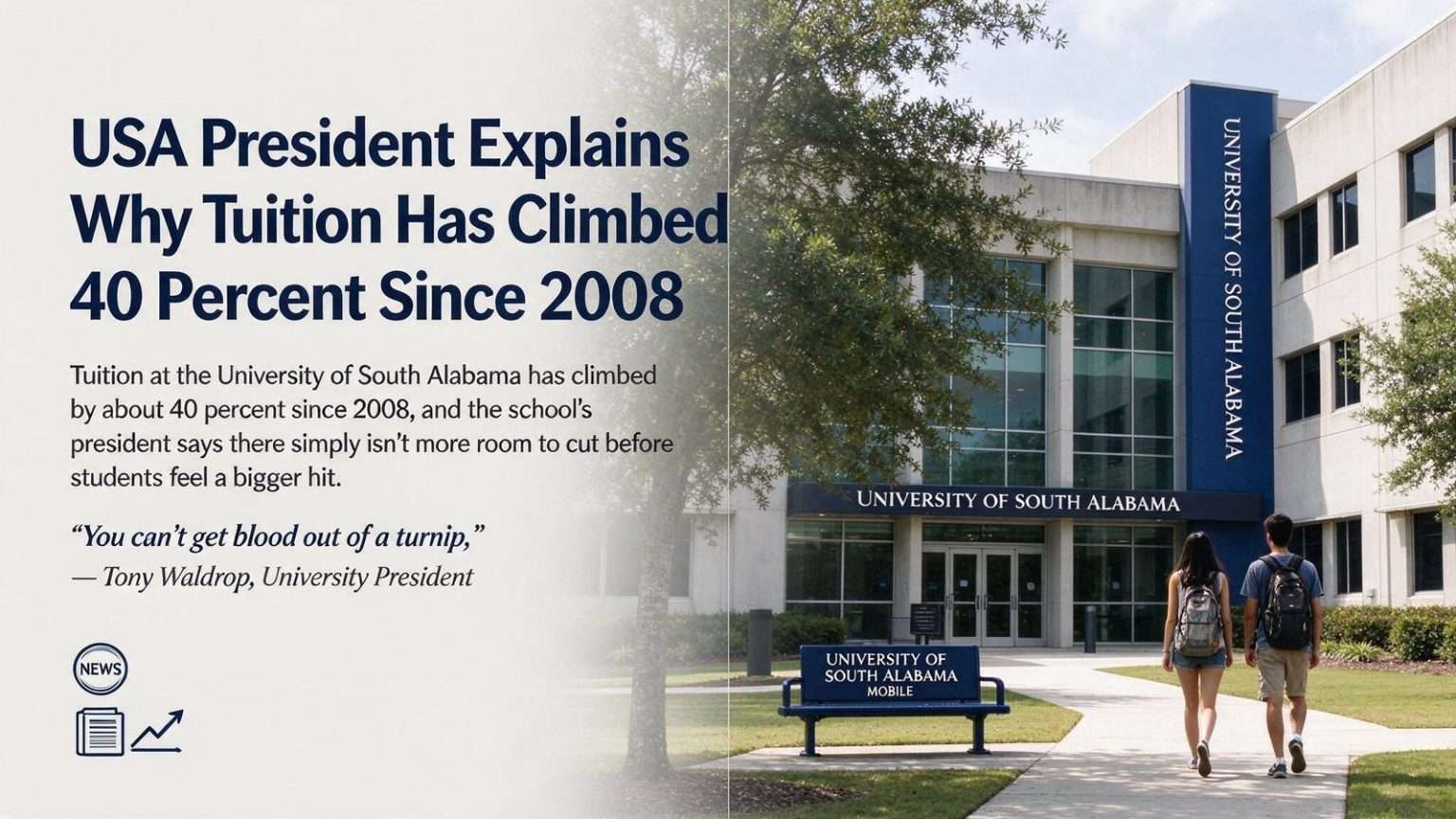
Tuition at the University of South Alabama has climbed by about 40 percent since 2008, and the school’s president says there simply isn’t more room to cut before students feel a bigger hit. “You can’t get blood out of a turnip,” university president Tony Waldrop said, describing the bind the Mobile school found itself in after state appropriations collapsed following the recession.
The arithmetic behind that bind is stark. Since 2008, the university has lost more than $262 million in pro-rated state funding cumulatively, and by the 2012-2013 school year state support had fallen to about $102.6 million, roughly $40 million less than before the recession hit. Against losses of that size, no amount of administrative trimming can fully close the gap, and the university’s board approved another 3.5 percent tuition increase for the 2014-2015 academic year — modest by the standards of the previous six years, but an increase nonetheless, and one officials attributed directly to the state’s retreat.
Alabama’s experience mirrors what has happened across the country. When the recession hollowed out state tax revenue, public universities became the release valve: legislatures cut higher education appropriations because, unlike K-12 schools or Medicaid, universities had a second revenue stream they could tap — their own students. The result has been a national, decade-long transfer of college costs from state budgets to family budgets, with institutions like USA raising tuition repeatedly just to hold their position.
Where the Money Actually Goes
Despite the increases, tuition and fees make up only about 14 percent of the university’s overall revenue — a figure that surprises many taxpayers who assume tuition covers the cost of a public university. The largest share, roughly $258 million, comes from patient services tied to the university’s medical operations, the hospitals and clinics that make USA as much a health system as a campus. That revenue composition gives USA a financial profile closer to an academic medical center than to a typical regional university, with all the sensitivity to health care economics that entails.
On the spending side, salaries account for about 64 percent of total expenses, with supplies and utilities making up another 26 percent and the remainder split between scholarships, interest and depreciation. Those proportions explain why cutting is so hard: an institution is, overwhelmingly, people. Faculty and staff salaries cannot be cut deeply without damaging the university’s core product, and utilities for a campus and hospital complex of USA’s size are what they are. The discretionary slice where cuts are painless is far smaller than the public imagines.
University officials pushed back on the idea that rising tuition is funding cosmetic upgrades. Major construction projects like the engineering and computer science building were paid for entirely through federal science grants, while the student recreation center was financed through activity fees and a state bond issue rather than general tuition dollars. New dining and residence facilities are treated as self-funding auxiliary enterprises, paid for by the room and meal plan fees tied directly to those services.
The distinction matters in the tuition debate. When students see new buildings appearing while their bills rise, the assumption that one pays for the other is natural but, according to university officials, wrong in this case — each major project carries its own funding stream, often restricted by grant terms or bond covenants, and general tuition dollars are not the source.
The President’s Own Compensation
Waldrop, whose base salary of $450,000 is lower than his predecessor’s, made his case while acknowledging that leadership compensation is part of the scrutiny that comes with tuition increases. His argument — that the university’s financial position is driven by forces far larger than any line item — was directed at an audience of students, parents and taxpayers who had watched tuition climb 40 percent in six years and wanted to know where the money was going. By taking a salary below his predecessor’s, he positioned himself as sharing the burden he was asking students to carry.
Presidential compensation has become a recurring flashpoint in public higher education nationally, and Alabama’s institutions have not been exempt. University leaders answer that competitive salaries are what attract and retain executives capable of running institutions with budgets in the hundreds of millions, hospital operations included; critics answer that leadership costs set the tone for an institution asking everyone else to sacrifice. Waldrop’s comments placed USA’s leadership on the side of restraint.
Campus Appearance as Strategy
Waldrop said landscaping and campus appearance remain a priority because they influence how prospective students choose a school, even as the university looks for other places to trim costs. The reasoning is grounded in recruitment economics: students and their families tour campuses before choosing, and the physical impression a campus makes in an hour’s walk shapes enrollment in ways that brochures cannot. For a university competing for a shrinking pool of Alabama high school graduates, deferred maintenance and shabby grounds are not just aesthetic problems — they are enrollment risks.
That does not make groundskeeping free, and the university has had to weigh every beautification dollar against the tuition pressure driving the debate. The position Waldrop described is a middle course: appearance spending continues because it protects revenue, but elsewhere the institution hunts for savings. Aging infrastructure has become a growing concern in that balance, as decades-old buildings across the campus and medical facilities require maintenance that cannot be deferred indefinitely — roof replacements, mechanical systems, and utility upgrades that are invisible to prospective students but essential to operations.
Deferred maintenance is the classic pressure point when public universities absorb funding cuts. Operations can be squeezed for a few years by postponing repairs, but the bill compounds: a roof repaired on schedule costs a fraction of one replaced after leaking, and mechanical failures in hospital buildings carry consequences beyond cost. Officials have described the growing weight of those needs as one of the quiet costs of the state’s funding retreat.
What the 40 Percent Means
The 40 percent figure deserves context both ways. In dollar terms, it means a student paying USA’s 2008 rates would now pay substantially more for the same degree, and that increase came during years when family incomes in Alabama were largely flat — which is why affordability has moved to the center of the state’s higher education conversation. In institutional terms, it means USA did what public universities everywhere did: it replaced state dollars with tuition dollars, dollar for dollar, because the alternative was fewer classes, fewer professors and fewer seats.
The 3.5 percent increase approved for 2014-2015 was framed as evidence that the steepest climb was over. University leaders have indicated they intend to hold increases as low as state funding allows, and every dollar of restored state appropriation reduces the pressure on tuition. But as Waldrop’s turnip remark made plain, the university’s position is that the room for further cuts has been exhausted — the remaining choices are tuition, quality, or both.
For Mobile and the region, the stakes extend beyond the campus. USA educates the nurses, teachers, engineers and physicians the Gulf Coast depends on, and its affordability determines who can access those careers. A university forced to price out the middle class fails its regional mission, however sound its balance sheet — and that is the outcome Waldrop said he is determined to avoid.
How USA’s Budget Actually Works
The university’s revenue structure is worth spelling out, because it explains nearly everything about the tuition debate. A university system like USA operates several distinct financial engines at once: the academic campus funded by tuition, state appropriations and grants; the medical enterprises, where patient services generate roughly $258 million; and auxiliary operations — housing, dining, parking — that are expected to pay for themselves. Each engine has its own revenue, its own costs and its own rules about what its money can buy, which is why “just use the hospital money for tuition” is not the simple answer it appears to be.
The medical side dominates the budget, and that dominance cuts both ways. Patient revenue gives USA a scale and stability that a purely academic institution lacks, but it also exposes the university to forces outside its control: federal Medicare and Medicaid reimbursement rates, insurance payment trends, and the state policy shifts that have complicated hospital finances in Alabama. A funding disruption on the medical side ripples through the entire institution, including the academic programs whose costs families experience as tuition.
On the academic side, tuition at roughly 14 percent of total revenue means state appropriations and medical revenue carry most of the load. When the state cut its appropriation by roughly $40 million a year, no realistic tuition increase could fully replace the loss — even doubling tuition would not have covered it, and the university instead made a mix of cuts and increases that distributed the pain. The $262 million in cumulative pro-rated losses since 2008 represents programs not expanded, positions not filled, and repairs postponed across that period.
The Board’s Decision
The board’s approval of the 3.5 percent increase followed the annual budget cycle that every Alabama public university navigates: the legislature sets its appropriation, the university builds a budget around whatever arrives, and the tuition decision comes last, sized to fill whatever gap remains. A 3.5 percent increase was smaller than the double-digit raises of the recession’s worst years, which university officials presented as evidence of progress even as they acknowledged that any increase lands on families still recovering from the same recession that emptied the state’s coffers.
Trustees weigh several considerations in that decision: the university’s competitive position against peer institutions in Alabama and the region, the enrollment consequences of pricing, the needs of the academic and medical enterprise, and the political reality of justifying increases to the public.USA’s leadership has argued that its increases, taken cumulatively, track the loss of state support rather than any expansion of institutional ambition — the university’s spending per student, adjusted for inflation, has not grown in step with what students pay.
That argument is the university’s core defense in the affordability debate: tuition rose because state support fell, not because the institution grew richer. The corollary, officials say, is that restoring state funding is the only durable way to slow tuition growth — a message Alabama’s public universities have carried to Montgomery together, with limited success, since the recession.
What Families Should Know
For students and parents evaluating USA, the practical takeaways from the budget discussion are concrete. The big new buildings visible on a campus tour were not funded by tuition — federal science grants, activity fees, state bonds and auxiliary revenue paid for them — so tuition increases are not buying amenities. The university’s costs are dominated by people and medical operations, meaning the value of a USA degree rests substantially on the faculty and clinical training those budgets sustain. And future tuition will depend heavily on Montgomery: every budget cycle in the legislature translates directly into the following year’s increase or restraint.
Waldrop’s tenure has coincided with the hardest fiscal stretch in the university’s modern history, and his “blood out of a turnip” formulation compressed the institution’s position into a sentence: USA has cut what can be cut, and the remaining gap is a public policy choice, not a university one. Whether Alabama’s next budgets accept that framing will determine whether the 40 percent climb since 2008 proves to be the steepest stretch of the slope or merely its beginning.