Mobile County Breaks Ground on Roundabout at Three Notch Road and Dawes Lane
Mobile County has begun building a one-lane roundabout at Three Notch Road and Dawes Lane, a federally funded project meant to cut crashes.
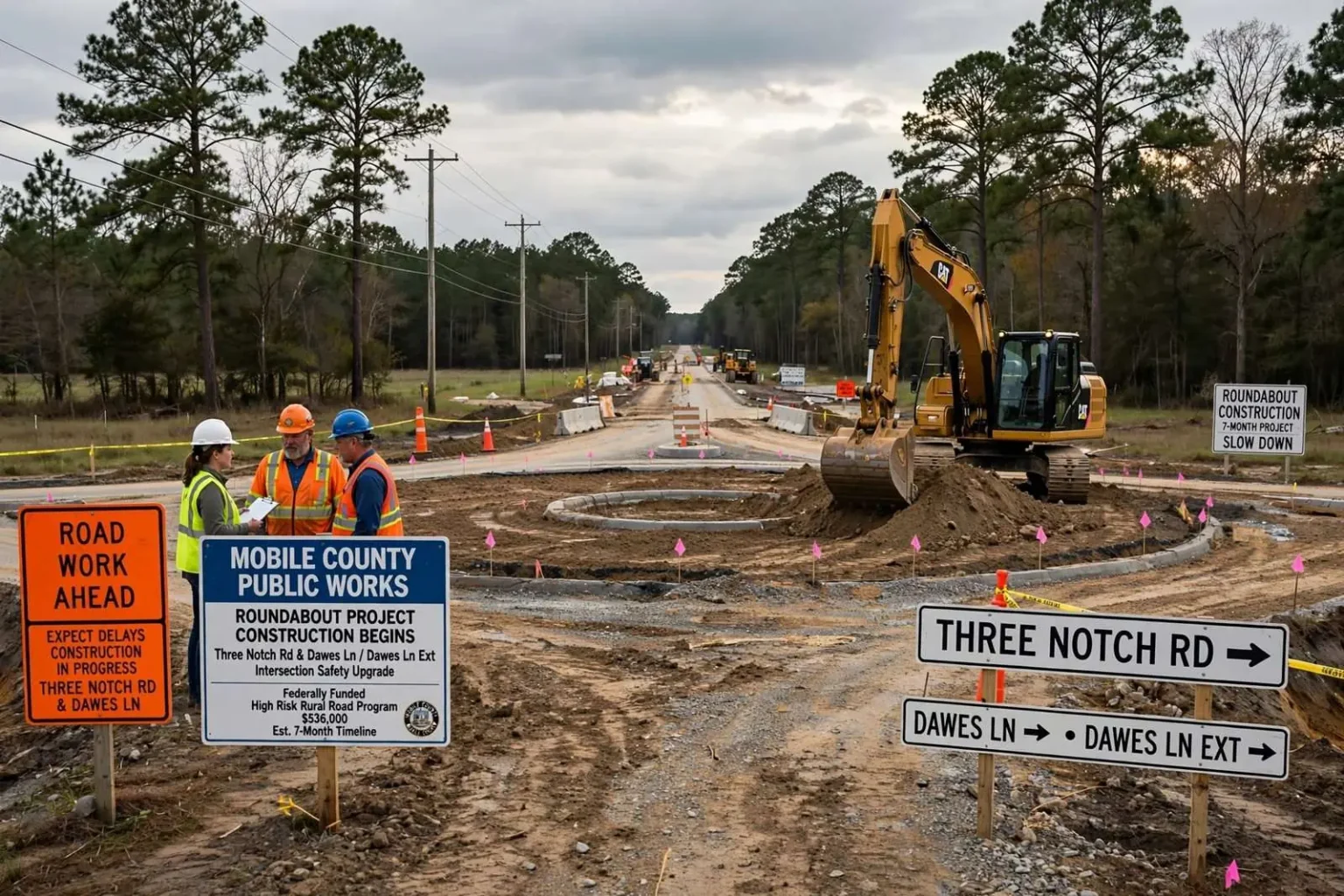
Construction crews have started work on a new roundabout at the intersection of Three Notch Road, Dawes Lane and Dawes Lane Extension in Mobile County, marking the county’s second such traffic feature. County spokeswoman Nancy Johnson confirmed the project is underway, with the one-lane roundabout expected to take as long as seven months to complete.
A federally backed safety project
The intersection overhaul carries a price tag of roughly $536,000 and is being funded in part through the Federal Highway Safety Administration under the High Risk Rural Road Program. Mobile County holds the distinction of being the first county in Alabama to receive federal dollars for a roundabout project through that program, underscoring how seriously officials have taken safety concerns at this particular crossing.
The High Risk Rural Road Program exists for exactly this kind of location: rural and semi-rural roadways where crash history and design combine to produce disproportionate danger. Federal dollars flow to sites where the data shows elevated risk, and a county must document its crash history and propose an engineering solution to win the funding. Mobile County’s successful application made it the first in the state to direct that money at a roundabout, a choice that reflects growing national evidence about the design’s safety record.
County officials pursued the funding specifically to address a pattern of right-angle collisions at the Three Notch and Dawes intersection, a type of crash that tends to be especially dangerous for drivers. Right-angle collisions — the broadside, T-bone crashes that happen when one vehicle strikes another from the side — expose occupants to impact forces that frontal crashes distribute differently, and they occur most often at intersections with signals or stop signs where drivers run red lights or pull out into traffic they misjudge.
Roundabouts are designed to virtually eliminate that risk because traffic moves in a single direction around the circle, removing the head-on and T-bone crash scenarios common at traditional signal-controlled intersections. Every vehicle enters to the right, yields, and merges — there is no crossing path at speed, and the geometry makes a broadside impact nearly impossible.
Why roundabouts cut down on crashes
Beyond eliminating right-angle and head-on collisions, the circular design also forces drivers to slow down as they approach and navigate the intersection, which further reduces the severity of any crash that does occur. Speed is the variable that turns crashes into fatalities, and a roundabout’s curved entry channels narrow and deflect traffic in a way that no stop sign can enforce. A driver who misjudges a gap in a roundabout may sideswipe a vehicle’s front quarter at low speed; the same misjudgment at a signalized intersection can be fatal.
It also does away with the stop-and-go delays typical of a signalized intersection, since vehicles can continue moving through the roundabout as gaps in traffic allow rather than waiting on a red light. During off-peak hours especially, the circle keeps traffic flowing continuously, and even at busy times the design often moves more vehicles per hour than a signal can — without the electricity, maintenance and re-timing that signals demand.
National crash data backs up the safety case for the design. According to the Federal Highway Administration, part of the U.S. Department of Transportation, roundabouts have been shown to reduce fatalities and incapacitating injuries at intersections by 67 to 80 percent, along with reducing overall crashes substantially. The agency’s guidance has made roundabouts a preferred engineering treatment for high-risk intersections, and Alabama counties — with Mobile County now first in line through this program — are beginning to apply that guidance locally.
Driving a one-lane roundabout
For drivers who have not navigated one before, a one-lane roundabout is simpler than it looks. Approaching vehicles slow, yield to traffic already circulating from the left, and enter when a gap appears. Once inside, a driver travels counterclockwise and exits at the desired road. Pedestrians cross at marked crossings set back from the circle, one lane at a time, and cyclists are encouraged to take the lane like a vehicle or use the crossings.
The rules that matter most are yielding before entering and never stopping inside the circle. Most confusion at new roundabouts comes from drivers who stop mid-circle to let others in, a courtesy that breaks the design’s logic. County engineers typically add advance warning signs and directional arrows during a new roundabout’s first months, and experience elsewhere shows that local drivers adapt quickly — usually within a few weeks of opening.
The seven-month construction window means drivers will live with work-zone traffic control at the intersection well into the year. Projects that rebuild an intersection’s center, curb lines and approaches require staged closures, flaggers and temporary lane shifts, and residents who cross Three Notch and Dawes daily should expect delays during construction that disappear once the circle opens.
The Three Notch corridor
Three Notch Road is one of south Mobile County’s historic arteries, tracing a route that carries its name from the three-notch marker trees that once guided travelers through the piney woods toward the settlements of the region. Today it functions as a primary north-south corridor through Theodore and the surrounding communities, carrying commuter traffic, school buses and commercial vehicles between the population centers of the southern county and the city.
Dawes Lane and its extension serve the fast-growing residential areas west of Three Notch, where subdivisions have multiplied over recent decades. The three-way meeting of these roads concentrates turning traffic from a large residential catchment onto a busy corridor, which is precisely the pattern that produces the right-angle crashes the county documented in its funding application.
As Mobile County’s second roundabout, the project also signals a shift in local engineering practice. The first roundabout gave county engineers and drivers a local example to learn from, and its performance will shape whether the design becomes a standard tool in the county’s safety program. Nationally, jurisdictions that build their first roundabout typically follow with more, because the crash data and driver adaptation both argue for the approach.
What the federal program means for Alabama counties
The High Risk Rural Road Program channels federal safety money to states for use on rural roads where crash data shows elevated danger, and counties compete for the funds through their state transportation departments. The program’s logic is preventive: rather than waiting for a crash history to grow into a crisis, agencies identify intersections and road segments where the combination of speed, design and traffic patterns predicts serious crashes, then engineer the risk out.
Mobile County’s position as the first Alabama county to win roundabout funding through the program is a marker of both need and initiative. The county’s engineering staff documented the right-angle crash pattern at Three Notch and Dawes, matched it to the federal program’s criteria, and proposed a treatment the national data supports. Winning the award means federal dollars cover part of the $536,000 cost, stretching local road funds further.
It also sets a precedent other counties can follow. State and local engineers watch early adopters closely, and a successfully completed roundabout with measurably fewer severe crashes gives every other Alabama county a case study for its own high-risk intersections. Rural intersections across the state share the same crash profile — high speed, cross traffic, occasional signals — and the roundabout model applies to them broadly.
Seven months of construction
The seven-month timeline reflects the full scope of building a roundabout from a conventional intersection. Crews must reshape the approaches, build the central island and truck apron, install new curbs, gutters, signage and lighting, and finish the paving and striping that tie the new geometry into the existing roads. Utility adjustments often accompany the work, since a new intersection footprint moves drainage and sometimes underground lines.
Weather along the Gulf Coast adds uncertainty to any construction calendar, with afternoon storms capable of halting earthwork for days. The county’s estimate accounts for normal seasonal delays, but drivers should treat seven months as an outer bound and watch for updates as the work progresses.
Once complete, the roundabout will operate around the clock without the power dependency of a signal — no outages, no dark intersections after storms, no re-timing studies. Maintenance costs drop accordingly, a quiet but real benefit the county will bank for the life of the intersection.
The road ahead
For the drivers who cross Three Notch and Dawes daily, the next seven months demand patience, and the years after that promise a safer crossing. The crash pattern that motivated the project — broadside impacts at speed — will be designed out of the intersection entirely, replaced by low-speed merging that national data shows cuts fatal and incapacitating injuries by two-thirds or more.
The project is also a small case study in how local government works: a documented problem, a federal program matched to it, the state’s first county application of its kind, and a construction season spent turning an intersection’s geometry into a proven safety design. When the circle opens and the work-zone signs come down, Mobile County will have its second roundabout — and, if the national experience holds, measurably fewer serious crashes at one of its busiest southern intersections.