Mobile County’s Second Roundabout Takes Shape as a Holiday-Weekend Detour Looms
Crews were set to close the intersection of Three Notch Road at Dawes Lane for about two months to finish Mobile County's second roundabout, part of a busy slate of area road work.
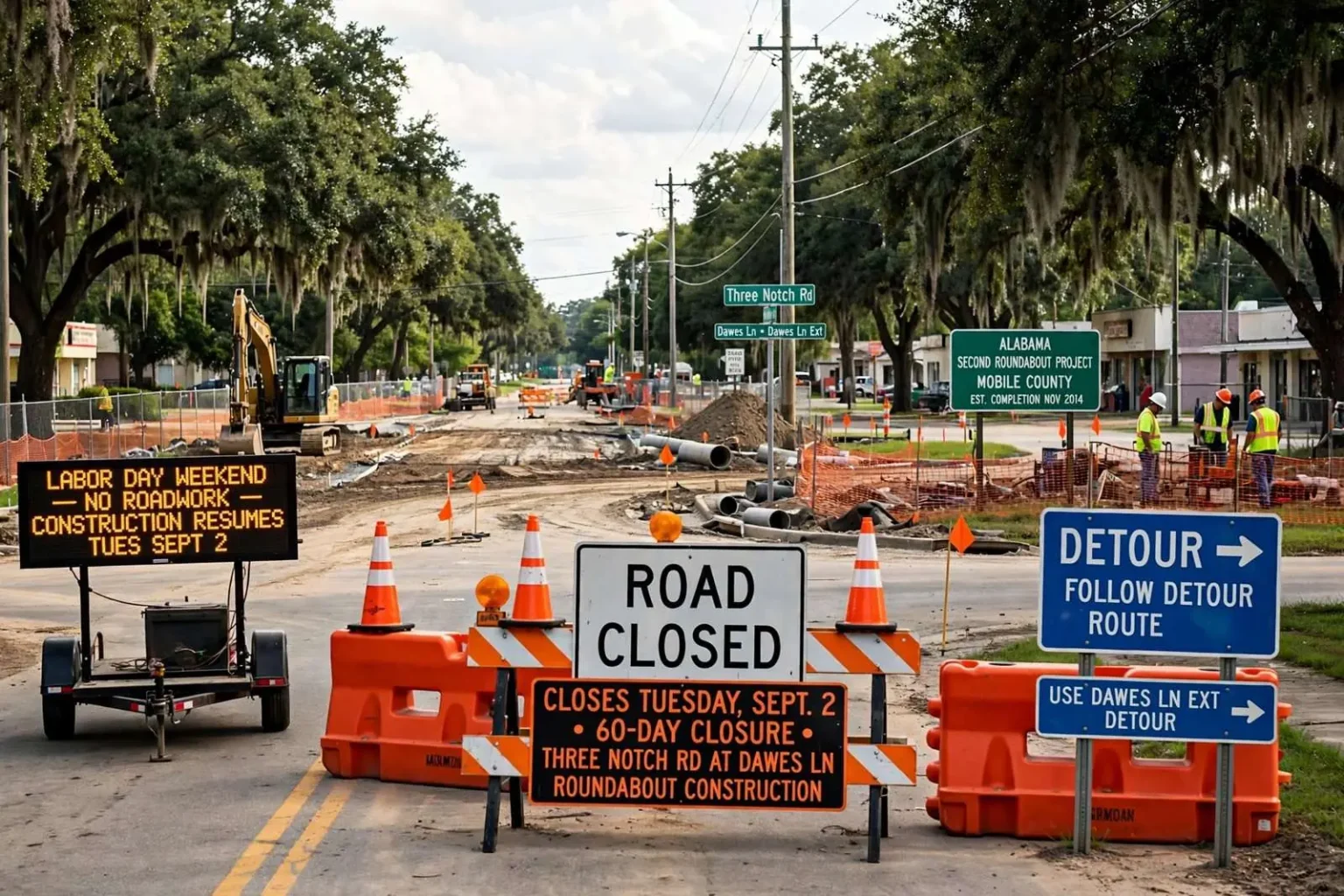
As the Labor Day weekend approached and much of the region prepared to travel or relax, transportation crews across Mobile County were about to reshape a busy intersection. Starting the Tuesday after the holiday, the junction of Three Notch Road at Dawes Lane and Dawes Lane Extension was set to close for roughly two months so workers could finish the county’s second roundabout.
The closure was scheduled to begin Tuesday, Sept. 2, 2014, with detour signs posted to route drivers around the work zone. The project marked the second roundabout to be built in Mobile County, part of an ongoing effort to rethink how traffic moves through certain intersections. For drivers who use Three Notch Road — one of the busiest commercial corridors in the county’s southern end — the two-month closure meant finding a new path to work, school and shopping while the junction itself disappeared into construction.
The timing was deliberate. The Alabama Department of Transportation planned to pull all crews from all projects by noon on the Friday before the holiday weekend, returning to work the following Tuesday. That meant travelers hitting the road for Labor Day would not have to contend with active work zones, even as the roundabout closure waited just on the other side of the weekend. The pause is standard practice for holiday periods, when traffic volumes on the region’s interstates and beach routes can double and lane closures would multiply the risk of crashes.
A downtown street set to reopen Elsewhere, drivers were about to get some relief. Royal Street between Dauphin and Conti streets in downtown Mobile was expected to reopen before the weekend after an emergency sewer repair had closed the section the previous week. The repair had detoured traffic around one of downtown’s busiest blocks, and the reopening restored a connection that businesses and residents along Royal Street depend on.
A two-month closure for the roundabout
Roundabouts occupy a growing place in American traffic engineering, and the arguments for them are the ones Mobile County engineers weighed in choosing the design. A modern roundabout keeps traffic moving at low speed in one direction, which sharply reduces the most dangerous kind of intersection crash — the high-speed T-bone collision — and eliminates the left-turn conflicts that signalized intersections create. The trade-off is unfamiliarity: drivers in regions without many roundabouts take time to learn to yield, and a first encounter can be confusing.
Finishing the second county roundabout required closing the junction entirely rather than maintaining traffic through the work. Building the circular roadway, the center island and the truck aprons that let large vehicles track through means reshaping every corner of the intersection at once, and utility relocations and drainage work beneath the new circle cannot be done with cars crossing the site. Two months is a typical construction window for a project of that scale, and the closure was set for the post-summer period when school-year traffic patterns would be established and detours predictable.
The Alabama Department of Transportation’s holiday pause covered the full slate of active work across the region. Crews on every project — resurfacing, bridge work, ramp repairs — would stand down at midday Friday and return the Tuesday after Labor Day, leaving the weekend’s travel as unimpeded as the road network allows.
A busy slate of road work
The roundabout was only one item on a long list of ALDOT projects underway across the Mobile and Baldwin County area. Among the work in progress: SR-163 resurfacing and safety widening began that Monday, with daytime work scheduled for 35 working days and the possibility of finishing early if the weather held. The project addressed a route that carries heavy daily traffic through Mobile and had been scheduled around daytime working hours to keep the work visible and efficient.
Interstate 10 remained the region’s most watched work zone. The ramp to Battleship Parkway, damaged in a fiery accident on July 31, remained closed, forcing causeway traffic to find alternate approaches while repairs proceeded. The Parkway — the causeway crossing of Mobile Bay that predates the interstate — depends on the ramp connections to I-10, and the damage from the accident had severed one of them.
I-10 from Halls Mill Creek to the George C. Wallace Tunnel was another long-term project: road and bridge work was just getting started, with nighttime lane closures and completion expected the following summer. The stretch approaching the tunnel is one of the most congested corridors in the state, and nighttime work was chosen precisely because daytime lane closures there can back up traffic for miles through downtown Mobile.
Interstate 65 in Saraland was about 95 percent complete, with only minor evening impacts — the closest thing to good news on the list. U.S. 90 from Halls Mill to Pine Hill Drive was beginning a resurfacing project, with nighttime lane closures and completion expected by December. The project takes on one of the older federal highways in the area, whose pavement had been worn by decades of through traffic and local growth alike.
Work reached into Baldwin County as well. On Alabama 181, resurfacing from U.S. 31 to south of U.S. 90 was creating nighttime lane closures, with the work expected to be complete by October. The route runs through one of the fastest-growing corridors in the county — the Spanish Fort, Fairhope and Daphne sphere — and its pavement had been strained by years of residential and commercial growth.
Near the coast, the Little Lagoon Pass bridge remained under construction and was about 50 percent complete, served in the meantime by a detour bridge expected to stay in place until the end of 2014. The pass is the narrow channel connecting Little Lagoon to the Gulf in Gulf Shores, and the bridge over it is a critical link in the road network serving the western end of the island. Building a replacement in an environment shaped by tides and shifting sand is slow work, which is why the temporary detour bridge was expected to carry traffic into the following year.
Work on the Interstate 10 connector to the Baldwin Beach Express was about 90 percent finished, with occasional lane closures on County Road 83. The connector ties the Beach Express — the toll road that carries Baldwin County’s beach-bound traffic east of the bay — directly into the interstate, part of the long-term effort to route summer traffic around the Wallace Tunnel and the downtown bottleneck on the Mobile side.
Reading the road list
Taken together, the roundup captured a region in the midst of steady road building and repair. Mobile and Baldwin counties were working through a generation of projects — a new roundabout in the city’s southern neighborhoods, resurfacing on corridors old and new, a bay crossing’s approaches under repair, and a second interstate connection under construction — all funded through the state’s routine capital program rather than a single special initiative.
For drivers, the immediate takeaway was straightforward: enjoy an unimpeded holiday weekend, then plan around the new roundabout work and the scattered lane closures that would resume once the crews returned. The projects that matter most day to day are rarely the dramatic ones. A resurfaced stretch of U.S. 90 or a reopened ramp to the Parkway changes more commutes than any ribbon-cutting, and ALDOT’s schedule of nighttime work and short daytime projects reflected an effort to fit the fixes around the traffic they serve.
The second roundabout at Three Notch Road and Dawes Lane stood as the most visible of those changes, a project that would keep a key intersection closed well into the fall before reopening in a new configuration. When it does, drivers in the area will join the growing share of Alabama motorists who navigate roundabouts as a routine part of the road network — and the county will have its second example of an intersection design built to keep traffic moving where a signal once made it wait.
Labor Day weekend itself is one of the heaviest travel periods of the year on the Gulf Coast, as the final beach weekends of summer send traffic across Mobile Bay and down the coast highways. ALDOT’s decision to clear the work zones entirely for the holiday reflected that pattern: lane closures that barely register on a Tuesday can create miles-long backups when vacation traffic stacks up behind them. The pause also gave the crews a clean break between phases of their respective projects.
Downtown, the Royal Street sewer repair was a reminder of how the city’s aging underground infrastructure announces itself. Emergency repairs of this kind — digging into a street to reach a failing line — close blocks with little notice, and the disruption falls on businesses that depend on street parking and walk-in traffic. The quick completion of the repair and the scheduled reopening before the holiday were welcome news for the shops and restaurants along the block.