Mobile County’s Second Roundabout Nears Completion as Road Work Continues Across the Region
Mobile County's second roundabout nears completion as crews finish curb work, while road projects continue across Mobile and Baldwin counties.
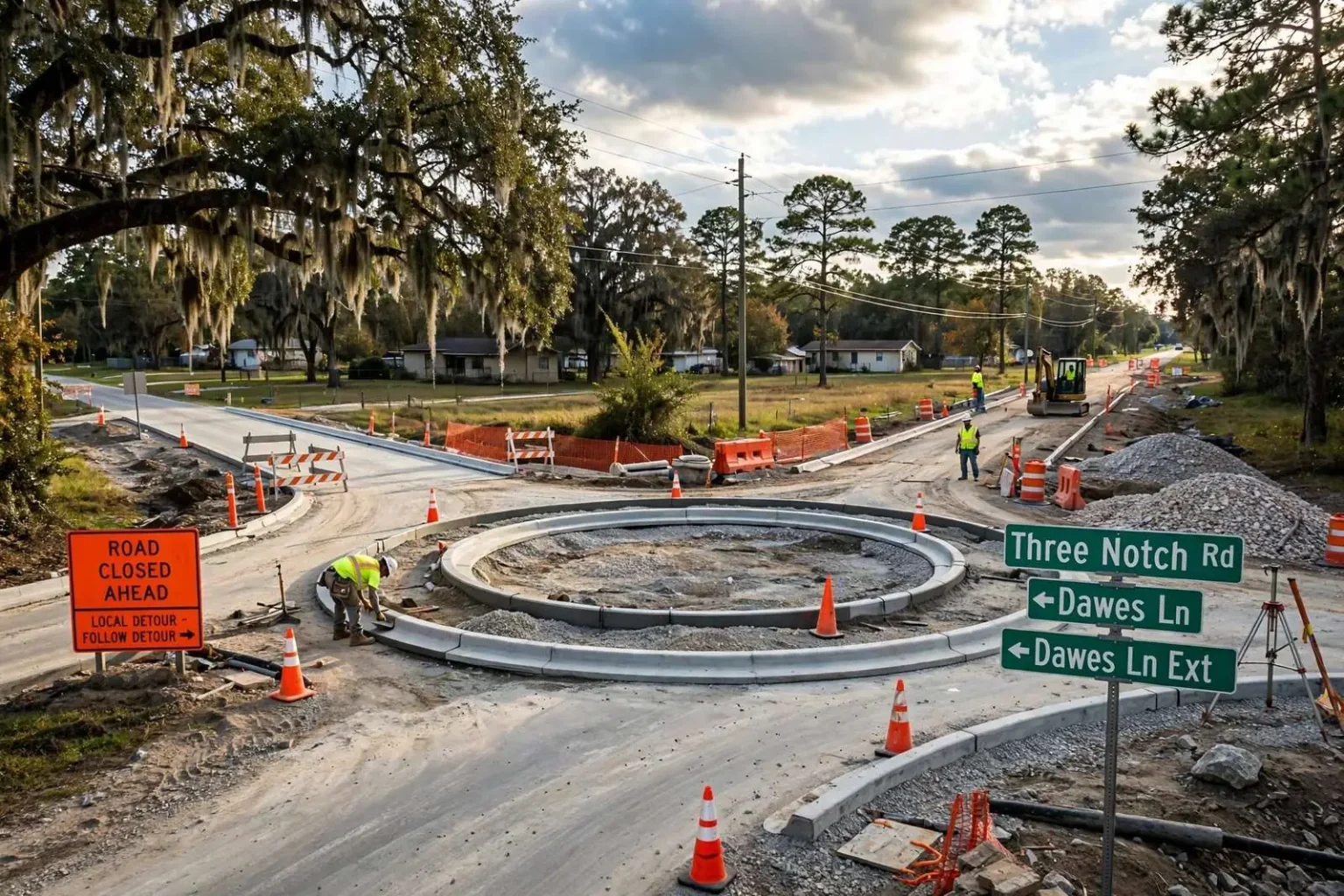
Mobile County’s second roundabout project is entering its final stages, according to officials with the county’s public information office. Crews are preparing to begin laying curb and gutter work within days, marking one of the last major steps before the intersection reopens to traffic.
The roundabout is being built at the intersection of Three Notch Road, Dawes Lane, and the Dawes Lane Extension. To allow construction crews to finish the work safely, that intersection was closed to through traffic for roughly two months beginning in early September. Drivers in the area were asked to use posted detours until the roundabout was ready for use.
How the County’s Roundabouts Are Growing
The Three Notch Road project is Mobile County’s second roundabout, a sign of how the traffic circle — long a fixture of older cities in the Northeast and Europe — has become an accepted tool for busy rural and suburban intersections along the Gulf Coast. Roundabouts keep traffic moving at low speeds, eliminate the dangerous left-turn conflicts of traditional signalized intersections and typically cost less to maintain over their lifespans than signals, since there are no lights to power or replace.
The first roundabout proved the concept locally, and county engineers have cited the safety record of single-lane circles as they look for candidates elsewhere in the unincorporated county. The Three Notch and Dawes Lane junction, where multiple approaches converge amid residential growth west of Mobile, fit the profile: a location with recurring crash patterns and enough right-of-way to build the circle without wholesale takings.
Curb and gutter work, while it may sound minor, is the stage that turns a graded circle into a drivable one — defining lane edges, directing drainage and setting the mountable aprons that let long vehicles track the turn. Once that work is complete and the approaches are striped, the intersection can reopen, ending the detour that has routed area drivers around the closure since early September.
Grand Bay Wilmer Road Paving Nears the End
County officials also confirmed progress on paving efforts along Grand Bay Wilmer Road South. The final unpaved stretch of that route, near its junction with Newman Road, was being finished as part of the broader push to complete outstanding county road projects before the fall.
Paving the last unpaved segment of a road changes daily life for the residents along it. Gravel roads generate dust, washboard surfaces and muddy stretches after Gulf Coast rainstorms, and the county’s paving program has methodically worked through its list of remaining unpaved segments as funds allow. For drivers who use Grand Bay Wilmer Road South to connect between communities in the county’s southwestern corner, the junction area near Newman Road was the last hurdle to an all-paved route.
The roundabout and paving work are part of a larger list of ongoing road projects affecting drivers across both Mobile and Baldwin counties — a fall construction season busy enough that regional commuters have learned to budget extra minutes for familiar routes.
Mobile Projects: Satchel Paige, the Loop and More
In Mobile, crews have closed Satchel Paige Drive between Government Street and Bolling Brothers Boulevard to widen it into a four-lane divided roadway, a project tied to construction at the nearby McGowin Park shopping development. That closure was expected to last about three months, reshaping a corridor that serves growing retail and commercial traffic in the city’s western suburbs.
Drivers near Airport Boulevard and the Loop have also been dealing with a detour onto Government Street while railroad track work continues in that area, adding congestion to one of the city’s busiest east-west arteries.
State Projects: SR-163, I-10 and the Wallace Tunnel
On the state highway side, the Alabama Department of Transportation reported that resurfacing on SR-163 in Mobile County was essentially finished, with only minor cleanup work remaining. The route, a key connection through western Mobile County, gets steady wear from commuter and port-related traffic, and fresh pavement extends its life while smoothing one of the rougher rides in the county’s state system.
Along Interstate 10, repair work began on the ramp leading to the Battleship Parkway that was damaged in a fiery wreck this past summer, with that repair expected to take about two months. The parkway ramp carries traffic to and across Mobile Bay on the route that runs alongside — and past — the USS Alabama Battleship Memorial Park, and its closure for repairs added pressure to bay-crossing routes already strained by daily volumes.
A separate, longer-term project resurfacing I-10 and upgrading the George C. Wallace Tunnel bridge approaches between Halls Mill Creek and the tunnel’s west end was continuing, with nighttime lane closures scheduled several nights a week through the following summer. The tunnel approaches are among the most heavily traveled — and most constrained — pavement in South Alabama, where the interstate narrows toward the underwater crossing beneath the Mobile River, and work there is necessarily confined to overnight hours when volumes dip.
Along U.S. 90 between Halls Mill and Pine Hill Drive, drainage improvements and resurfacing were underway, with nighttime lane closures expected periodically and completion targeted for December. Drainage work rarely draws attention until it fails, but on a coastal corridor like U.S. 90, standing water is both a safety hazard and a cause of premature pavement failure, making the underground improvements as consequential as the new surface above them.
Baldwin County: Beach Express, Alabama 181 and a Bridge Halfway Done
In Baldwin County, work connecting Baldwin Beach Express to County Road 68 was reported to be more than 90 percent finished, with only isolated lane closures expected on County Road 83 as crews wrap up remaining tasks. The Beach Express has reshaped north-south travel in Baldwin County since it opened, and each new interchange link adds convenience for residents of the county’s fast-growing interior communities heading toward the beaches.
Resurfacing on Alabama 181 between U.S. 31 and just south of U.S. 90 was also nearly complete, with an October finish date anticipated. The route parallels the county’s explosive growth corridor, and its new surface will serve commuter traffic between Bay Minette, Fairhope and the communities in between.
Perhaps the most closely watched Baldwin County project remains the replacement of the Little Lagoon Pass bridge, which officials said was roughly halfway finished. A temporary detour bridge installed alongside the original span was expected to remain in place through the end of the year, with only minor delays anticipated for drivers using the route in the meantime.
The Little Lagoon Pass bridge connects Gulf Shores’ western end, carrying residents and visitors to the Fort Morgan peninsula. Its replacement has been a priority for years, given the original span’s age and its vulnerability in a coastal environment where salt air, tides and hurricanes take a steady toll on structures. Building the replacement while traffic continues to cross — using the temporary detour bridge — has allowed the town to keep functioning during construction, a careful choreography that has kept delays to a minimum.
Local officials continue to encourage drivers throughout both counties to watch for updated signage and to allow extra travel time in active work zones as these projects move toward completion.
A Busy Season on Both Sides of the Bay
Few stretches of Alabama see as much overlapping construction as the Mobile Bay area in a given year, and this fall’s slate illustrates why. The region sits at the junction of interstate commerce — I-10 is the principal east-west freight corridor along the Gulf Coast — and two counties whose populations are growing faster than their road networks were designed for. Every project on the list, from a county roundabout to interstate tunnel approaches, is a response to that growth and to decades of deferred wear.
The coordination burden falls on agencies that rarely make headlines: the county’s engineering and public information staff, city traffic engineers, and ALDOT division offices that sequence lane closures to avoid stacking detours on the same corridors. Even so, drivers this season have faced simultaneous disruptions on Government Street, Airport Boulevard, Satchel Paige Drive and the interstate, a confluence that comes with the territory when the funding arrives to address long-standing needs at once.
Why the Roundabout Made Sense for Three Notch
The decision to build rather than signalize the Three Notch Road intersection reflects both engineering judgment and cost logic. A signal requires power, controller equipment, ongoing maintenance and periodic retiming as traffic patterns shift; a roundabout’s operating costs are largely limited to landscaping and occasional striping. Studies of converted intersections nationwide have found substantial reductions in fatal and injury crashes after stoplights or four-way stops became roundabouts, because the circle removes the head-on and broadside collisions that dominate signal-crash statistics.
The tradeoff is unfamiliarity. Drivers encountering their first roundabout — especially in a rural county — must learn to yield at entry, keep speeds down and signal their exits. The county’s first circle served as a proving ground, and by the time construction wraps at Three Notch and Dawes Lane, the learning curve for area drivers should be far shorter than it was for the first one.
For residents near the intersection, the two-month closure was the price of building the circle safely and quickly, and the reopening will bring a permanent change: continuous flow where a two-way stop or signal once governed the junction of three roads.
What Drivers Should Expect Next
The projects now underway follow a sequence that will stretch through the winter and into next summer. The Three Notch roundabout should open first, followed by the completion of the Satchel Paige widening and the U.S. 90 drainage work in December. The I-10 ramp repair and the Baldwin County links — the Beach Express connection and Alabama 181 resurfacing — were on track to finish around the same period, while the tunnel approaches work and the Little Lagoon Pass bridge replacement continue deeper into next year.
Motorists can keep up with changing conditions through posted signage at each project and updates from the county and ALDOT as schedules firm up. The standard advice applies doubly in a season this crowded: build in extra time, obey work-zone speed limits and treat the flaggers and barriers that keep crews safe as part of the drive.
When the dust settles, the region will have a second roundabout, a four-lane Satchel Paige Drive, freshly paved state routes on both sides of the bay, a restored Battleship Parkway ramp and a new Little Lagoon Pass bridge halfway to done — a substantial down payment on the infrastructure a growing coastal Alabama requires.