Mobile’s The Mustachios release new Ride EP
Mobile indie rock band The Mustachios have released their first professionally recorded EP, Ride, ahead of a fall slate of local shows.
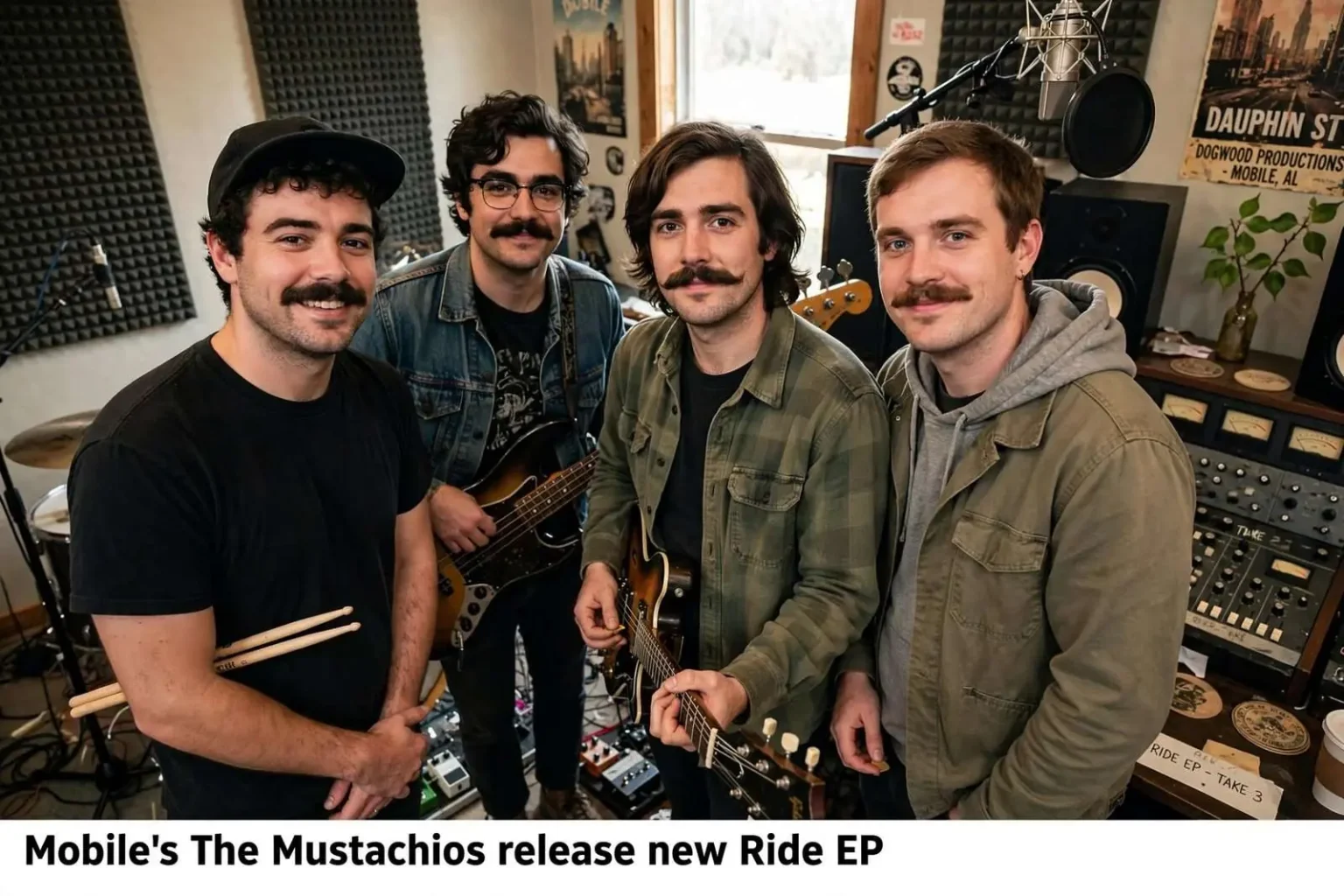
Mobile indie rock outfit The Mustachios have released Ride, their first professionally produced EP, recorded locally at Dogwood Productions with engineer Ray Norman. The release marks a step up for the band, which had previously worked from demo recordings, and it arrives with the polish and sequencing that a proper studio session makes possible. For a group that built its name on Dauphin Street stages, Ride is both a document of where the band stands and a sign of where it intends to go.
Dogwood Productions has served as a recording home for Mobile-area musicians, and pairing with an experienced engineer like Norman gives a young band something rehearsals cannot — a second set of trained ears and a room built for capturing performances cleanly. The decision to record close to home rather than travel to a larger market reflects a practical streak that runs through the Gulf Coast music scene, where local studios have long supported regional acts at prices touring-market facilities rarely match.
The four-song collection builds on the band’s earlier release, Mavis, and reworks demo versions of “300 Million,” “Tailspin” and “WTPOY” while introducing new tracks “Arsenic,” “Back Patio” and “Splitting Hairs.” The track list tells the story of a band in transition: three songs that existed in rough form get full production, and three newcomers join them, making Ride less a debut than a coming-of-age record for a band that has been at work for years.
A New Chapter for a Growing Mobile Band
“We tried to work from what we know, and ideas that we want to talk about,” drummer Justin Skinny said. “There’s definitely a structure to the track sequence that hopefully will keep listeners engaged.” Skinny’s comments point to the care the band put into Ride as a whole — not just a batch of songs but an ordered listen, front to back, with pacing that carries a listener through the four tracks.
Listeners can expect punchy bass lines and crunchy guitars balanced against an understated vocal delivery with falsetto overdubs. The sonic profile places the band in the indie-rock tradition that prizes rhythm-section drive beneath melodic restraint, and the falsetto touches give the songs an airiness that contrasts with the guitar work underneath. It is a combination that plays well live — and the band has had plenty of practice at that part.
The band, which gained wider exposure with a performance at SouthSounds 2014, has become a familiar name on Dauphin Street’s live music scene. SouthSounds, the annual festival that showcases emerging artists across downtown Mobile venues, has functioned as a launching pad for regional acts since its start, putting unsigned bands in front of audiences and industry scouts during a weekend that turns the city into a living audition. A slot there is a marker of momentum, and The Mustachios used theirs to broaden a following built one bar show at a time.
Dauphin Street remains the center of gravity for original music in downtown Mobile. On any weekend, its venues host touring indie and punk acts alongside local bands working through original sets, and the street’s foot traffic turns a show into a scene — crowds drift between rooms, and a band’s reputation builds through word of mouth among the regulars. The Mustachios have put in that circuit work, and Ride arrives with an audience already primed for it.
From Demos to a Real Record
The journey from Mavis to Ride traces a common path for area bands. Early releases made from demo recordings serve a purpose — they book shows, they build a catalog, they give a band something to sell — but they rarely capture what a group actually sounds like. Studio time changes that: arrangements tighten, performances get second takes, and the mix can separate the bass line from the fuzz rather than burying one under the other. The reworked versions of “300 Million,” “Tailspin” and “WTPOY” on Ride represent that second pass, with the songs rebuilt around what the band learned playing them live.
Engineering choices matter in that process. Norman’s work at Dogwood aimed to keep the band’s live punch intact while adding the clarity a record needs, and the sequencing decisions Skinny described suggest the band treated the EP as a statement rather than a sampler. Four songs is a short canvas, but it leaves no room for filler — every track has to earn its place in the running order.
Available Now, More to Come
Ride is available as a digital download for $5. The group describes it as the first in a continuing series of EPs, with part two expected early next year. The EP-series approach is increasingly common among independent bands, trading the long gaps and big budgets of full-length albums for a steady drip of new material that keeps a band in conversation with its audience. For The Mustachios, it also spreads production costs across releases, letting the band fund part two with what the first one earns and proves.
The $5 download price puts the record within impulse-buy range and follows the pricing conventions of the independent download market, where fans pay directly for the music without a label middleman. Digital-only distribution also means no pressing or manufacturing delay — the band can sell the record the same week it comes out, at shows and online alike.
The Mustachios plan to play more shows around Mobile this fall in support of the release. The local album-support circuit is where an EP earns its keep: each show moves downloads, builds the live set around the new material and tests the reworked songs against the crowd’s response. Fall is a strong season for it, too — downtown Mobile’s calendar fills as the weather cools, and audiences return to patios and stages after the summer’s heat.
What Ride Says About Mobile’s Scene
A local band releasing a professionally produced record at a Mobile studio, priced at five dollars and supported by hometown shows, is a small story with a bigger echo. Mobile’s music economy runs on exactly this kind of self-sufficiency — studios like Dogwood providing regional access to quality recording, festivals like SouthSounds providing visibility, and Dauphin Street venues providing the stages where bands grow. When one of those bands produces work that holds up on headphones as well as it does in a bar room, the whole pipeline gets a proof point.
The songs on Ride also sketch where the band’s writing is headed. “Arsenic,” “Back Patio” and “Splitting Hairs” sit alongside the reworked tracks as new material written after the band had already been playing together for years, and Skinny’s description of “ideas that we want to talk about” suggests a band conscious of its own voice rather than chasing trends. The falsetto overdubs and understated vocals indicate a group comfortable trading volume for texture — a choice that records reward more than live rooms do.
For listeners discovering the band through the record, the live shows this fall will supply the other half of the picture. Indie rock on a Dauphin Street stage comes with the room’s energy — crowds close to the band, requests shouted mid-set, and the casual collisions that happen when a scene’s regulars all end up at the same show. The band’s setlists this fall will no doubt lean on Ride, but the audience response will shape how part two sounds when it arrives early next year.
Ride is available now as a $5 digital download, with The Mustachios playing around Mobile throughout the fall in support of it. Part two of the series is expected early next year — and if the first installment is any indication, the band’s recording era has only just begun.
The EP also documents the band’s rhythm section, and Skinny’s drumming gets a featured role in the mix. Indie rock of the punchy, guitar-forward variety lives or dies on the drummer’s ability to keep energy high without crowding the songs, and the studio setting let the band tune that balance in a way demos never could. Listened to back to back, the reworked versions on Ride and the older Mavis-era demos chart how much difference a real session makes.
The band’s rise through Mobile’s scene also reflects the ecosystem that supports original music in the city. SouthSounds gave The Mustachios their widest exposure to date, but the festival only works because year-round venues keep the bands working between editions — weeknight shows, opening slots and multi-band bills where a group like this one can play to new listeners. A record like Ride is the natural product of that cycle: years of gigs, a growing songbook, and eventually the confidence to book studio time and do the material properly.
Fans picking up the EP this fall can follow the band’s progress toward part two as it happens, since the group’s local show schedule offers a running preview of new material and a chance to hear the Ride tracks in the rooms where they were built. For a Mobile band on the way up, that loop — record, play, repeat — is exactly where it wants to be.