McGowin Park Work Closes Satchel Paige Drive in West Mobile
Satchel Paige Drive near McGowin Park has closed for road widening as Mobile County's second West Mobile roundabout project also continues nearby.
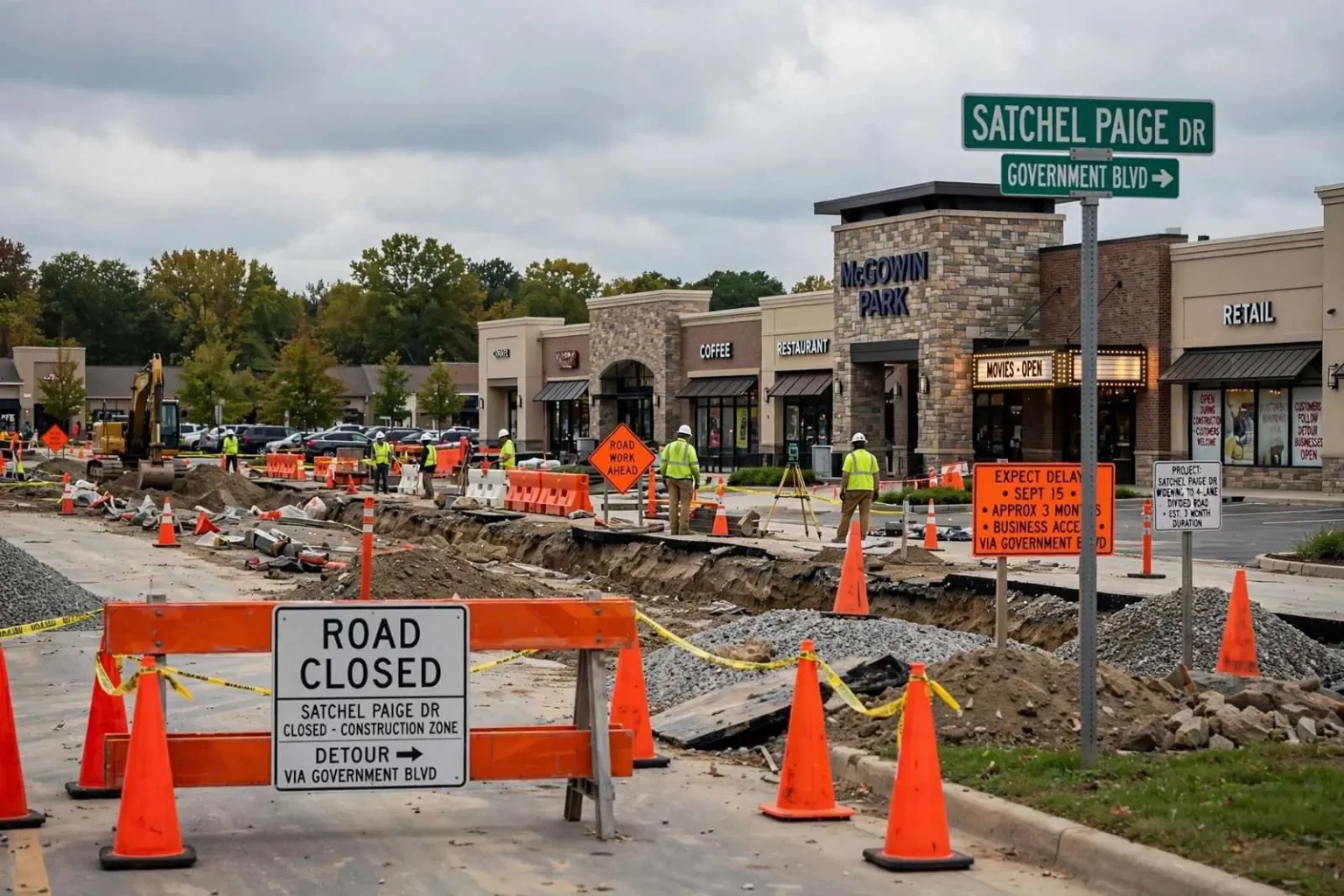
Drivers in West Mobile faced a fresh round of road construction this month as crews closed Satchel Paige Drive to widen the roadway near the McGowin Park retail development, while a separate roundabout project continued to take shape nearby. The two projects, along with several others scattered across Mobile and Baldwin counties, have made this one of the busiest construction seasons the area has seen in recent years. Commuters who plan around the closures will find the work worth the trouble when the roads reopen; those caught unaware have been sitting in detour traffic.
Satchel Paige Drive shut down starting Monday, Sept. 15, as construction crews began widening the stretch between Government Boulevard and Bolling Brothers Boulevard into a four-lane divided road. The closure eliminated through access along a corridor that has become a main commercial artery for the growing McGowin Park district. Crews moved in quickly, and the change was visible within the first days of work.
The work, tied to ongoing development around McGowin Park, is expected to last at least three months. McGowin Park has transformed the area in recent years, drawing national retailers, restaurants and entertainment venues to a corridor that was largely undeveloped a decade ago. The road widening is designed to handle the traffic that development has generated, four lanes replacing a roadway never built for the volume it now carries.
Restaurants and the movie theater located in the closure zone will stay open throughout construction, with customers directed to access the area through the intersection of Satchel Paige Drive and Government Boulevard. Business owners have been anxious about the closure, and the maintained access point is the compromise that keeps the district’s economy running while the road is torn up. Shoppers who follow the marked route will find every business reachable, even as the stretch behind them becomes a construction zone.
The street’s name is a reminder of Mobile’s deep baseball heritage. Satchel Paige, the Hall of Fame pitcher who starred in the Negro Leagues before integrating Major League Baseball in his forties, got his start in Mobile, and the city has honored him with street names and markers across the area. The road carrying his name now carries thousands of shoppers a day to one of the city’s busiest retail districts.
The roundabout at Three Notch
A few miles away, work continued on Mobile County’s second roundabout, located at the intersection of Three Notch Road, Dawes Lane, and Dawes Lane Extension. The intersection has long been one of the area’s most confusing crossings, with multiple approaches converging at awkward angles in a part of West Mobile that has grown faster than its road grid. The roundabout is intended to untangle it.
That intersection closed in early September to allow crews to complete the roundabout, with the closure expected to last about two months. Drivers who use the Three Notch corridor daily have been routing around the work, adding minutes to commutes in an area where alternatives are limited. County officials have urged patience, pointing to the permanent improvement the temporary pain is buying.
County officials have said the roundabout is designed to improve traffic flow and safety at an intersection that has seen mounting congestion as West Mobile continues to grow. Roundabouts keep traffic moving at low speeds through a continuous flow, eliminating the left-turn crossings that produce the most serious crashes at conventional intersections. The county’s first roundabout gave engineers a local proof of concept, and this second installation extends the approach deeper into the growing Dawes Road corridor.
West Mobile’s growth is the thread connecting both projects. New subdivisions, schools and retail centers have pushed traffic volumes far past what the area’s two-lane roads and legacy intersections were designed to carry. Each project on the list this fall is, in one way or another, an attempt to catch the road network up to the population that arrived while no one was building.
Downtown utility work
Elsewhere in the area, sewer repair work by the Mobile Area Water and Sewer System kept a stretch of Royal Street closed between Dauphin Street and Conti Street in downtown Mobile, with no firm reopening date announced. The utility has been working through aging infrastructure in the downtown grid, where decades-old lines have produced sinkholes and service failures when they fail. Royal Street’s closure has redirected traffic through nearby blocks already busy with downtown activity.
Downtown businesses along the closed stretch have remained open, with foot traffic from surrounding blocks providing some cushion. MAWSS has not committed to a completion date, which has frustrated some drivers and merchants, though utility crews typically restore streets promptly once line repairs are finished. The work is part of the unglamorous maintenance that keeps a port city’s infrastructure functioning below street level.
State projects on I-10
State transportation crews also had several Mobile and Baldwin County projects underway. The Alabama Department of Transportation’s fall slate touches both counties, from interstate resurfacing to bridge construction, and most of it is sequenced to happen at night or behind barriers to limit the disruption. Still, the cumulative effect on drivers crossing the bay or navigating the interstate has been hard to miss.
On Interstate 10, a ramp leading to Battleship Parkway that was damaged in a fiery accident in late July remained closed while a Montgomery-based contractor prepared to begin repairs under a contract awarded in early September. The crash damaged the ramp badly enough that engineers closed it pending reconstruction, cutting off one of the main links between the interstate and the Parkway route across Mobile Bay. Drivers who used the ramp to reach the Eastern Shore have been detouring through alternate interchanges since the accident.
Repairs under the new contract will rebuild the damaged structure, and the ramp’s reopening date depends on the contractor’s schedule once work begins in earnest. The closure has shifted traffic onto surrounding roads, and ALDOT has asked drivers to plan for the detour until the ramp is restored.
Separately, resurfacing and bridge work continued along I-10 between Halls Mill Creek and the George C. Wallace Tunnel, with nighttime lane closures expected to continue into next summer. The project refreshes one of the interstate’s most heavily traveled segments through Mobile, the corridor that funnels port traffic, commuters and beach-bound travelers alike through the heart of the city. Night work keeps the lane closures out of peak hours, but the reduced capacity has still produced delays on evenings when traffic volume runs high.
Baldwin County work
In Baldwin County, resurfacing work on Alabama 181 between U.S. 31 and U.S. 90 was expected to wrap up by October. The project covers a stretch of the county’s north-south spine that has carried steadily increasing traffic as Baldwin’s population booms, and the fresh surface should extend the road’s life through years of continued growth to come.
Construction on the Little Lagoon Pass bridge remained roughly halfway complete, with a detour bridge expected to stay in place through the end of the year. The pass connects Gulf Shores’ lagoon system to the Gulf of Mexico, and the bridge replacement is one of the coastal county’s signature infrastructure projects. Until the permanent span is finished, drivers will continue using the detour bridge that has carried traffic since construction began.
Getting through the fall
Mobile County drivers were also advised that resurfacing and safety widening work on State Route 163 was scheduled to continue for several more weeks, adding to the list of active projects reshaping roadways across the region this fall. Taken together, the projects span the map from downtown Mobile to the Baldwin beaches, touching nearly every major route in the two counties.
The common thread is growth and deferred maintenance finally catching up with demand. West Mobile’s retail boom brought the Satchel Paige widening and the Three Notch roundabout; interstate corridors worn by decades of traffic got their resurfacing; and Baldwin’s explosive population growth keeps every bridge project on the fast track. Drivers willing to build a few extra minutes into their trips this fall will reach their destinations intact, and by next year the region’s roads will be measurably better for the wait.
For commuters, the practical advice from officials has been consistent across all the projects: know the detours before you need them, expect the interstate to be slow after dark, and assume any given corridor could gain a construction zone between one week and the next. The intersection of Satchel Paige Drive and Government Boulevard remains the reliable gateway into the McGowin Park district, and businesses there are publicizing the route to keep customers coming while the widening proceeds. On the state routes, message boards and project notices are updating drivers as phases change.
The fall’s construction calendar will thin out as projects finish, with the Alabama 181 resurfacing wrapping first and the roundabout expected to open traffic once its roughly two-month closure ends. The longer projects, including the interstate work near the Wallace Tunnel and the Little Lagoon Pass bridge, will carry into next year. Drivers can expect the West Mobile corridors to reopen first, and the retailers along Satchel Paige Drive are counting on a strong holiday season once the roadwork no longer stands between them and their customers.