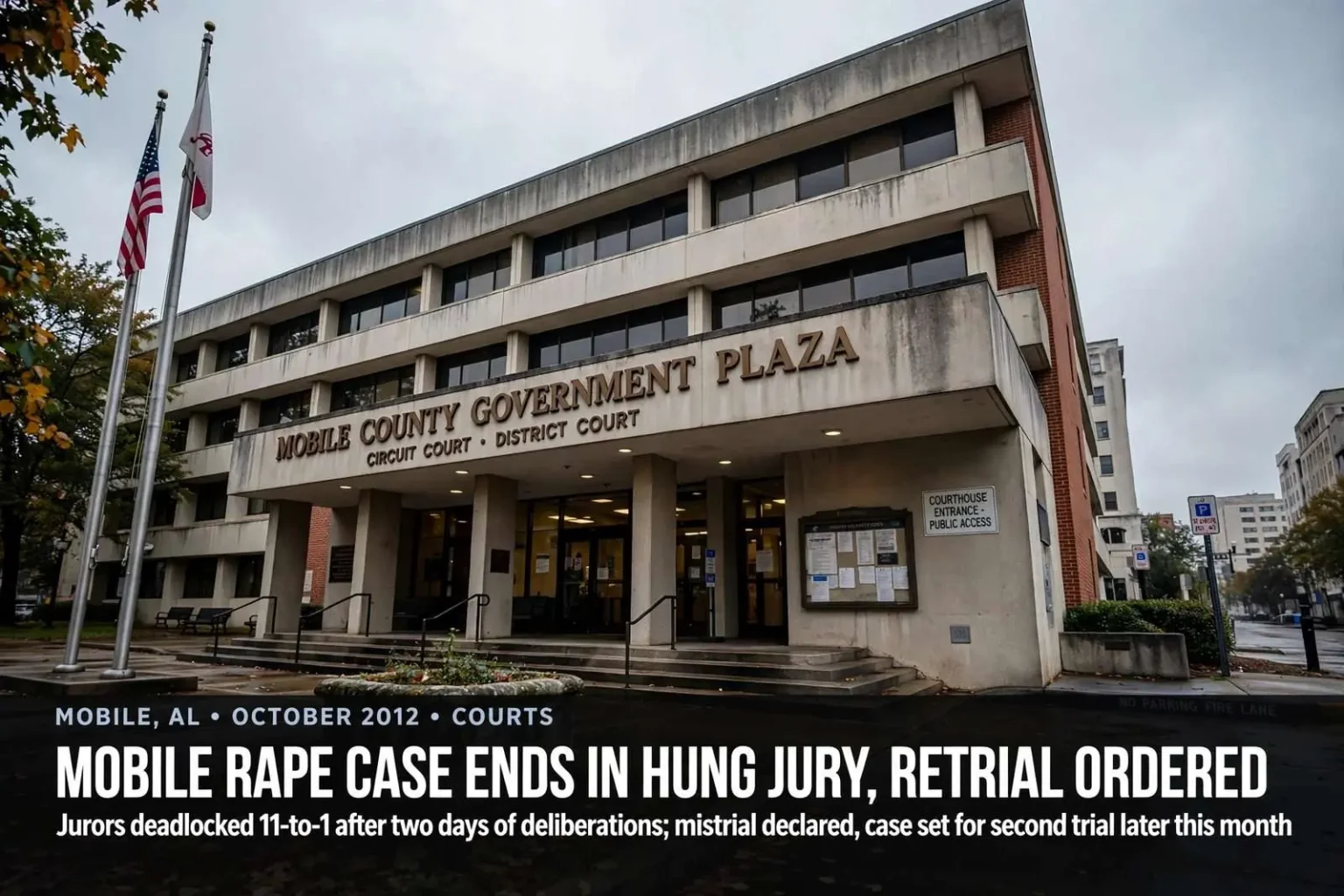
Mobile Rape Case Ends in Hung Jury, Retrial Ordered
A Mobile County jury deadlocked 11-to-1 after two tense days of deliberation, forcing a mistrial and a new trial date in a midtown assault case.
A criminal trial in Mobile ended without a verdict this week after jurors spent two contentious days locked in a deliberation room, eventually telling the court they could not reach a unanimous decision. Circuit Judge Rick Stout declared a mistrial late Thursday after the panel deadlocked 11-to-1, and the case against defendant Calvin Chambers is now headed for a second trial, set to begin later this month.
Chambers stood accused of burglary and rape stemming from an assault on an elderly woman, 85, near Little Flower Church in midtown Mobile in October 2012. Testimony wrapped up earlier in the week, and jurors began deliberating soon after. According to one juror who spoke afterward on condition of anonymity, the panel was split 10-2 in favor of conviction as of Wednesday. By the time deliberations resumed and stretched through nearly ten hours on Thursday, several jurors had shifted their positions, though one holdout never wavered from a vote to acquit.
The scene inside and outside the courtroom grew emotional as the deadlock dragged on. Arguments among jurors reportedly grew loud enough to be heard from the back of the courtroom, prompting Judge Stout to step to the deliberation room door at one point and admonish the group for how sharply they were speaking to one another. At least one juror left the room mid-session and told those nearby she did not intend to go back in.
When the mistrial was finally announced, family members of the victim were seen crying in the courthouse hallway. Stout, who described the deliberations as among the most contentious he had witnessed from the bench, took the unusual step of pulling four jurors aside individually to discuss what had caused the impasse. Assistant District Attorney Jill Phillips, along with a colleague who had not been part of the prosecution team, also spoke with several jurors informally in the hallway after the case ended.
Emotional aftermath in the courthouse
In the lobby of Government Plaza, the victim’s daughter and son-in-law spent several minutes talking with, and receiving hugs from, at least four members of the panel. One juror later told a reporter that the eventual decision to report a hung jury came down to simple exhaustion. Some jurors, he said, remained focused on reaching the legally correct outcome even as the hours wore on, while others appeared to want the process to end.
Whatever the internal dynamics, the result leaves the case unresolved for now: prosecutors will have to present it to a new jury, with the retrial scheduled to begin later in September. Cases like this one underscore how difficult it can be for a Mobile County jury to reach consensus in matters involving conflicting testimony and no independent witnesses. The upcoming retrial will give both sides a chance to make their case again, this time in front of twelve jurors who have not yet weighed in on the outcome.
What a hung jury means under Alabama law
A hung jury is not a verdict of guilty or not guilty. It simply means the jurors, after honest and extended discussion, could not agree on a single outcome. When a judge accepts that no amount of additional deliberation will break the deadlock, the judge declares a mistrial, and the case returns to the trial docket as if the first jury had never been seated. That is the procedural position Chambers now occupies, with the burglary and rape charges still pending and a second trial on the calendar later this month.
The law treats a mistrial caused by a deadlock very differently from an acquittal. Because the jury never reached a verdict, the constitutional protection against being tried twice for the same offense does not bar a second trial. Prosecutors in the Mobile County District Attorney’s Office therefore retain the full range of options they had the first time around: they can re-file the same charges, call the same witnesses, and present the same evidence to a fresh panel. Defense attorneys, for their part, get another opportunity to test the state’s case before twelve new jurors.
Retrials carry real costs for everyone involved. The victim’s family, which sat through days of testimony and then watched the first jury deadlock, must prepare to endure the process again. Witnesses, many of them elderly or spread across the region, can be summoned back to Government Plaza to repeat what they saw. And taxpayers foot the bill for another round of jurors, court reporters, bailiffs and attorney time. Judges like Stout weigh those burdens when deciding whether to keep pushing a divided jury to continue or to accept the deadlock and move the case toward retrial.
Deadlocks are not rare in criminal courts, but juries that fracture this badly are. A panel that begins at 10-2 for conviction and spends nearly ten additional hours in deliberation, only to arrive at 11-1, suggests genuine disagreement about the evidence rather than a single stubborn juror. In this case, however, observers inside the courtroom said one holdout never moved from a vote to acquit, even as colleagues around her changed positions during the long second day.
Why juries deadlock in cases like this one
Trials built on conflicting testimony, with no eyewitnesses to the underlying assault and no independent evidence placing the defendant at the scene, are among the hardest for juries to resolve. Jurors must weigh the credibility of witnesses against one another, and credibility judgments are deeply personal. One juror’s decisive detail is another’s reason for doubt, and no judge can instruct that difference away.
Jurors in the Chambers case reportedly grew heated as those divisions hardened. Stout’s rare decision to question four of them individually afterward reflected a practical concern shared by trial judges across Alabama: understanding why a jury failed helps prosecutors and defense lawyers decide whether to settle the case, seek another trial, or explore a plea. It also helps the court manage its docket, since Mobile County’s circuit judges handle one of the heaviest criminal caseloads in the state.
The road to a second trial
In the weeks ahead, prosecutors will prepare to retry the case with the benefit of what they learned from the first jury. Assistant District Attorney Jill Phillips and her colleagues now know where the first panel’s doubts centered, and they can refine their presentation accordingly, whether by reordering witnesses, clarifying the timeline of the October 2012 assault, or addressing the defense’s theories more directly in opening statements. The defense, likewise, will study which arguments moved at least one juror to hold out for acquittal through two full days of pressure.
The retrial is set to begin later in September, back before Judge Stout in the same downtown Mobile courthouse where the first trial played out. Jury selection alone will take on added weight, because both sides will be looking for jurors who can be candid about their ability to weigh evidence and who have not been influenced by coverage of the first trial’s messy ending. Twelve new residents of Mobile County will be asked to do what the last panel could not: listen to the same evidence and reach a single, unanimous conclusion.
For the victim’s family, the announcement of a mistrial was a bitter pause rather than an ending. relatives who wept in the hallway Thursday will return to the same seats when the new trial convenes, hoping the second jury reaches the resolution the first could not. Their emotional exchanges with jurors in the Government Plaza lobby offered a rare glimpse of the human weight these deliberations carry, on both sides of the rail.
A reminder of the system’s demands
Beyond one courtroom, the case illustrates the standard Alabama jurors are asked to meet. A criminal conviction requires proof beyond a reasonable doubt on every element of every charge, and burglary and rape charges tried together multiply the questions a panel must answer. When the evidence turns on testimony alone, reasonable jurors can and do disagree, even after ten-hour days and two rounds of argument.
Judge Stout’s handling of the deadlock, from the admonition at the deliberation room door to the individual post-mortem interviews, drew no complaints from either side. Court observers noted that the alternative, an allen-charge pushing jurors to reconsider, might have bought another hour of deliberation but was unlikely to bridge a gap that wide. Accepting the mistrial and setting a firm retrial date kept the case moving.
Whether the second jury convicts, acquits or deadlocks again, the outcome will rest on the same twelve sets of ears and the same hard questions of credibility. For now, the machinery of the Mobile County court system resets, and the search for a verdict that has already consumed more than a year begins again later this month.