
Amended Complaint Deepened the Ethics Case Against a Suspended Mobile Judge
In July 2007, prosecutors added 15 charges against suspended Mobile County Circuit Judge Herman Thomas after most of his colleagues on the bench accused him of pulling cases off other dockets.
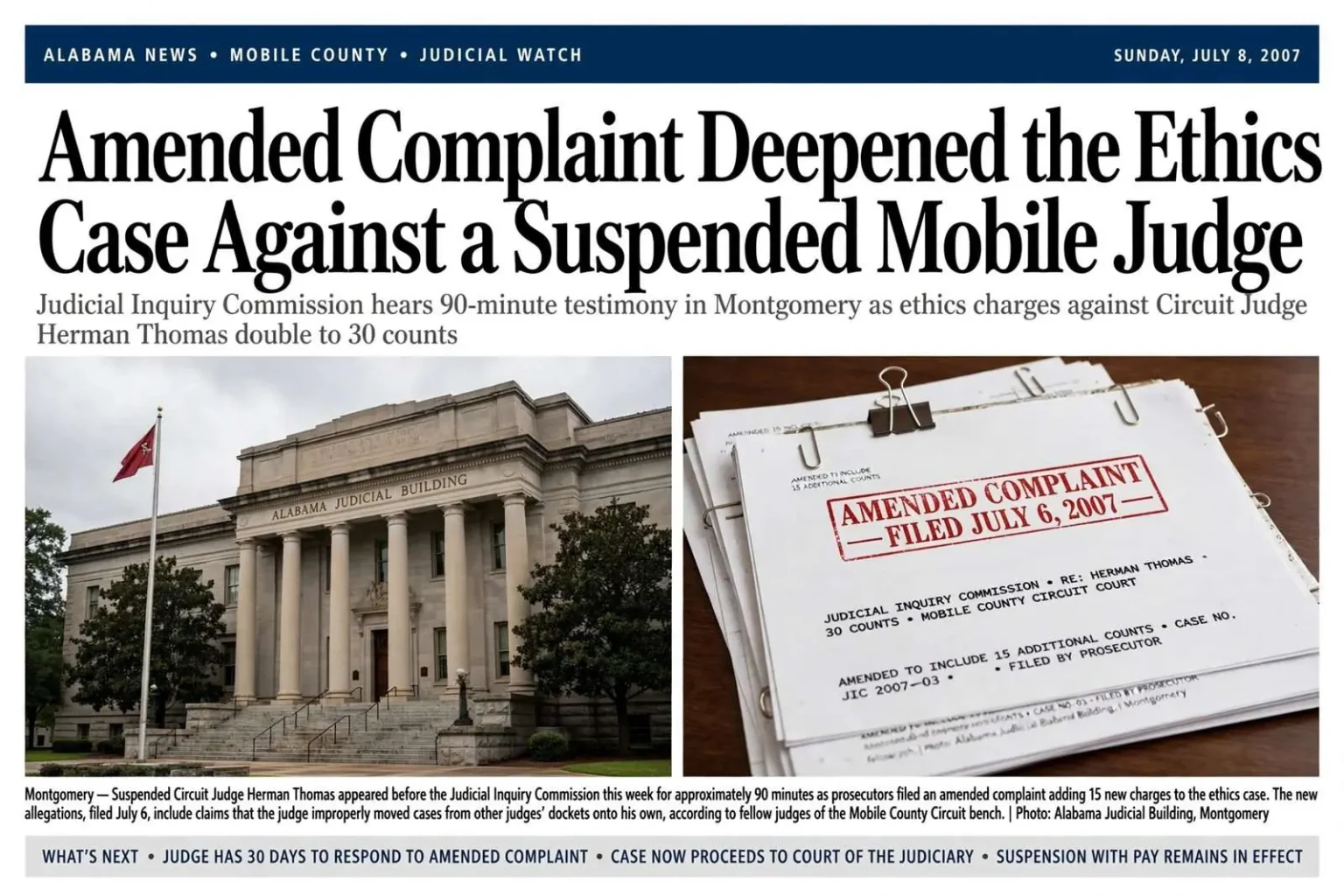
The ethics case against one of Mobile County’s best-known jurists grew heavier in the first week of July 2007. Suspended Circuit Judge Herman Thomas appeared before the Judicial Inquiry Commission in Montgomery for roughly an hour and a half to two hours, according to sources within the state court system, in a session that gave the commission its first extended look at the judge’s side of a rapidly expanding file.
Prosecutors, who had been given until July 6 to amend a 15-count complaint against him under an order from Judge J. Scott Vowell of the Court of the Judiciary, moved more quickly than that. The amendment doubled the case against Thomas, adding a full second set of charges drawn from grievances inside his own courthouse, and transformed what had been a dispute over individual rulings into a broad referendum on how the judge ran his docket.
What the original complaint alleged
Thomas had been charged in March with ethical violations in his handling of criminal cases involving three defendants with notable connections: his cousin, ousted Mobile County school board commissioner David Thomas; former Auburn and professional football player Leonardo Carson; and Akil Figures, son of state Sen. Vivian Figures and the late Michael Figures, a pillar of Mobile’s legislative delegation.
The overlapping relationships were what drew public attention to the case from the start. A circuit judge’s criminal docket touches thousands of defendants a year, and the allegation was not that Thomas lacked the authority to handle the cases assigned to him, but that his exercise of that authority had bent around defendants connected to him by family, friendship or politics. Thomas had withheld public comment on the matter but flatly denied the initial accusations in his formal response to the commission.
Then his colleagues weighed in, and the case changed shape. About two months before the July hearing, a second round of allegations reached the commission after most of the judges on the Mobile County Circuit bench signed a letter accusing their colleague of poaching cases from other dockets — that is, of moving criminal cases assigned to other judges onto his own. A letter signed by most of a circuit’s sitting judges is an extraordinary document, and it gave the commission a category of evidence the original complaint lacked: testimony, in effect, from the judges who worked beside him.
The amended complaint added 15 charges arising from those grievances, effectively doubling the case. Thomas, represented by Montgomery attorney Dave Boyd of Balch & Bingham, had 30 days to answer the new charges. He had used the full 30 days on the original complaint, though his defense was expected to move faster on the new round, which rested on conduct that could be reconstructed from court records and the recollections of fellow judges.
The longer arc
Stepping back, the case illustrates how judicial discipline differs from criminal prosecution or electoral accountability. Voters rarely have enough information to judge a judge’s conduct, criminal law reaches only the gravest abuses, and peers are reluctant to accuse one another lightly. The commission-and-court system exists precisely to fill that gap, giving Alabama a formal channel between the ballot box and the grand jury. When it works, misbehavior is documented by investigators, tested by a mixed panel, and resolved on the record; when it fails, the failures are spectacular precisely because they were invisible for so long.
The Thomas matter is shaping up as a demanding test of that machinery. It features a large volume of charges, a defendant with resources and a capable firm, a complainant group made up of the judge’s own colleagues, and defendants and families whose political prominence raises the public stakes. Each of those elements has appeared in discipline cases elsewhere; all of them together in one file is rare, and it explains why lawyers and judges across the state are following a Mobile dispute so closely.
The machinery of judicial discipline
Alabama’s system for policing its judges runs in two stages. The Judicial Inquiry Commission investigates and files charges; it is the charging body, and a judge is automatically suspended with pay once charges are filed. The Court of the Judiciary, a nine-member body drawn from judges, lawyers and lay members, then tries the case and holds the power to sanction a judge in anything from a reprimand to removal from the bench.
The two-stage design matters to how a case like Thomas’s unfolds. The commission’s hearings, such as the July appearance in Montgomery, are investigative rather than adjudicative — a chance for the judge and his counsel to respond to the file before formal proceedings begin. Nothing said there binds the Court of the Judiciary, but everything gathered there shapes what the trial panel eventually hears.
Suspension with pay is the system’s middle position, and it is easy to misread. It is not a finding of guilt, but it is also not neutral: a charged judge stops hearing cases immediately, even while the allegations are contested. In Mobile County, where criminal dockets are heavy and judicial manpower is tight, the loss of a sitting judge’s labor ripples through scheduling for everyone else on the bench.
Why docket control sits at the center
The second round of allegations goes to the heart of how a circuit court actually operates. In a large circuit, criminal cases are assigned to judges by lot or by rule, precisely so that no judge chooses his own cases. The accusation of case poaching — pulling files assigned to colleagues onto one’s own docket — strikes at that assignment system, and judges tend to regard interference with it as a breach of the compact that makes shared dockets workable.
That is why the signed letter from most of the circuit bench carried such weight. Whatever the commission ultimately concludes about the specific charges, the letter documented that Thomas’s fellow judges, the people best positioned to know how files moved in the courthouse, believed the rules had been bent repeatedly enough to put their names on paper.
For Thomas, the road ahead runs through Montgomery. His answers to the amended charges will frame the dispute for the Court of the Judiciary, and his defense is expected to argue that actions attributed to him were authorized, routine or misunderstood. The judge has denied the accusations from the start, and the proceedings that follow — formal, slow and rule-bound — will decide whether a suspended Mobile circuit judge returns to the bench or becomes one of the rare Alabama jurists removed by his peers.
A courthouse and a community watching
The case has drawn more attention than a typical judicial discipline matter because Thomas was, until his suspension, one of Mobile County’s most visible jurists — a judge whose name recognition extended well beyond the courthouse and whose docket regularly included cases that made the news. Discipline proceedings against well-known judges rarely stay inside the legal press, and this one involves defendants whose families are fixtures in Mobile politics and business.
The privacy rules that govern the process cut the other way, too. Judicial Inquiry Commission filings become public once charges are filed, but the commission’s deliberations, witness interviews and investigative steps do not, which leaves much of the record unknown to the public and the press. What is public — the complaint, the amendment, the signed letter from the bench, and the judge’s denials — is what the parties themselves have put on paper.
What happens next
The procedural clock is now the story. Thomas’s 30-day window to answer the amended complaint will produce a written response that either concedes nothing and contests every charge, or parses the allegations into those the defense will fight and those it will characterize differently. After the answer, the commission and the judge’s counsel move toward either a resolution or a formal trial before the Court of the Judiciary.
Both bodies have done this work quietly for decades. The Court of the Judiciary hears comparatively few cases in any given year, most ending in public reprimands or agreed resolutions rather than trials. A contested proceeding involving 30 charges, a suspended judge, and a circuit bench that signed on to the complaint would be anything but routine, and lawyers around the state recognize that the Thomas case could set reference points for how Alabama polices judicial conduct for years to come.
For Mobile County, the practical stakes are immediate. Criminal defendants whose cases were touched by the disputed rulings face uncertainty about how those files will be handled, and the circuit’s remaining judges are absorbing the workload while the process runs. The system was built to remove politics from judicial discipline — the commission investigates, the court tries, the record becomes public — and the Thomas case is now the test of whether that machinery can resolve a dispute this entangled with family, friendship and courthouse politics without leaving the community doubting the result.