Alabama State Government Brewton
Isaias Damage Assessments: State Crews, Not FEMA, Go House to House as Ivey Extends Emergency
Gov. Kay Ivey extended Alabama's state of emergency 14 days as state crews, not FEMA, go house to house documenting Hurricane Isaias damage. Here is how Escambia, Monroe and Conecuh residents can report damage.
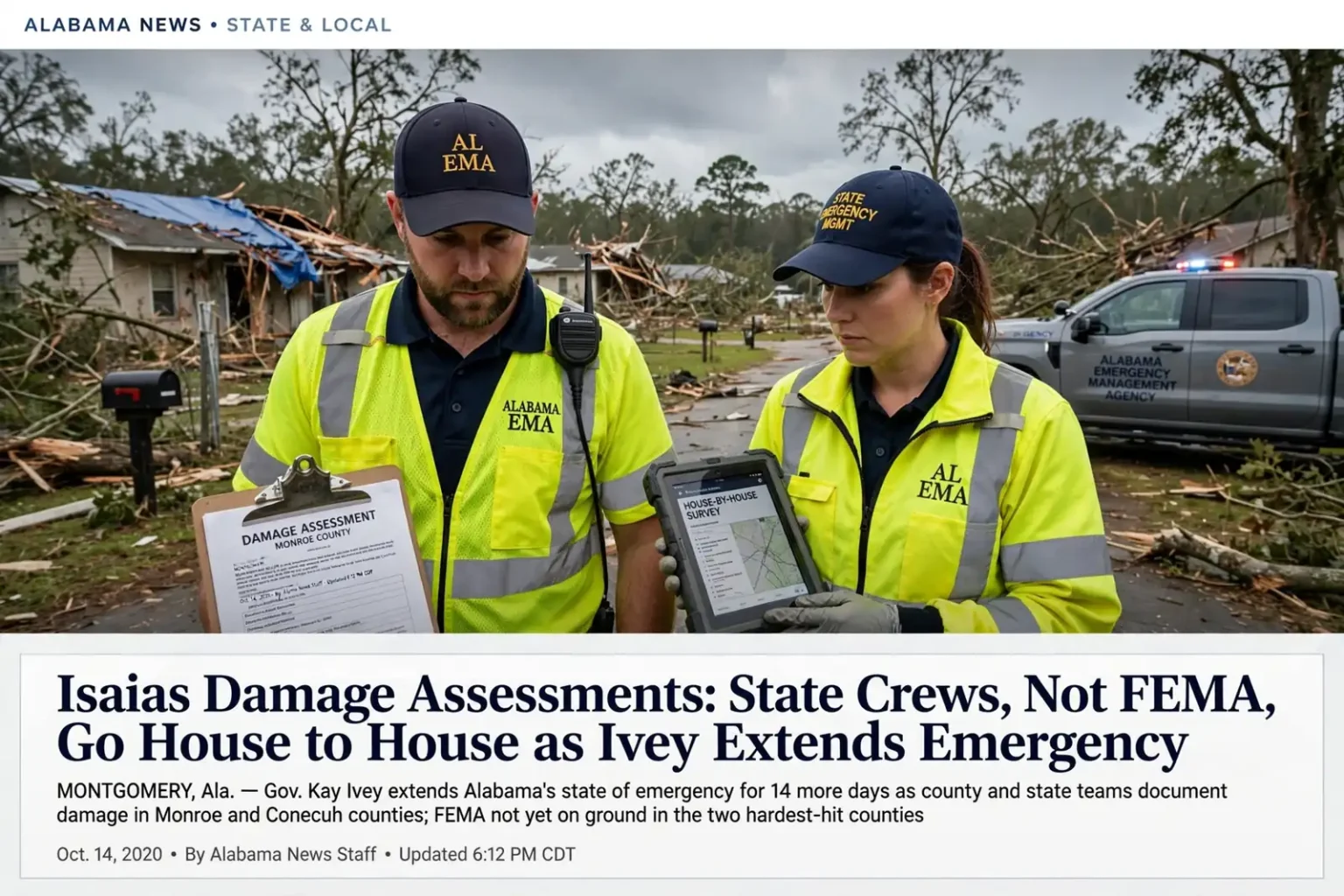
MONTGOMERY, Ala. — Gov. Kay Ivey has extended Alabama’s state of emergency for 14 more days after Hurricane Isaias, giving local and state officials more time to complete Isaias damage assessments and apply for federal disaster relief. In Monroe and Conecuh counties, local emergency management directors want residents to know who is doing that work right now: county and state teams, not FEMA.
Despite rumors circulating in the hardest-hit communities, FEMA teams are not on the ground conducting assessments in those counties, the local emergency directors confirmed. Instead, state emergency crews are going neighborhood by neighborhood, house to house, documenting damage that will be used to determine whether Alabama qualifies for more federal aid.
Emergency order extended
Ivey’s original state of emergency took effect Wednesday, Oct. 7, as Isaias churned toward the Gulf Coast, and covered 40 counties from the coast to the Montgomery, Lee and Tuscaloosa areas. The proclamation had been set to expire at 11:59 p.m. Wednesday, Oct. 14, unless the governor extended it.
The 14-day extension keeps the state’s emergency powers in place while the recovery continues. A governor’s emergency declaration is typically the foundation for any request for federal help, and it keeps Alabama’s emergency operations plan active. While the state of emergency remains in effect, Alabama’s price gouging law also continues to apply in the covered counties.
Why it starts at the local level
Applying for federal assistance begins with counties. Federal disaster aid is built on a bottom-up process, and the first step is documenting what happened, house by house and road by road.
In general, the process works like this:
- Local reports. County emergency management agencies gather damage reports from residents, first responders and local governments to build an initial picture of the destruction.
- State verification. The Alabama Emergency Management Agency sends teams to confirm and document damage to homes, businesses and public infrastructure.
- Joint assessments. When the numbers suggest damage is beyond what the state and counties can handle alone, the state can ask FEMA to join in preliminary damage assessments.
- Governor’s request. Based on those findings, the governor can ask the president for a major disaster declaration.
- Federal decision. If the president approves, specific programs open in specific counties, such as Individual Assistance for households or Public Assistance for local governments’ debris removal and repairs.
That is why officials are urging residents to report damage now, even if they have already called their insurance company. The more complete the local record, the stronger the case the state can make.
What federal help exists so far
President Donald Trump approved an emergency declaration for Alabama on Oct. 9, the day Isaias made landfall near Destin, Fla., as a Category 2 hurricane. That declaration covers Mobile, Baldwin and Escambia counties and the Poarch Band of Creek Indians. It authorizes FEMA to coordinate the federal response and provide emergency protective measures, but it does not open individual disaster aid for households.
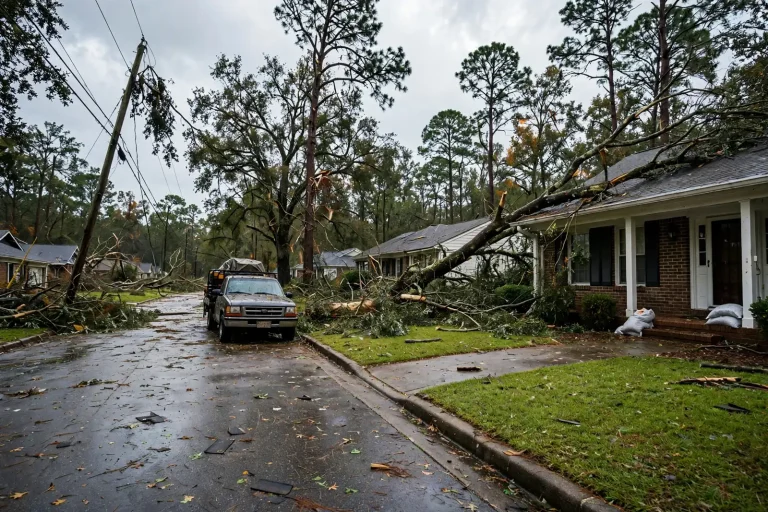
Monroe and Conecuh counties were not included in that declaration, even though both were among the hardest-hit areas in the state. Nearly every customer in Conecuh County lost power at one point after the storm, and outages lingered for days in Monroeville and across rural Monroe County. Adding counties or opening new aid programs would require further federal action, and the damage assessments now under way are a key part of making that case.
In Brewton, Mayor Frank Nalty Jr. said earlier this week that FEMA was ready to help once Escambia County’s damage assessment was sent to the state.
How to report storm damage
Counties are using different tools to collect reports from residents. Here is how to report damage in the three counties covered by the local directors’ guidance:
- Escambia County: Visit the Escambia County EMA Facebook page and click the “Citizen Damage Reporter” link, marked with the Futurity logo. Upload details of the damage along with clear photos.
- Monroe County: Visit the Monroe County EMA Facebook page and use the same “Citizen Damage Reporter” link with the Futurity logo. Include a description and clear photos.
- Conecuh County: Report damage and upload photos through the Conecuh County Public Safety app. Residents without internet access can call the Conecuh County EMA directly at 251-578-1921.
Residents of other counties should check their county EMA’s website or social media pages for local reporting instructions.
Tips for documenting damage
Good documentation helps with damage assessments, insurance claims and any assistance that may become available later. Emergency managers and insurers generally recommend that residents:
- Photograph and video all damage before cleaning up or making repairs, including wide shots that show the whole structure and close-ups of specific damage.
- Note the date, address and type of damage, such as roof, windows, fallen trees, flooding or damaged outbuildings.
- Keep receipts for tarps, chainsaw work, generators, temporary repairs, hotel stays and other storm-related expenses.
- Make reasonable temporary repairs to prevent further damage, such as tarping a roof, after taking photos.
- Contact your insurance company promptly and write down claim numbers and the names of people you speak with.
Watch out for false claims
Rumors that FEMA is already on the ground can create openings for scammers. FEMA and U.S. Small Business Administration representatives do not charge fees for inspections or help with applications, and they carry official photo identification. Anyone who knocks on a door promising a federal grant in exchange for a payment does not represent FEMA. If federal individual assistance becomes available, application information will be announced through official channels, including state and county emergency agencies and DisasterAssistance.gov.
Residents who are approached by someone claiming to be a federal disaster worker can ask to see identification and call their county EMA to confirm whether any federal teams are working in the area.
Tax relief now in place
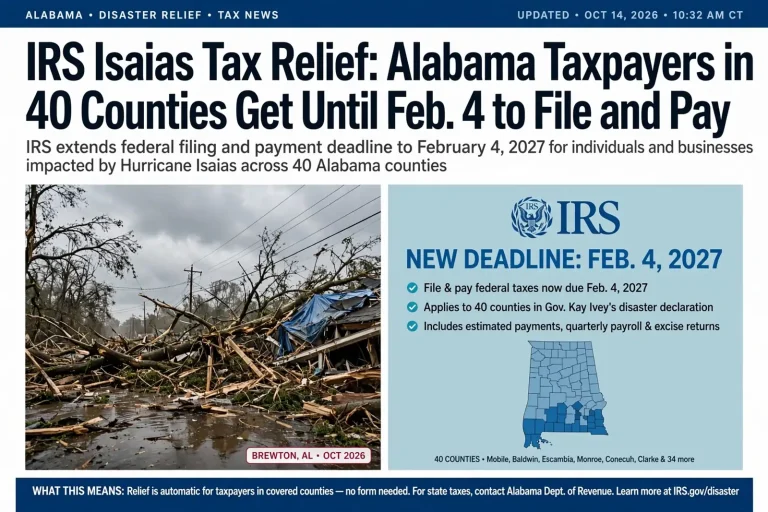
The governor’s office has also been working with the Internal Revenue Service to secure filing and payment postponements for storm victims. On Wednesday, Oct. 14, the IRS announced that taxpayers in all 40 counties covered by Ivey’s declaration, including Escambia, Monroe and Conecuh, have until Feb. 4, 2027, to file many federal returns and make payments. The Alabama Department of Revenue is separately considering state late-filing penalty waivers on a case-by-case basis.
Where to get help now
While assessments continue, help is available from state, local and volunteer groups across southwest Alabama. Residents with unmet needs can call 211 to be connected with resources for food, water, shelter and cleanup. Distribution sites for water and tarps have been set up in Escambia County, and volunteer organizations including Samaritan’s Purse are helping uninsured and underinsured homeowners with tree removal and roof tarping.
Residents should continue to follow their county EMA, the Alabama Emergency Management Agency and the governor’s office for updates on the assessment process and any new federal declarations.