Alabama State Government Hurricane
IRS Isaias Tax Relief: Alabama Taxpayers in 40 Counties Get Until Feb. 4 to File and Pay
The IRS gave Hurricane Isaias victims in 40 Alabama counties, including Mobile, Baldwin and Escambia, until Feb. 4, 2027, to file many returns and make tax payments, with payroll deposit penalties abated if made by Oct. 22.
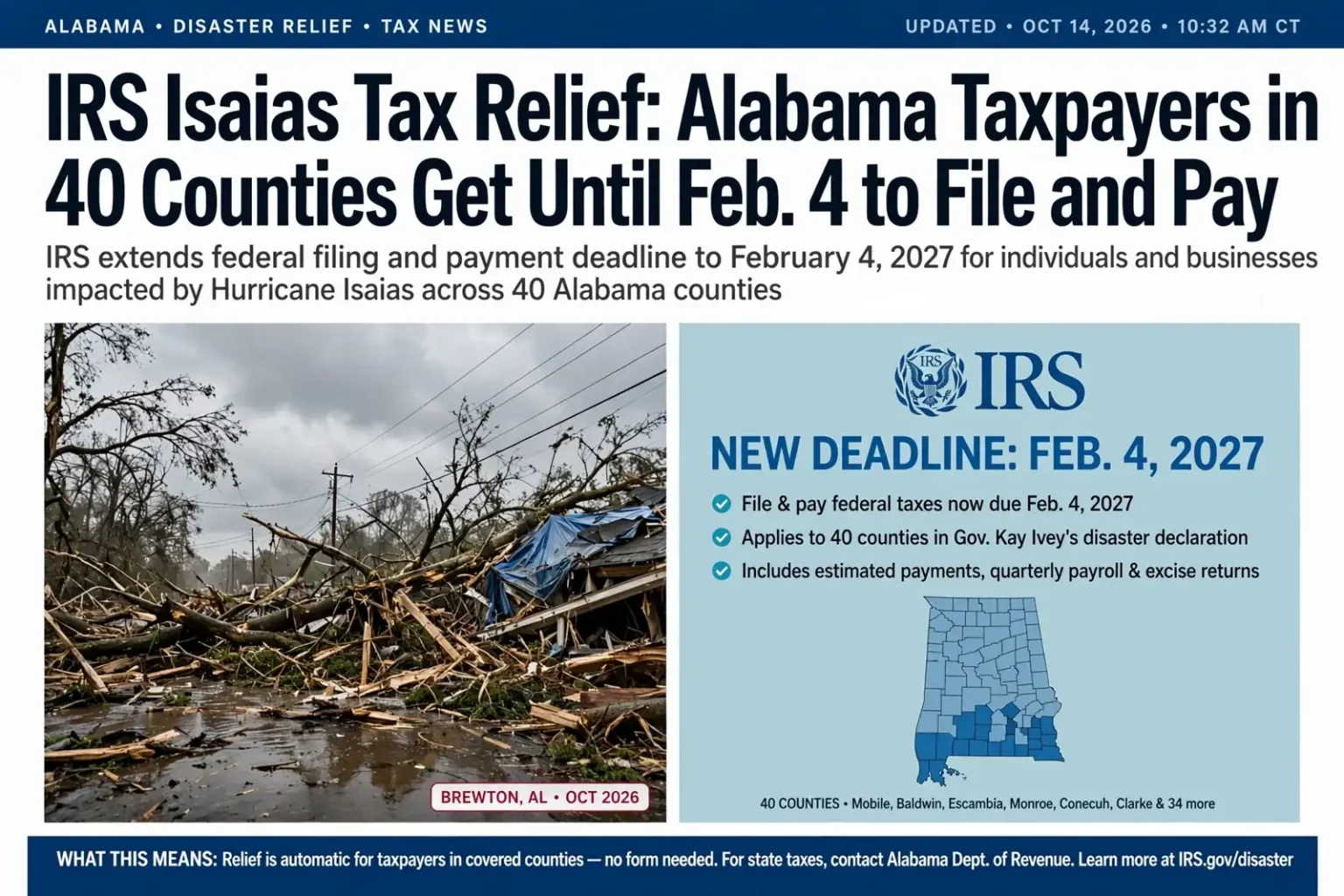
Alabama individuals and businesses in 40 counties affected by Hurricane Isaias now have until Feb. 4, 2027, to file many federal tax returns and make tax payments. The Internal Revenue Service announced the IRS Isaias tax relief on Wednesday, Oct. 14, extending deadlines for taxpayers in every county covered by Gov. Kay Ivey’s Oct. 7 disaster declaration, including Mobile, Baldwin, Escambia, Monroe, Conecuh and Clarke.
The federal postponement arrives on the same week as the Oct. 15 deadline for people who requested an extension on their individual returns in the spring, and one day after the Alabama Department of Revenue said it would consider waiving state late-filing penalties for storm victims on a case-by-case basis.
What the IRS is postponing
According to the IRS, affected business owners and individuals have until Feb. 4, 2027, to file tax returns or make payments tied to the disaster period that began with the governor’s Oct. 7 declaration. The relief covers:
- Estimated tax payments: Estimated income tax payments originally due on or after Oct. 7, 2026, are postponed through Feb. 4, 2027. Affected taxpayers will not face penalties for failing to pay estimated tax installments as long as the payments are made on or before Feb. 4.
- Quarterly payroll and excise returns: The Feb. 4 deadline also applies to affected quarterly payroll returns and certain excise tax returns normally due Nov. 2, 2026.
- Payroll and excise tax deposits: Penalties on payroll and excise tax deposits due on or after Oct. 7 and before Oct. 22, 2026, will be abated as long as the deposits are made by Oct. 22.
The deposit deadline is the one most likely to catch employers off guard. Unlike the return deadlines, it is not pushed into February. Businesses that missed a payroll deposit while closed by the storm have until Oct. 22 to make it up without a penalty.
The 40 counties covered
The relief applies to individuals, households and business owners who live or are located in the following Alabama counties:
- Autauga, Baldwin, Barbour, Bibb, Bullock, Butler, Chambers, Chilton, Clarke and Choctaw
- Coffee, Conecuh, Coosa, Covington, Crenshaw, Dale, Dallas, Elmore, Escambia and Geneva
- Greene, Hale, Henry, Houston, Lee, Lowndes, Macon, Marengo, Mobile and Monroe
- Montgomery, Perry, Pickens, Pike, Russell, Sumter, Tallapoosa, Tuscaloosa, Washington and Wilcox
That list matches the 40 counties in Ivey’s state of emergency, which stretches from the Gulf Coast north through the Wiregrass, the Black Belt and the Montgomery and Tuscaloosa areas.
How IRS disaster relief usually works
In disaster postponements, the IRS generally applies relief automatically to taxpayers whose address of record is in a covered county. Those taxpayers typically do not need to call the agency or file a special form to get the extra time. If a late-filing or late-payment penalty notice is sent for a period covered by the postponement, the agency’s standard advice is to call the number on the notice to have it removed.
Taxpayers who live outside the 40 counties but whose records needed to meet a deadline are located inside the disaster area, such as clients of an Escambia County accountant whose office was damaged, can generally qualify for relief by contacting the IRS. The agency’s disaster assistance line is 866-562-5227. Relief workers affiliated with a recognized government or charitable organization helping with the recovery may also be eligible.
The IRS often includes returns already on extension in its disaster postponements, which would matter to people who have been working toward the Oct. 15 extended deadline. Because the details of each announcement can differ, taxpayers in the covered counties who are unsure whether a particular return or payment is included should check the Isaias relief announcement on IRS.gov or ask a tax professional before letting a deadline pass.
The postponement gives people more time to file and pay. It does not forgive taxes owed.
State taxes are handled separately
The IRS announcement covers federal taxes only. The Alabama Department of Revenue, which administers state income, sales, withholding and business privilege taxes, said Tuesday it will consider requests to waive late-filing penalties for taxpayers who cannot file on time because of Isaias. That relief is not automatic; taxpayers must call the department and be ready to explain how the storm affected their ability to file.
ALDOR listed these numbers for taxpayers seeking state relief:
- Individual Income Tax: 334-353-0602
- Corporate Income Tax: 334-242-1200
- Pass-through Entities: 334-242-1033
- Sales and Use Tax: 334-242-1490
- Business Privilege Tax: 334-353-7923
- Withholding Tax: 334-353-7680
Earlier this week, local emergency officials said Ivey’s office was working with the IRS to try to obtain a filing and payment postponement for storm victims. Wednesday’s announcement delivers that federal relief.
The storm behind the relief
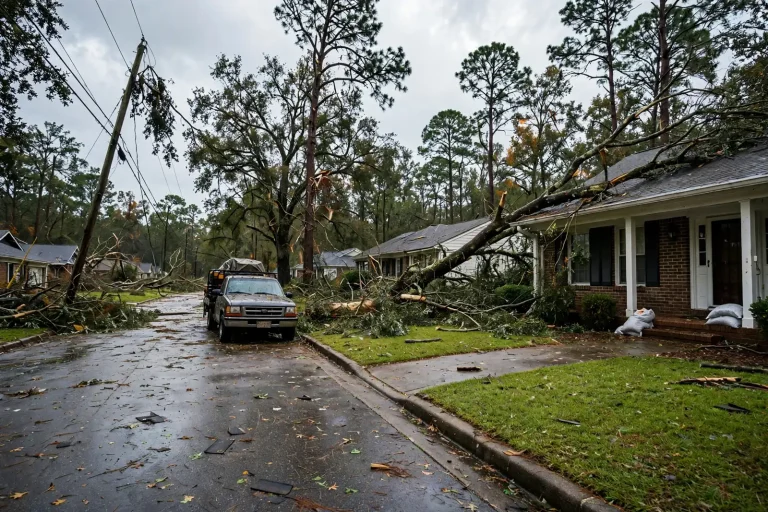
Isaias made landfall near Destin, Fla., on the night of Friday, Oct. 9, as a Category 2 hurricane, then moved north into Alabama. The storm caused widespread damage, left thousands without power for days and was blamed for at least two deaths in Alabama.
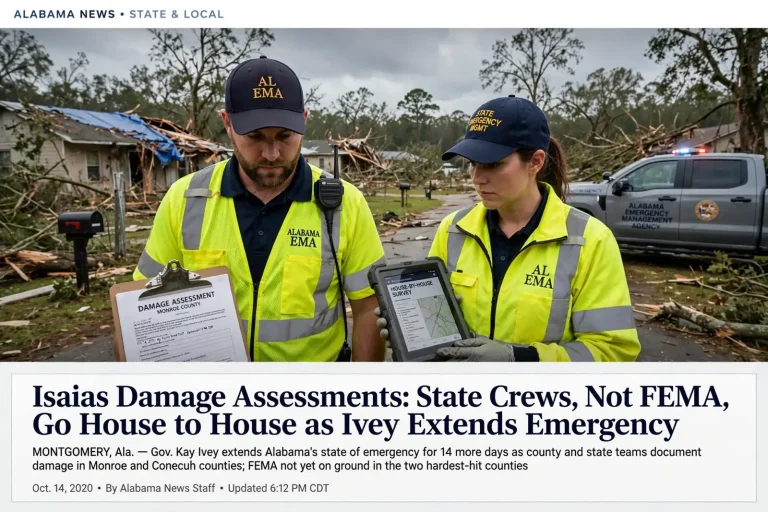
Southwest Alabama’s inland counties took some of the heaviest blows. Brewton, the Escambia County seat, has been described by local officials as the hardest-hit community in the state, with downtown buildings damaged, hundreds of broken utility poles and a nightly curfew still in effect this week. Monroe and Conecuh counties also endured long outages, and Ivey has extended the state of emergency to give local and state officials more time to document damage and seek federal aid.
For many families and small businesses, the timing could hardly be worse. Records and computers may have been damaged, home offices may still be without power, and owners who are paying for cleanup and repairs may be short on cash for an estimated tax payment due in the middle of the recovery.
Bank relief for storm victims
Birmingham-based Regions Bank also announced Wednesday that it is offering a range of financial services to individuals and businesses in the affected disaster areas. The bank said the assistance includes fee waivers, interest rate discounts and other help. Customers of Regions and other banks and credit unions who are struggling after the storm should contact their institution directly to ask what options are available, such as payment deferrals or waived fees.
Tips for taxpayers recovering from Isaias
- Do not wait if you can file. If your records and access are intact, filing on time avoids complications later. The postponement simply gives you more room if you need it.
- Mark Oct. 22 on the calendar. Employers who missed payroll or excise deposits during the storm should make them by Oct. 22 to have penalties abated.
- Rebuild lost records. Copies of prior returns and tax transcripts can be requested from the IRS, and banks and employers can reissue statements and wage forms.
- Document storm losses. Photos, repair estimates, receipts and insurance paperwork may be needed if you claim a casualty loss. The IRS explains the rules in Publication 547, and a tax professional can help determine whether a loss is deductible.
- Talk to your preparer. If your tax professional’s office is in a covered county and was damaged or closed, ask how the postponement affects your filing.
- Watch for impostors. The IRS generally makes first contact by mail. Be wary of calls, texts or emails claiming to be from the IRS or the state revenue department that demand immediate payment by gift card, wire transfer or payment app.
Where to find more
Official details of the Isaias postponement, including any updates to the list of covered counties, are posted on IRS.gov under disaster relief. Questions about Alabama taxes go to the Alabama Department of Revenue at the numbers above. Residents with storm-related needs beyond taxes, including food, water, tarps and cleanup help, can call 211 to be connected with local resources.