Alabama State Government Hurricane
HHS Declares Isaias Public Health Emergency in Alabama, Florida, Easing Medicare and Medicaid Rules
HHS Secretary Robert F. Kennedy Jr. declared a public health emergency in Alabama and Florida after Hurricane Isaias, letting CMS grant Medicare, Medicaid and CHIP providers temporary flexibilities retroactive to Oct. 7 in Alabama.
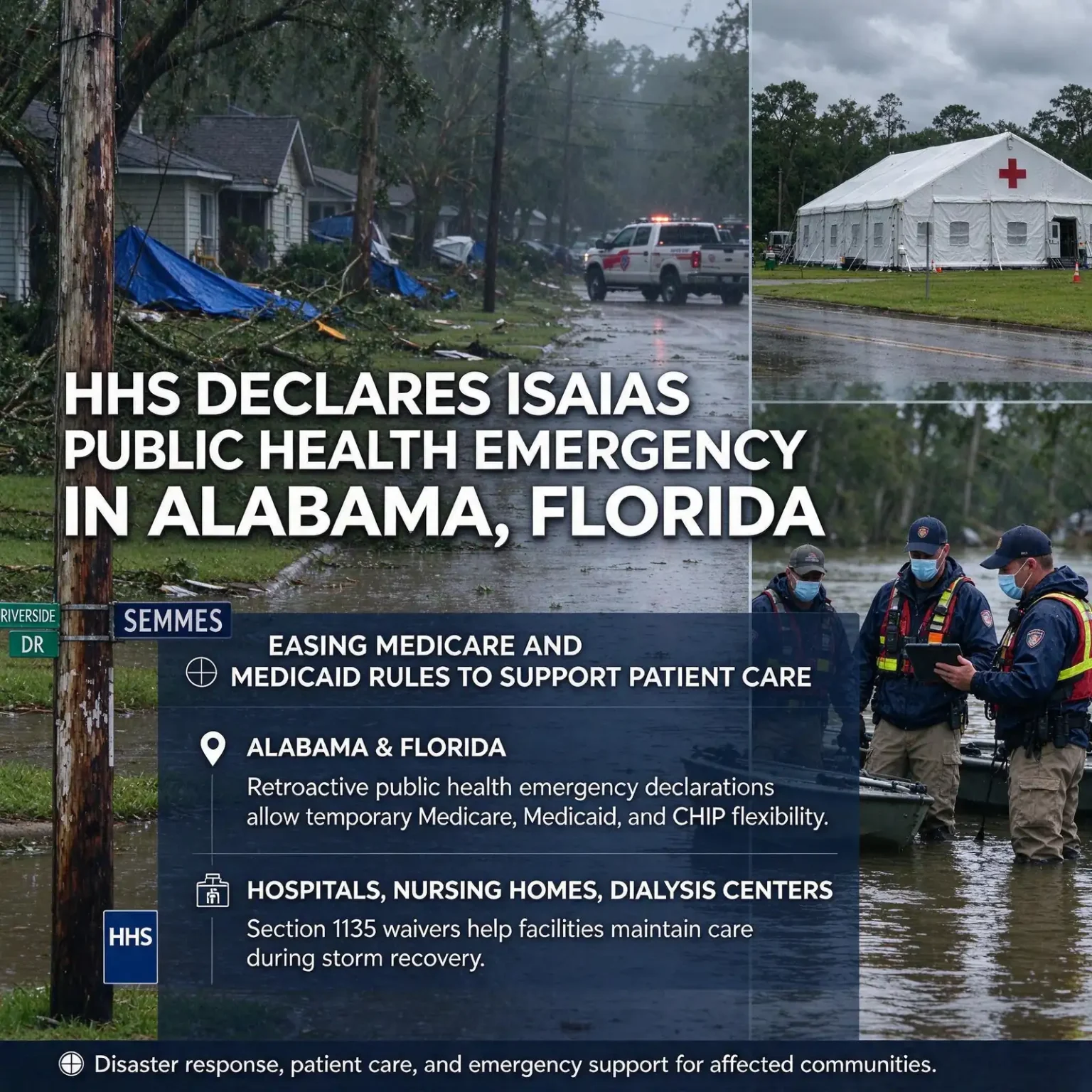
WASHINGTON — The federal government has declared an Isaias public health emergency in Alabama and Florida, a step that lets hospitals, nursing homes, dialysis centers and other health care providers bend certain federal rules while they keep caring for patients after Hurricane Isaias. U.S. Health and Human Services Secretary Robert F. Kennedy Jr. made the determination Tuesday, Oct. 13, according to an HHS announcement released Wednesday.
The declarations are retroactive. In Alabama, the emergency and the flexibilities that come with it reach back to Oct. 7, 2026, the day Gov. Kay Ivey’s state of emergency took effect for 40 counties. In Florida, they date to Oct. 6.
What the declaration does
The public health emergency follows President Donald Trump’s Oct. 9 emergency declarations for both states. Together, the president’s declarations and the secretary’s determination allow HHS to authorize temporary waivers and modifications of certain federal requirements.
Those flexibilities are aimed mainly at the Centers for Medicare & Medicaid Services, or CMS, the agency that runs Medicare and oversees Medicaid and the Children’s Health Insurance Program, known as CHIP. HHS said the changes help CMS support health care providers and suppliers serving people enrolled in those programs in the covered emergency areas.
Kennedy acted under his authority in the Public Health Service Act and the Social Security Act, HHS said.
“Under President Trump’s leadership, HHS is giving healthcare providers in Florida and Alabama the flexibility to keep caring for patients in the wake of Hurricane Isaias,” Kennedy said. “We are helping them maintain essential services, respond quickly as needs change, and keep care available throughout the response and recovery.”
How health care waivers work after a disaster
Medicare and Medicaid come with detailed rules about where patients can be treated, how long they must stay in a hospital before other services are covered, which professionals can provide care and how paperwork must be filed. In normal times, those rules protect patients and taxpayers. After a hurricane, they can get in the way.
When a presidential emergency declaration and an HHS public health emergency are both in place, federal law allows the secretary to temporarily waive or modify some of those requirements. These are often called Section 1135 waivers, after the section of the Social Security Act that authorizes them. The goal is to make sure enough care is available for people enrolled in federal health programs during the emergency, and that providers who act in good faith are not penalized for working around storm damage.
In past hurricanes, flexibilities granted under this authority have commonly addressed situations such as moving patients to another facility when a building loses power or is damaged, caring for patients in temporary or alternate locations, easing paperwork and reporting deadlines, and helping beneficiaries get replacement medical equipment and supplies lost in a storm. The specific waivers granted for Isaias are set by CMS, and providers can find them on the agency’s emergency response website or by contacting CMS directly.
For patients, the practical effect is often invisible. A nursing home resident who must be moved, a hospital patient transferred to a facility with working power or a Medicare beneficiary who needs a new oxygen concentrator after a flood is less likely to run into a billing or eligibility snag because of the move.
Why it matters in South Alabama
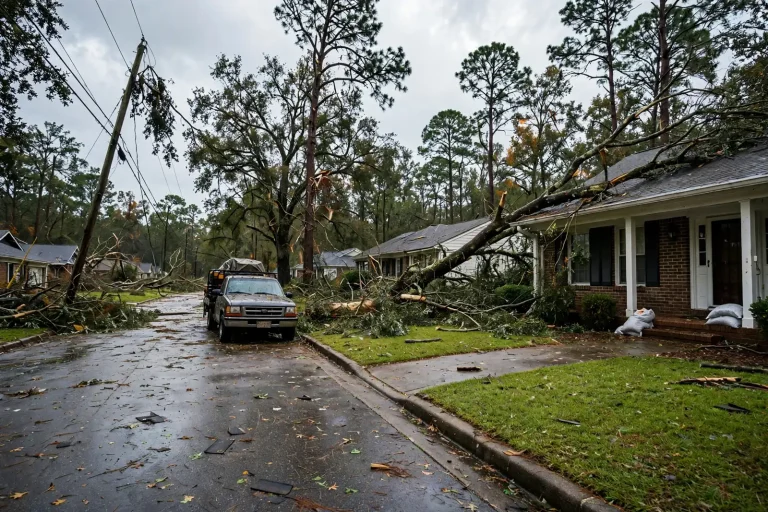
Isaias made landfall near Destin, Fla., on the night of Friday, Oct. 9, as a Category 2 hurricane with 105 mph winds, then raced north across Alabama. Hundreds of thousands of Alabama utility customers lost power, and inland communities in Escambia, Monroe and Conecuh counties were among the last to get it back.
Health care facilities were not spared. In Brewton, D.W. McMillan Memorial Hospital ran on emergency generators after the storm, and Mayor Frank Nalty Jr. said earlier this week that patients had to be shipped out, including by helicopter, before the hospital’s power was restored Monday. Long outages are especially risky for people who depend on oxygen, home dialysis equipment, powered wheelchairs and other electricity-dependent medical devices, and for those who need refrigerated medications such as insulin.
Four deaths in Alabama and Florida had been attributed to the storm as of last weekend, two of them in Alabama.
Federal teams were in place before landfall
HHS said its Administration for Strategic Preparedness and Response, known as ASPR, pre-positioned regional staff in areas at risk before the storm came ashore. Those staff members monitored the storm’s effects on public health and health care systems and stood ready to provide technical help in anticipation of requests from the states.
Healthcare System Assessment Teams also deployed to evaluate the storm’s impact on health care facilities, according to HHS.
“When a storm disrupts someone’s ability to get care, the need is immediate and personal,” said Sean Kaufman, HHS principal deputy assistant secretary for preparedness and response at ASPR. “I want the people affected by Hurricane Isaias to know that we are here to help. Our federal teams worked alongside state and local partners to understand what communities needed and to support the healthcare services they depend on.”
Data to find vulnerable residents
ASPR also shared HHS emPOWER datasets with states in the storm’s path. The data can help responders identify, by geographic area, how many Medicare beneficiaries rely on electricity-dependent medical equipment or on certain essential health care services, including facility-based dialysis and home health care.
The emPOWER program draws on Medicare claims data to give emergency planners and utilities a picture of where at-risk residents live without releasing individual patients’ identities to the public. Emergency managers can use the counts to decide where to send welfare checks, where to place generators or cooling and charging stations and which neighborhoods to prioritize when power crews and health teams are stretched thin.
Help for emotional distress
The storm’s toll is not only physical. Residents who lost homes, spent days without power or are still clearing debris may be dealing with anxiety, sleeplessness, grief or stress.
HHS pointed residents to the Disaster Distress Helpline, which anyone experiencing emotional distress related to Hurricane Isaias can reach by calling or texting 1-800-985-5990. The toll-free, multilingual crisis support service is managed by the Substance Abuse and Mental Health Services Administration, or SAMHSA, and is available 24 hours a day, seven days a week, to all residents of the United States and its territories who are struggling after natural or human-caused disasters.
Callers can be connected with counselors in more than 100 languages through third-party interpretation services by telling the responding counselor which language they prefer.
What patients and caregivers can do now
The emergency declaration works mostly behind the scenes, but Medicare and Medicaid enrollees and their families can take several practical steps while recovery continues:
- Call your provider before you go. Dialysis centers, clinics and home health agencies affected by the storm may have changed hours or locations. Ask where and when to get care.
- Replace lost equipment and supplies. If oxygen equipment, a wheelchair, glucose monitor or other medical supplies were lost or damaged, contact your doctor and supplier to ask about replacement.
- Ask about prescription refills. If medications were lost or spoiled during an outage, talk to your pharmacist or health plan about an early refill.
- Keep medicines cold safely. Insulin and some other drugs need refrigeration. Ask a pharmacist how long yours is safe without power and how to store it.
- Use generators outdoors only. Carbon monoxide poisoning is a leading cause of illness and death after hurricanes. Keep generators far from doors, windows and vents.
- Check on neighbors. Older adults and people who rely on powered medical devices may need help getting to care or to a charging location.
- Reach out for support. Call or text the Disaster Distress Helpline at 1-800-985-5990 at any hour.
Part of a wider federal response
The HHS action adds to federal steps already taken for Isaias. The president’s Oct. 9 emergency declaration for Alabama authorized FEMA to coordinate federal response efforts and covered Mobile, Baldwin and Escambia counties and the Poarch Band of Creek Indians, with assistance limited to emergency protective measures. That declaration does not open individual disaster aid for households.
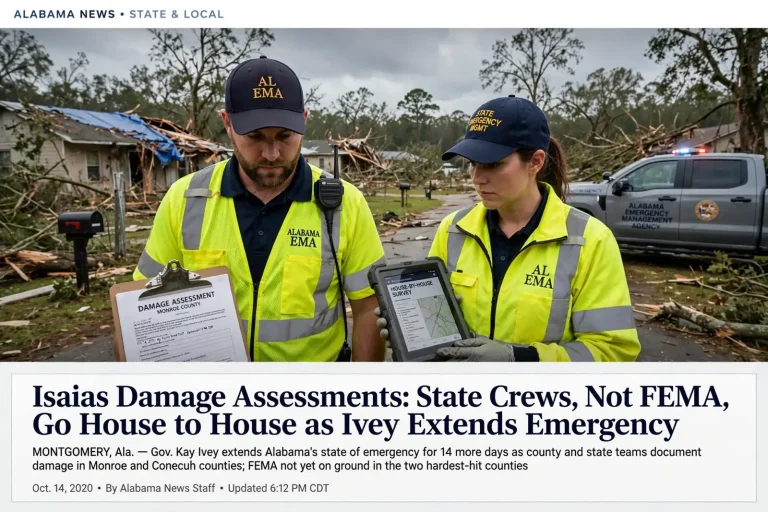
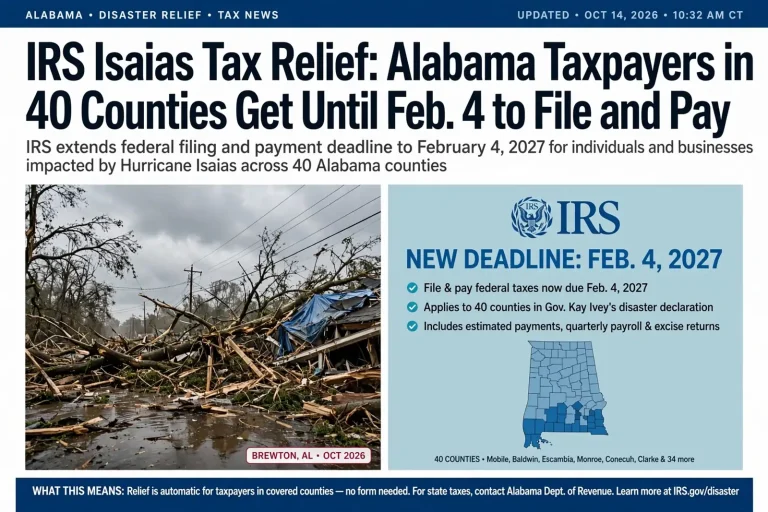
Ivey has since extended Alabama’s state of emergency, and state and local emergency teams are documenting damage across the hardest-hit counties to determine whether Alabama can seek broader federal help. The Internal Revenue Service has also postponed many filing and payment deadlines to Feb. 4, 2027, for taxpayers in the 40 counties covered by the governor’s declaration.
Residents with unmet needs can call 211 to be connected with local resources, including food, water, shelter and cleanup help.