How Hurricane Frederic Shaped a Young FEMA’s Playbook in Alabama
A newly formed FEMA cut its teeth on Hurricane Frederic in 1979, learning lessons in coastal Alabama that still guide disaster response nationwide today.
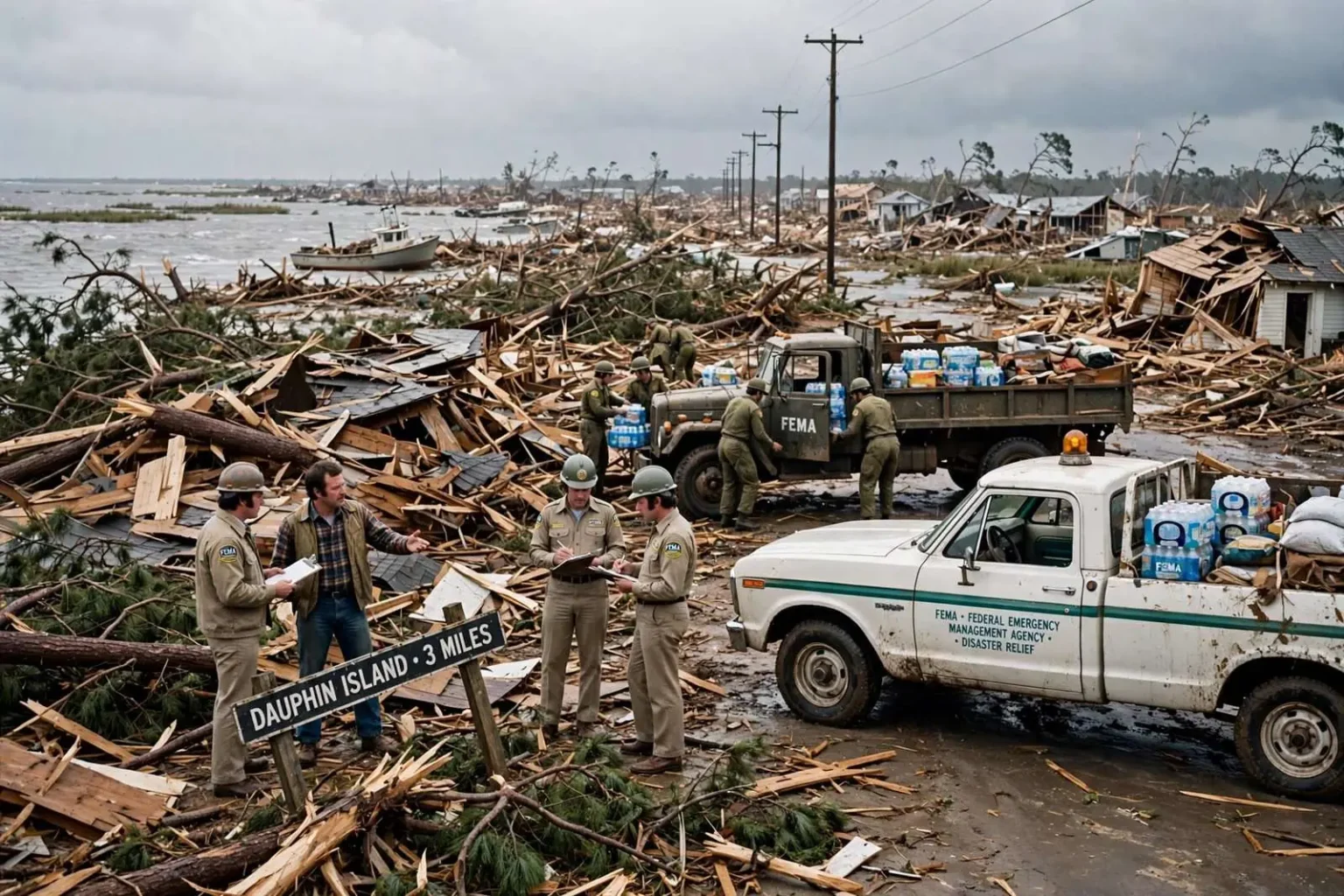
When Hurricane Frederic slammed into the Alabama coast in September 1979, the federal government’s newest disaster agency was barely five months old. The Federal Emergency Management Agency, stitched together that April from three older programs, was still working out how to respond to a major storm when Mobile and the surrounding coast needed help most. What happened in the months after landfall taught the young agency lessons that still shape how disasters are managed.
Frederic was the storm of the modern era for the Alabama coast, a major hurricane that came ashore with destructive winds and pushed a storm surge across Dauphin Island and the beaches of the Gulf. In Mobile and Baldwin counties it toppled signs, stripped roofs and knocked out power for weeks, leaving a damage footprint that ranked among the costliest in the nation’s history to that point. For the new agency created in April 1979 from the Defense Civil Preparedness Agency, the Federal Disaster Assistance Administration and the National Flood Insurance Program, Frederic arrived as a proving ground nobody had rehearsed for.
Improvising a Response
Bruce Baughman, who later spent decades with FEMA before retiring, arrived in Alabama about a month after Frederic made landfall, taking over as the agency’s Regional Public Assistance Officer. He has since described those early days as an exercise in improvisation, built on the backs of experienced staff pulled from the three legacy programs that had been merged into FEMA — people who had managed Cold War civil defense, disaster grants and flood insurance but who had never worked together under one roof on a catastrophe of this scale.
“There were a lot of good people, very, very bright individuals that worked in that program,” he has said of the agency’s founding staff. The praise reflected a practical reality: the machinery existed, but the operating procedures did not. Decisions about who paid for what, which debris pile came first and how families applied for aid were being made in conference rooms and on phone calls while the response was underway.
One structural quirk from that era didn’t survive long. During the Frederic response, two separate officials shared top authority: a Disaster Recovery Manager who could authorize spending, and a Federal Coordinating Officer who worked with other federal agencies but had no power over the checkbook. Baughman has said the split created friction, since the coordinating officer often had to negotiate for authority he didn’t hold.
The arrangement was retired after Frederic, and today a single official handles both roles. The change sounds bureaucratic, but in the middle of a disaster it is the difference between a decision made in minutes and one made after a negotiation — and it came directly from the experience of watching two parallel chains of command collide over Alabama’s recovery.
No Playbook for the Recovery
There was no standard playbook for organizing the recovery either. Acting regional director John Swanson worked directly with state and local officials to sort out priorities on the fly, assigning responsibility for debris removal, restoring the Dauphin Island ferry service, controlling mosquitoes in the standing floodwater, and assessing crop damage across the region.
Each of those assignments demanded a different kind of coordination. Clearing debris meant contracting crews and disposal sites; restoring the Dauphin Island ferry meant working around a barrier island whose bridge connection had been severed; mosquito control meant public health, not roadways; and crop damage meant reaching farm families across rural stretches of two counties. In the absence of a written framework, the recovery was assembled task by task, with the lessons absorbed by the people doing the work rather than recorded in a manual.
Years later, when Baughman took charge of FEMA’s newly created Operations Division in 1992, he drew directly on lessons from Frederic to build a standardized disaster-response framework, work that eventually fed into today’s National Incident Management System and the broader National Preparedness System used nationwide. The incident structures that fire departments, police agencies and emergency managers across Alabama train on every year trace part of their lineage to what officials improvised on the Gulf Coast in the fall of 1979.
Law Enforcement Under Strain
Local law enforcement felt the strain differently. In Prichard, the mayor worried openly about the potential for unrest after the storm, and the city was temporarily allowed to arm and expand its police force with extra vests, weapons and personnel. Prichard, like other communities across the damaged region, had lost the ordinary infrastructure of daily life — lighting, communications, patrollable streets — and its leadership saw public order as a fragile thing in the weeks after landfall.
The episode reads differently now than it did then. Modern emergency management treats post-storm security as a staffing and logistics problem solved through mutual assistance rather than local escalation, and the ad hoc reinforcement Prichard received in 1979 has since been replaced by formal frameworks. The Emergency Management Assistance Compact lets trained responders cross state lines when a disaster overwhelms local capacity, while Alabama’s own Mutual Aid System allows departments to help each other within the state — the mechanism that could put Huntsville police on Mobile streets during a crisis, and has put officers from across the state into storm-damaged jurisdictions in more recent hurricanes.
The contrast between 1979 and today is one of the clearest measures of how much the field has professionalized. A mayor improvising a bigger police force with federal permission has given way to pre-negotiated compacts, credentialing systems and deployment protocols that move certified responders where they are needed within days. The anxiety that produced Prichard’s unusual arrangement is now answered by a system designed long before the storm makes landfall.
Stockpiles and Speed
Baughman also pointed to changes in how FEMA prepares before a storm even hits. Bottled water, ready-to-eat meals and generators are now positioned near likely landfall zones in advance, rather than shipped in after the fact. For Gulf Coast residents, that shift is visible every hurricane season, when convoys of supplies stage within reach of the coast and distribution plans are drafted while the storm is still days out in the Atlantic or the Caribbean.
And the pace of financial relief has changed dramatically. In 1979, residents seeking aid often waited six weeks or more, standing in line to file paperwork that had to work its way through a processing center before a check arrived. Families rebuilding after Frederic navigated an entirely paper-based system at a moment when many had also lost mail service, transportation and the documents they needed to prove ownership of damaged homes.
Today’s system, built on the lessons of storms including Frederic, is designed to move considerably faster. Applications arrive online and by phone, inspections are scheduled through digital workflows, and disaster survivors can track assistance the way they track a package. No system is seamless — every major hurricane since has produced complaints about delays — but the six-week wait and the paper line have been replaced by a process whose baseline expectation is days, not months.
The Legacy of a Single Storm
The institutional changes that trace back to Frederic add up to something larger than a list of reforms. The split command structure was abolished; the improvised recovery became a written framework; the framework became NIMS; the paper lines became digital intake; the ad hoc police expansion became mutual aid compacts. Each reform carried the fingerprints of people like Baughman, who watched the 1979 response from inside and spent the following decades building the system that should have existed then.
For a region that continues to face hurricane threats every season, Frederic’s legacy lives on less in the storm damage itself than in the disaster-response systems it helped create. Every Mobile and Baldwin County resident who registers for assistance on a phone, sees staged generators in a grocery store parking lot before a storm, or watches out-of-state utility crews arrive under a pre-signed compact is seeing the aftermath of the fall of 1979 — the storm that taught a five-month-old agency, and the country behind it, how to do better the next time.
The story also underscores how much of modern emergency management was written on the Gulf Coast. The stretch of shoreline from Mobile Bay to the Florida line has absorbed some of the most instructive disasters in American history, and the agencies that respond to them have repeatedly rebuilt their playbooks afterward. Frederic’s timing — striking just as FEMA was finding its footing — made Alabama an unlikely classroom for the federal government’s newest bureaucracy.
The people who ran that response have their own place in the history. Baughman’s career, from Regional Public Assistance Officer in post-Frederic Alabama to leadership of FEMA’s Operations Division, embodies the institutional memory that carried the lessons forward. Swanson’s on-the-fly prioritization with state and local officials became a case study in federal-state coordination. The engineers, insurance administrators and civil defense veterans merged into FEMA in 1979 brought the expertise; the storm supplied the exam.
Local officials, too, took lessons home from Frederic. The cities and counties that rebuilt in 1979 and 1980 did so under building codes, floodplain rules and insurance requirements that had been strengthening since the creation of the National Flood Insurance Program, and the storm accelerated the region’s embrace of elevation requirements, improved drainage and better-anchored construction along the coast. The barrier islands and beachfront that rebuilt after Frederic rebuilt differently than they would have a decade earlier.
Half a century on, the storm remains a reference point for the Alabama coast — the storm by which later hurricanes are remembered and compared. And for the emergency managers who now run responses from county emergency operations centers, Frederic is more than history: it is the origin of the procedures they practice, the compacts they sign and the supply lines they stage. The storm that found a young agency without a playbook left behind the one this country still uses.