A Sold-Out Lamb Special Sends a Critic Across the Parking Lot to Jerusalem Cafe
A thwarted trip to Zea's Thursday lamb night ended at Jerusalem Cafe in Mobile, where the Greek salad was called the city's best and the lamb kabob was called a disappointment.
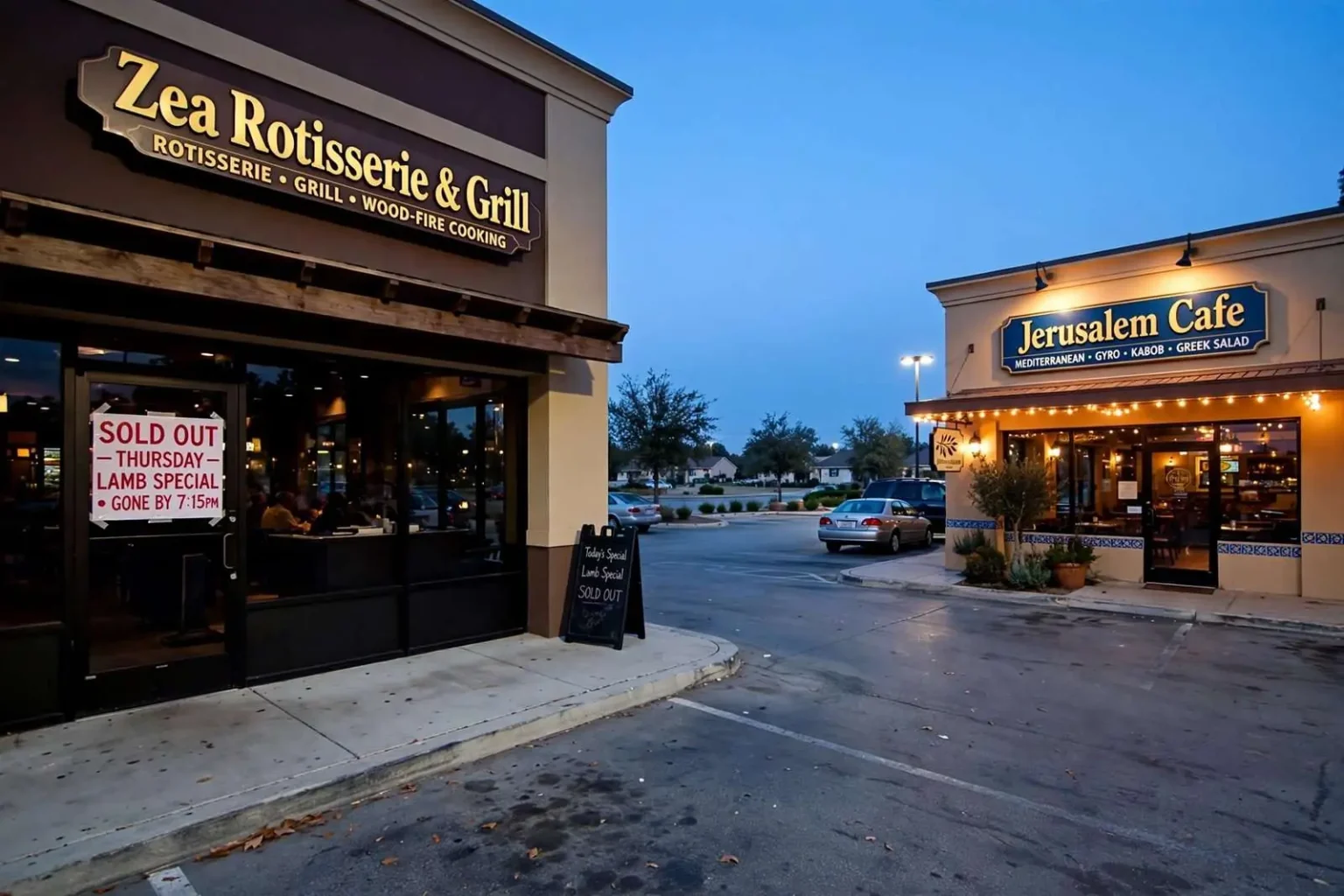
Some of the best restaurant reviews begin with a plan that collapses at the door. In April 2008, a Mobile dining critic writing under a pen name arrived at Zea Rotisserie & Grill with a single objective: the Thursday lamb special, which he had been anticipating for some time. The aroma inside was encouraging — the rotisserie smoke that gives the chain its name was doing its work, and the dining room was running the kind of service a reviewer hopes to find.
He was greeted, seated and approached promptly by a server who delivered the news with what he described as admirable directness. The lamb was gone. It had run out about forty-five minutes earlier. He did what he considered the only honorable thing available to a diner in that situation. He excused himself politely and left.
There is a small ethics to the move that deserves attention. A critic who stays, orders something else and reviews the substitute is no longer reviewing what he came to review; a critic who accepts a comped consolation dish has complicated his own ledger. Walking out to a second restaurant and paying for his own dinner was, in its way, the most honest option on the table, and it set up the evening’s real story — the one across the parking lot.
A short drive, and a Greek salad worth the detour
His destination was just across the parking lot, past two chain restaurants he advised readers to bypass, at the Jerusalem Cafe. He was seated quickly, the server came immediately, and he ordered a lamb kabob with a Greek salad. It was not the meal he had driven out for, but it was the closest thing to it within walking distance, and the Middle Eastern kitchen was the likeliest place in the neighborhood to cook lamb well.
The salad arrived first and rescued the evening. He called it perhaps the best Greek salad in Mobile, a superlative he did not hand out casually, and it disappeared before the entree landed. A critic who spends his weeks sorting competent plates from memorable ones does not distribute “best in the city” lightly, and the verdict put a small neighborhood cafe ahead of every polished kitchen in town on at least one dish.
The lamb, and the letdown
The main dish did not fare as well. Asked about its origin, the server told him the lamb was Arabian. What reached the table was overcooked and dry, with the flavor, in his words, practically nonexistent. The grilled vegetables alongside it were the best thing on the plate. The rice was just okay.
He was careful to frame the failure as a bad night rather than a bad restaurant. The meal, he wrote, was not the quality he normally experienced at Jerusalem Cafe. Every kitchen misses, and a single dry kabob tells a reader less about a restaurant than a reviewer’s history with the place does — which is why he went out of his way to put the disappointment in context rather than let it stand alone.
Still, he had opinions about where better lamb could be found. He directed readers to Zorba the Greek on Hillcrest Road, whose chef he believed did a far better job, and whose Australian lamb he preferred outright to the Arabian lamb he had been served. It was the kind of cross-recommendation that gives local food writing its value: not a verdict on one plate, but a working map of where each kitchen does its best work.
The setting, and the critic’s trade
Zea Rotisserie & Grill was, by the standards of the Mobile market, a polished operation — a Louisiana-born chain built around rotisserie meats, wood-fire cooking and a menu that aimed somewhere between casual and upscale. Its Thursday lamb special had developed exactly the following such specials develop: regulars who plan the week around it. That following is why the sellout mattered. A dish available every day can be missed without ceremony; a dish available once a week, gone by a quarter past seven, leaves its devotees with nothing to do but come back in seven days.
The critic’s pen name, meanwhile, was part of the furniture of the local food page. Writing under one was a tradition borrowed from bigger markets, adopted by smaller papers for the same reason: a reviewer who hopes to get a normal table, a normal bill and a normal plate of food cannot do the job under his own name. The anonymity let the review read the way a dinner actually goes — greetings, orders, disappointments, salvages — without anyone in the dining room performing for the critic.
The geography of the evening deserves its own note. The cluster of restaurants sharing that parking lot was, in miniature, the story of suburban Mobile dining in the years after the malls: national chains gathered at the intersections, with locally owned kitchens tucked into the endcaps and side buildings between them. The critic’s instruction to bypass two chains on the walk over was not snobbery so much as a mapmaker’s honesty — the chains served a purpose, but the reason to cross the lot was the independent place at the end of it.
That Jerusalem Cafe held its own in such company said something about the niche it occupied. Middle Eastern kitchens in the Gulf South have long run on the same fundamentals the critic found that night: quick seating, generous plates, grilled meats over open fire, and salads made to order rather than portioned from a commissary. On the night the review described, the fundamentals held for everything on the table except the lamb itself — the one ingredient the kitchen had not cooked that day to its usual standard.
The friend who was not there
The review’s warmest passage concerned a man who never appeared. Had his friend Nick Coumanis been at the table, the critic imagined, Coumanis would have marched into the kitchen and, in full animation, scolded the chef for desecrating the lamb. But Coumanis was not there, and was most likely at home enjoying whatever Kathryn had prepared for him instead.
It is a small aside, and it carries the flavor of a certain kind of Mobile dining culture, where restaurants are judged not only by their kitchens but by the company you would want beside you when the kitchen falters. Every longtime diner has a friend like this — the one who treats a bad plate as a personal affront and a kitchen’s honor as something worth defending — and naming him in print is its own compliment: the reviewer is telling readers that the meal was short the person who would have made it an occasion.
Salvaged by the chicken
The evening was rescued a second time. His dining companion ordered the chicken kabob and could not finish it. Describing himself as a generous and benevolent soul, he politely consumed the remainder, and found it delicious, seasoned just right and remarkably tender. It was, he wrote, a consoling finish to a disappointing lamb experience.
Next time, he would order the chicken. That is how the practical arithmetic of a neighborhood restaurant actually settles in a diner’s mind: one bad dish does not close the account, it just revises the order. The chicken kabob, seasoned well and grilled to tenderness on the same night the lamb failed, was the evidence the critic needed that the kitchen knew what it was doing.
The verdict
Would he return to Jerusalem Cafe? Yes, without hesitation. It was usually a very good place to dine, he wrote. Just not that night, and not for anyone who ordered the lamb kabob. A review that ends with a standing reservation is, on balance, a positive one — the failure was specific, dated and priced, and the recommendation against it was narrowly drawn.
As for the meal he had actually set out to eat, he intended to wait for Thursday to come around again, and he expressed a modest hope that Zea’s management would plan more carefully for its next lamb special. Running out of the featured dish forty-five minutes into the evening is the kind of inventory failure that costs a restaurant its most motivated customers — the ones who plan their week around a special — and he noted it without rancor, as a suggestion rather than a complaint.
He promised to report back.
The episode captures something true about restaurant criticism at the neighborhood level. A single dry kabob does not end a relationship with a restaurant. It simply reorders the menu for next time, and the diner returns, having learned something.
What the reader takes away
Read as a whole, the review told its readers three things worth acting on. The best Greek salad in town was being made in a storefront cafe, not in a chain kitchen. The lamb kabob there was a risk that particular week, and Australian lamb done by a particular chef across town was the surer bet for the cut. And the chicken kabob was the dish to order on a return visit. That is more practical guidance than most reviews deliver, and it came out of a dinner that, by the critic’s own account, failed at its center.
The lesson generalizes beyond one parking lot. Local restaurant criticism at its best functions as a running conversation between a city and its kitchens — forgiving enough to keep the relationship going, specific enough to be useful next Thursday. The critic who left Zea hungry, crossed the lot, ordered carefully and came back to write it all down was doing exactly that work, one Thursday at a time.