University of South Alabama Dauphin Island
For Dauphin Island’s Mayor, Hurricane Frederic Set a Course That Still Guides Him
Hurricane Frederic in 1979 derailed Jeff Collier's college plans, keeping him on Dauphin Island and eventually leading him to become its longtime mayor.
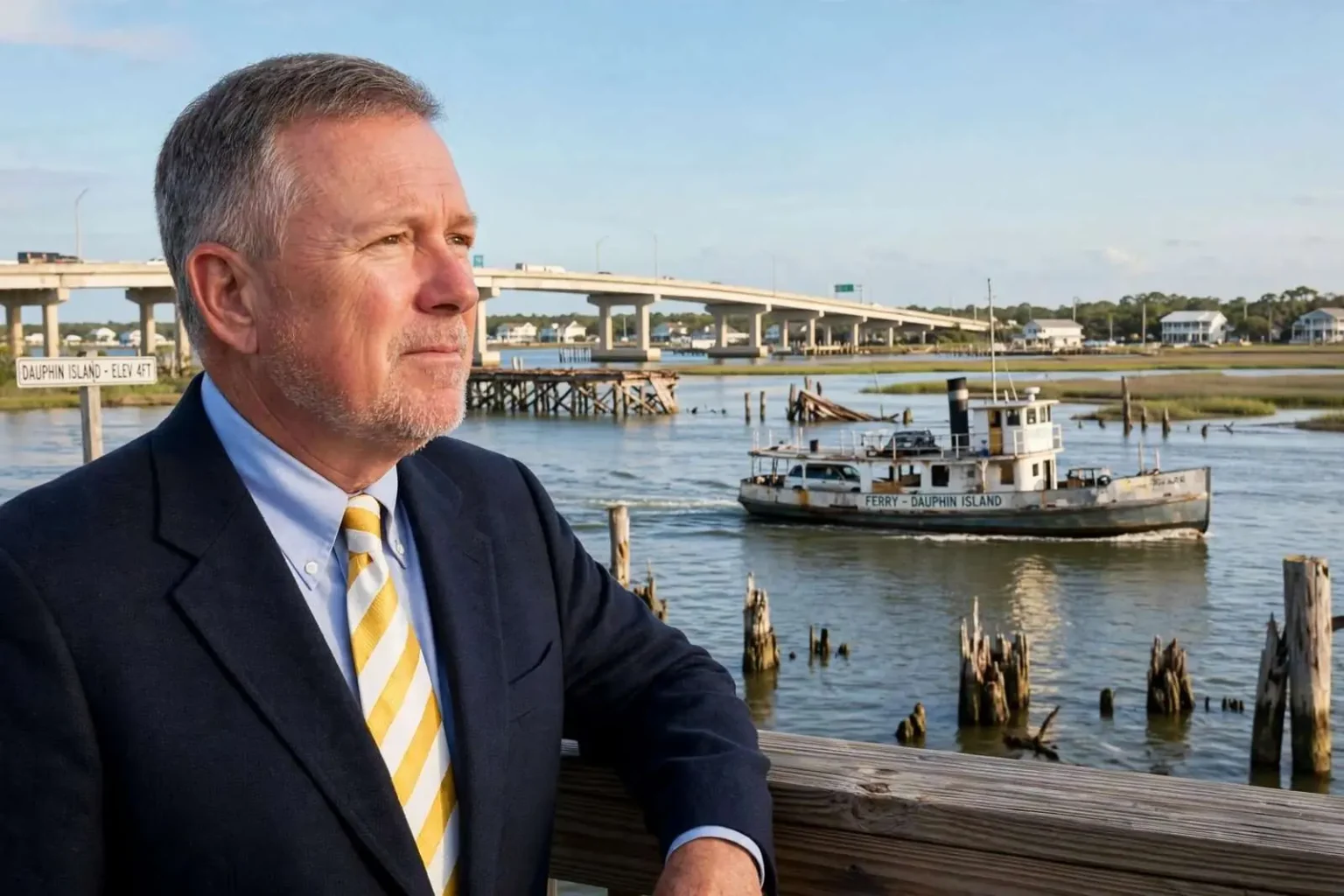
Dauphin Island Mayor Jeff Collier says he can trace the entire shape of his adult life back to a single storm. In September 1979, Hurricane Frederic tore through the Alabama coast just as Collier, a fresh high school graduate, was preparing to leave for the University of South Alabama. Instead of moving into a dorm, he found himself standing in the wreckage of his family’s business, wondering how long it would take the island to recover. The decision he made in those days — to stay and rebuild rather than leave for school — set the course for everything that followed.
“The biggest hit was the bridge,” Collier has recalled of the storm’s aftermath. With the only span connecting Dauphin Island to the mainland destroyed, he faced an immediate choice: head off to college as planned, or stay behind to help his parents put the Dauphin Island Golf Course and their storm-damaged home back together. He chose to stay, delaying his enrollment by what he assumed would be a matter of months. It turned out to be three years.
Frederic remains one of the defining storms in Alabama’s recorded history. It came ashore in September 1979 as a major hurricane, lashing Mobile Bay and the barrier islands with winds that flattened homes, stripped forests across south Mobile County and knocked out power for weeks. At the time it ranked among the costliest hurricanes in American history, and along the Gulf Coast its name still stands for a particular kind of upheaval — the storm that taught the region what a modern hurricane could do.
An island cut off
Rebuilding the bridge took far longer than anyone expected, and in the meantime islanders had to reorganize their entire way of life around a ferry system. The first car ferry could haul only 20 to 25 vehicles at a time, with a one-way trip lasting roughly two hours. Miss the boat, and the wait for the next one could stretch to four hours. As a result, most residents crossed to the mainland sparingly, sometimes only once every week or two, planning trips with military precision.
For three years, that ferry schedule was the island’s lifeline. Groceries, fuel, medical appointments and school logistics all bent around the crossings. Workers commuted on the boats when they had to, and families learned to keep spare parts, canned goods and patience on hand. An island that today is a quick drive over the Gordon Person bridge and causeway from the mainland was, in those years, effectively a day trip for anything essential.
The lesson stuck with a generation of islanders. Before Frederic, the bridge was simply infrastructure. After it, residents understood in their bones that the span was not a convenience but the island’s connection to everything — hospitals, hardware stores, jobs and family on the mainland. That understanding has shaped how Dauphin Island has argued for its causeway and bridge ever since.
Generators, ice cream and getting by
Electricity was another challenge. Alabama Power trucked in room-sized generators and staged them near Ben Buerger’s Ship and Shore store, a modest market that Collier credits with holding the island community together during those lean years. Because the store carried basic supplies, fewer people needed to make the long ferry crossing just to shop. When a cooler was eventually added, Collier remembers it as a genuine luxury. “It was a luxury to get a cold drink or ice cream,” he has said of those days.
The detail says something about how recovery actually works on a barrier island. Power restoration after a major hurricane follows a triage logic — hospitals, shelters, mainland neighborhoods first — and a community at the end of a damaged causeway can wait a long time. Portable generators bridged the gap, but only for those who could reach them, and the store that kept them running became, for a while, the center of daily life.
Those years also built the habits that barrier-island communities still rely on. Neighbors checked on neighbors before anyone was asked to. Boaters and ferry crews improvised supply lines. Families measured recovery not in headlines but in milestones — power restored, the store restocked, the bridge reopened. For Collier, watching his parents hold a small business together through all of it was a practical education no classroom was offering that fall.
The bridge comes back
Traffic finally returned to a rebuilt Dauphin Island Bridge in July 1982, nearly three years after Frederic hit. By then, the storm had already reshaped Collier’s path. He went on to work in the golf industry through the PGA program, and in 1988 he won a seat on the Dauphin Island town council. A decade later, in 1998, he was elected mayor for the first time, a post he has held for decades since.
The rebuilt span carried more than cars. It carried the island’s recovery, and it set a benchmark that residents and officials have measured later storms against. When subsequent hurricanes have knocked out the bridge or buried the causeway in sand, the memory of the Frederic years — the ferries, the generators, the two-hour crossings — has informed how quickly the town pressed for restoration and how islanders prepared to be cut off again.
Collier’s route to the mayor’s office ran through those years in another way too. A man who spent his twenties helping put his family’s business back together learned where the island’s vulnerabilities were and who could be counted on. That network of neighbors, business owners and longtime residents became the base of a civic career that has now spanned town council and decades in the mayor’s office.
A mayor shaped by the storm
Looking back, Collier doesn’t describe the hurricane as simply a disaster he survived. He describes it as the event that set the direction of his entire career and civic life. Had the bridge not gone down, he says, he likely would have left for college on schedule and never returned to serve the island in local government. Instead, the storm tied him permanently to the place he now leads, a connection that residents say has shaped decades of decisions about how Dauphin Island prepares for, and recovers from, the next big storm.
That preparation matters on an island that sits directly in the path of Gulf hurricanes. Dauphin Island has been struck or brushed by repeated storms since Frederic, including Hurricanes Elena, Georges, Ivan and Katrina, each of which tested the island’s beaches, homes and the connection to the mainland. Every rebuilding effort since has carried the memory of 1979, when the island learned how long the road back could be.
Under Collier’s tenure, the town has pressed state and federal partners on coastal restoration, dune rebuilding and the island’s long-term vulnerability — the same issues, in modern form, that a young graduate confronted standing in his family’s wrecked business. The mayor who watched a community hold itself together for three years without a bridge has spent his career arguing that the island is worth the investment it takes to keep it whole.
What Frederic left behind
The storm’s legacy along the Alabama coast extends beyond one island. Frederic reshaped building codes, spurred the modernization of emergency management and left a generation of Gulf Coast residents with a lasting respect for hurricane season. On Dauphin Island, it produced something more personal: a community narrative in which the bridge, the ferries and the store with the cooler feature as the landmarks of a shared trial.
For Collier, the story ends where it began — with a choice. Three years of ferry schedules and generators turned a temporary delay into a permanent home, and the island got, in the process, a mayor whose understanding of storms is not academic. When he talks about recovery timelines, evacuation logistics and the value of a working bridge, he is speaking from a September afternoon in 1979, standing in wreckage, deciding to stay.
The story also explains why the mayor’s voice carries weight when coastal policy is debated in Montgomery and Washington. Officials who lived through Frederic tend to talk about disaster recovery differently than those who studied it, because they know the difference between a recovery that is announced and a recovery that is actually felt on a street where people live. Collier’s account — the ferry math, the missing ice cream, the three-year wait — is the kind of testimony that budget hearings rarely capture but that residents recognize instantly.
It is a reminder, too, of how barrier-island life differs from mainland life even in ordinary times. Everything on Dauphin Island arrives over a single road, and everything the island needs in a crisis leaves the same way. A community that has once spent three years organizing its life around a boat does not forget the arithmetic, and its leaders do not stop doing it.
Forty years on, the hurricane that kept a teenager off the bus to college remains the reference point for how Dauphin Island measures its own resilience. The rebuilt bridge stands as the physical proof that the island came back. The mayor stands as the personal one — a man whose career in public service began the night the water went down and the only road out was gone.