R & R Seafood Was Written Off by a Reliable Source. The Crawfish Said Otherwise.
A Causeway seafood market that became a restaurant after Katrina exceeded low expectations, with boiled crawfish cooked just right and a shrimp poorboy on New Orleans bread.
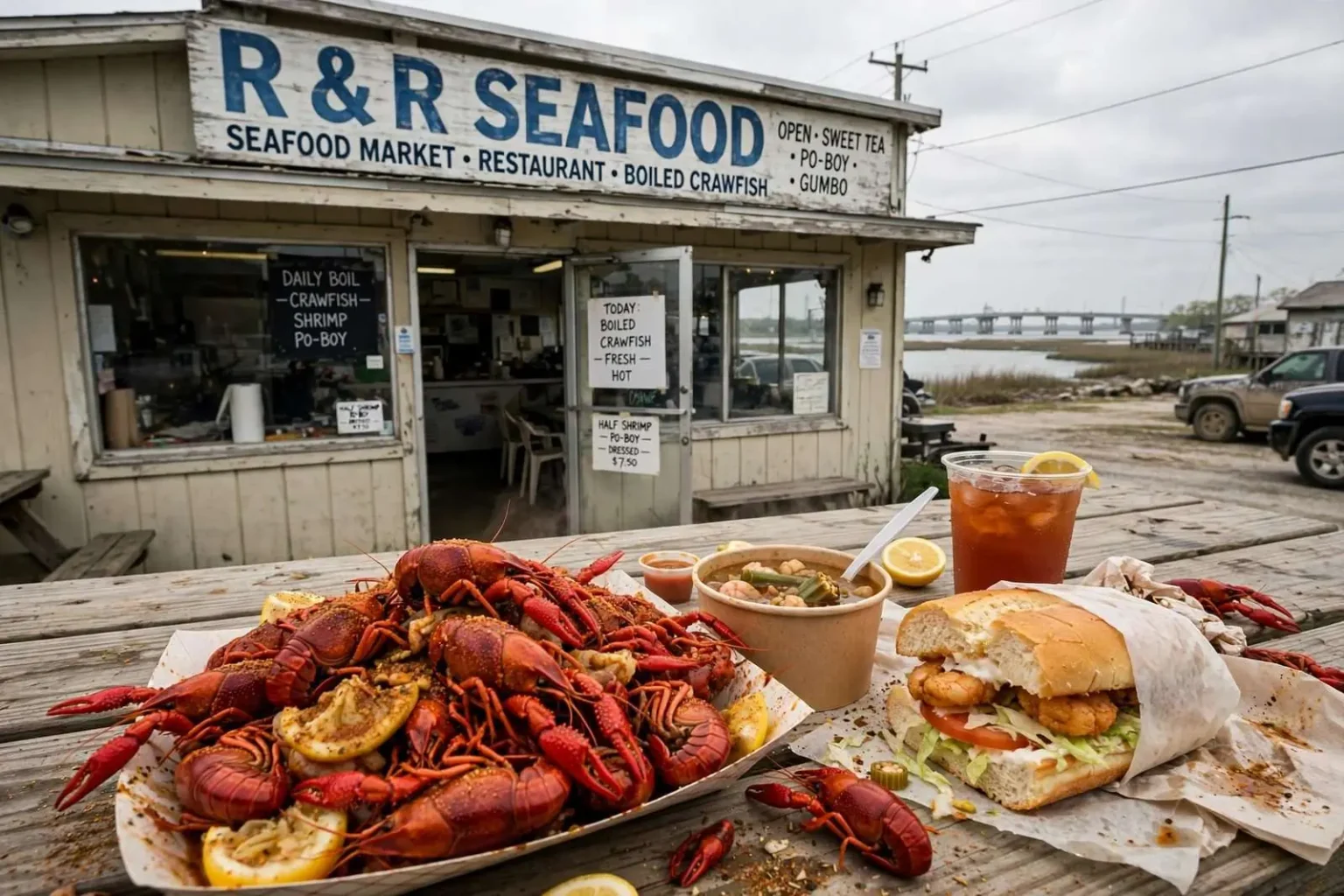
An anonymous dining correspondent walked into R & R Seafood on the Causeway in the spring of 2008 expecting very little. He had been told by what he described as a reliable source that the place was a mediocre seafood restaurant that probably would not last long. He left, he confessed, impressed. With all due respect to his source, he wrote, the source had missed this one.
The Causeway, formally known as the Bankhead Tunnel approach and the older Cochrane-Africatown USA Bridge corridor, runs across the upper reaches of Mobile Bay and serves as the working waterfront’s spine. Seafood markets and oyster houses have lined it for generations, supplying restaurants across Mobile and Baldwin counties. R & R had occupied a spot on that road for a while, but only as a seafood market. It emerged as a restaurant in the years after Hurricane Katrina, one of the small transformations that reshaped the food economy along Mobile Bay after the August 2005 storm, as businesses that had previously sold raw product to other people’s kitchens began cooking it themselves.
From market to restaurant
The company’s website promised that from the moment a customer walked through the door, the senses would be delighted. Our critic, who normally treats such lines with the skepticism they deserve, found the claim accurate. What greeted him at the door was the smell of boiling crawfish and frying seafood, two distinct smells layered one on top of the other, an honest introduction to what the kitchen was doing that afternoon. He took it as a good sign.
The dining room was spare and functional rather than decorative. Tables were covered in plain paper, the kind that signals a working seafood house rather than a destination restaurant. The waitstaff moved with the quick, slightly distracted manner of a place that knew how to turn tables. He sat down, ordered a sweet tea, and waited to see what the kitchen would produce.
The gumbo, again
He was in the middle of a long-running survey of the region’s gumbos, and R & R’s went into the ledger as average. The roux was dark and the portion was generous, but the depth he had learned to look for at the better seafood houses was not quite there. He rated it below Bluegill’s, a longtime benchmark on the Causeway, and well above the versions he had endured at Ed’s, the Captain’s Table and Oysterella. Felix’s, he promised, would get its own verdict later.
Alabama-style seafood gumbo is its own subgenre, separate from the Cajun versions found across south Louisiana. The local tradition begins with a dark roux, often chocolate brown, into which goes a Holy Trinity of onion, celery and bell pepper, then a thin river of stock, then okra or filé powder or neither depending on the cook. The best versions on the Causeway include a layer of crab and sometimes shrimp, and a careful balance of heat from cayenne or hot sauce that should arrive late rather than early. R & R’s cup had the right color and the right heat, he noted, but the seafood flavor that distinguishes the better pots was muted. He wrote it up without bitterness, but also without praise.
The poorboy
He ordered the half shrimp po-boy, dressed, which came with the cup of gumbo. At R & R it is advertised and sold as a poorboy, a spelling variation our critic noted without objecting to. The dish is a New Orleans export that found a permanent home along the Gulf Coast after the post-Katrina diaspora, when restaurants from New Orleans and the surrounding parishes opened or relocated up the highway through coastal Mississippi and into Mobile.
Whatever the sandwich was called, it was good. The bread had the qualities that matter most: a crunchy crust and a soft interior. The server did not know the brand but volunteered a fact that explained a good deal. We get our bread and our crawfish from New Orleans, she said. The use of New Orleans-style loaves is what distinguishes a real po-boy from the dressed-sub routine found at most quick-service restaurants, and the connection to a working bakery on the other side of the Gulf is what keeps the sandwich honest.
There was an abundance of shrimp on the sandwich. They were not seasoned quite the way our critic prefers, and they were slightly over-fried. He likes fried shrimp to come out of the grease golden rather than brown, and these were on the brown side. But they were good nonetheless, and he said plainly that he would order the sandwich again. The lettuce, tomato and mayo that came with the dressed version were fresh, the proportions were right, and the gumbo cup on the side turned the plate into a small meal.
The crawfish
Then came what he called the coup de grâce, and what had drawn him in from the parking lot in the first place. He ordered a few boiled crawfish. The crawfish arrived at the table in a paper tray, piled high, bright red from the boil and dusted with the traditional dusting of seasoning that any Gulf Coast crawfish lover recognizes. He cracked the first one, sucked the head, and sat back.
Crawfish season along the Gulf Coast runs roughly from late December through early July, with the peak months for the local catch falling between February and May. Louisiana produces the vast majority of the crawfish eaten in the United States, and a great deal of what is served in Mobile and Baldwin county restaurants is trucked in from the Atchafalaya Basin and the ponds around Henderson, Breaux Bridge and Eunice. The boil is the same in any good kitchen: live crawfish, a heavy hand with cayenne, garlic, lemon and a powder blend that often includes Zatarain’s and a house mix, and a steeping period long enough to let the seasoning penetrate the shell.
His crawfish were fat, which suggested they had been bought late in the season when the catch is at its peak. The seasoning was balanced, with heat that built across the tray rather than arriving all at once. He ate his way through the pile slowly, the way a person eats crawfish when the crawfish are worth eating, and emerged from the meal with stained fingers and a clear opinion. The crawfish, he wrote, were the reason to drive to the Causeway.
What it added up to
He left R & R Seafood convinced that his source had been wrong. The gumbo was a pass, the po-boy was a buy, and the crawfish were a destination. He filed the visit in his ledger under places he would return to, and he noted in his column that the Causeway continued to do what it had always done: surprise diners who came looking for one thing and found another.
For Mobile diners, R & R sits in a stretch of road where seafood restaurants rise and fall with the tides and the price of shrimp. The places that endure are the ones that respect the product and know how to boil a crawfish. R & R, on this spring afternoon in 2008, belonged on that list. With all due respect to his source, our critic wrote, you missed this one.
A note on the Causeway seafood economy
The strip of road that locals call the Causeway was rebuilt several times after Katrina, and each rebuild drew a different mix of restaurants. Some of the older oyster houses reopened within months. Others sold their leases and let a new generation take over. R & R Seafood was part of that newer generation, a market that decided to add a dining room and a kitchen rather than rely on the wholesale business alone.
The shift from raw to cooked is a story that has played out across coastal Alabama. A seafood market that survives on its wholesale accounts will often find that the retail counter and the dining room become a more stable source of revenue as the restaurants that once bought from it open their own fish counters. The smartest operators respond by opening their own kitchens and turning the product into the meal. R & R was one of the smartest, our critic suggested, and the crawfish were the proof.
For anyone visiting the Causeway in the spring and early summer, the practical lesson was simple. Walk in without high expectations. Order the crawfish. Eat them slowly. The gumbo is a side note and the po-boy is a reliable second choice, but the crawfish are what the place is built to do, and on the day our critic visited, they did it well, the way the best Gulf kitchens always have done it.