The Pink Motel That Guided Shrimpers Home: Remembering Dauphin Island’s Moulin Rouge
Before the bridge, Dauphin Island was a village of 200 with goats in the trees and cattle on the beach. A B-24 pilot named Aubrey Bishop built its first motel there, painted it bright pink, and shrimpers used it to find shore.
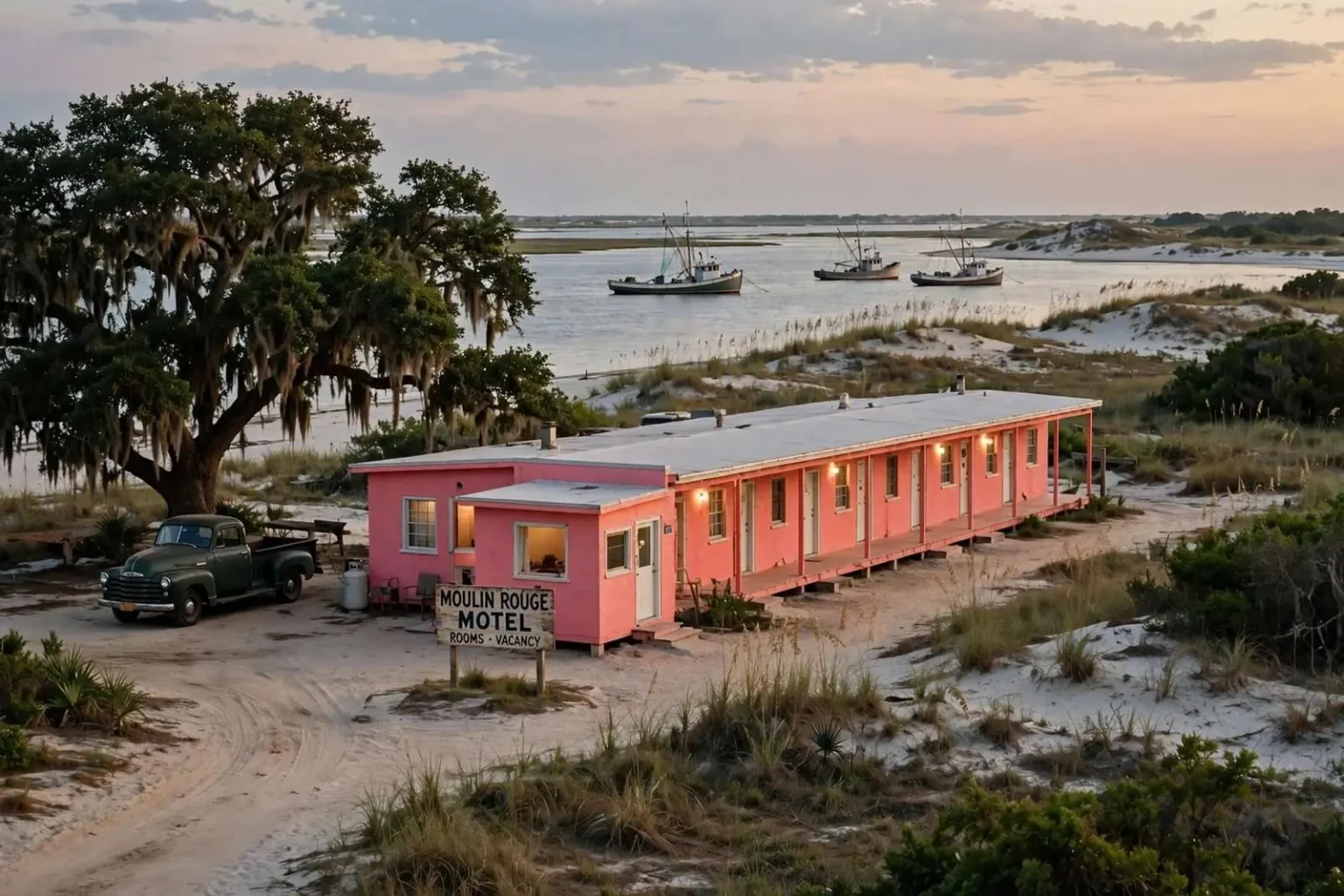
Dauphin Island in the early 1950s was not the place it is today. There were roughly 200 residents, no bridge, and no particular urgency about any of it. Villagers reached Mobile by boat when they needed to and returned when they were finished. Sand dunes stood as tall as houses. Goats nested in low-hanging tree limbs. Cattle wandered the town and the beach. Into that landscape came Aubrey Alison Bishop Jr., a pilot, and by every account an exceptional one. He flew B-24s in World War II and later operated reconnaissance aircraft along the East German border during the Korean Conflict. He flew fixed-wing planes and helicopters with equal ease. He also built Dauphin Island’s first motel, and he painted it bright pink.
The island’s isolation defined its character. Before the Dauphin Island Bridge opened in 1955, the only connections to the mainland were by private boat, the occasional barge, and the ferry that ran from Cedar Point when weather and tides permitted. The island’s 200 residents — shrimpers, oystermen, a handful of merchants, and the families of Coast Guard personnel stationed at the lighthouse and the Loran station — lived a life governed by the Gulf’s rhythms. Electricity had arrived only in the late 1940s, brought by submarine cable from the mainland. There was no paved road the length of the island; Bienville Boulevard was a shell-and-sand track that disappeared into the dunes at the western end. Water came from shallow wells and cisterns. Sewage was handled by septic systems that the sandy soil barely filtered before it reached the Sound.
The Moulin Rouge
Bishop named the motel after the Parisian cabaret. “Daddy was fond of Paris, which he saw during the war,” says his daughter, Sherry Bishop. The building held seven rooms. Two were for the family, one for Aubrey and his wife Doris, and one for the children, Sherry, Ava and Aubrey III. The remaining five were rented to guests. The family spent summers on the island and the rest of the year at their home in Mobile. Located on the island’s west side, the Moulin Rouge turned out to serve a second, entirely unintended function. “Shrimpers used to tell us, when they were offshore, the one thing they could spot was that blip of pink on the sand,” Sherry recalls. “When they found the shoreline’s pink dot, they knew where they were.” A seven-room motel had become a navigational aid.
The choice of pink was practical as much as aesthetic. The Gulf Coast’s intense sunlight bleaches most paint colors within a season or two, but the particular shade of coral-pink Bishop chose — a marine-grade enamel formulated for offshore structures — held its vibrancy against salt spray and UV exposure. Shrimpers returning from the fishing grounds 20 to 30 miles south of the island, often in darkness or fog, could pick out the pink rectangle against the white sand and green scrub long before they could make out the lighthouse beam or the channel markers. The motel sat on a slight rise just west of the main pass, positioned so that its color flash was visible from the approaches to both Mobile Bay and the Mississippi Sound.
Landing an Airplane Wherever He Pleased
Bishop worked at Brookley Air Force Base before the war and returned afterward as superintendent of aircraft, staying until the base closed in 1969. Getting to an island with no airport required improvisation, and he was equal to it. He landed his L-19 Bird Dog on the Dauphin Island Bridge while it was still under construction, for no reason other than that he wanted to. Later he landed a helicopter on it, dropping his children off for school in Mobile when the ferry wasn’t running. He once set a Piper Cub down on the hard-packed sand of the west end at low tide, taxied to the motel, and parked it under the live oaks beside the office.
Brookley Field, later Brookley Air Force Base, had been Mobile’s economic engine since its establishment in 1939. At its peak during the Korean War, it employed 17,000 civilians and military personnel, overhauling B-29s, B-47s, and later C-130s. Bishop’s role as superintendent of aircraft placed him at the center of the base’s flight operations — he coordinated test flights, managed the transient alert force, and oversaw the maintenance scheduling for the depot’s assigned aircraft. His reputation for unconventional flying was known across the Gulf Coast aviation community; stories circulated of his landing a T-33 on the beach at Grand Lagoon during a fuel emergency, of his flying a helicopter through the eye of Hurricane Camille in 1969 to assess damage to the base’s runway lighting.
The bridge landing stories, while spectacular, had a practical basis. The Dauphin Island Bridge, a 3.2-mile structure of concrete spans and a central bascule section, was the largest construction project in Mobile County’s history when it began in 1953. Bishop, consulting on the project’s aviation safety aspects, argued that the bridge’s alignment created a natural visual corridor for pilots approaching the island from the north. His demonstration landings — first the L-19, then a Bell 47 helicopter — proved the concept and led to the inclusion of a lighted helipad on the bridge’s eastern approach, used for medical evacuations until the island’s own helipad was built at the fire station in the 1980s.
The motel’s role as a navigational landmark became part of the island’s oral history. Shrimpers told their sons, and their sons told theirs: “Look for the pink motel, then turn north for the pass.” The Coast Guard, in its Local Notice to Mariners, never charted the Moulin Rouge as an official aid to navigation, but the pilots of the Mobile Bar Pilots Association — the federally licensed mariners who guide ships through the Mobile Ship Channel — included it in their informal briefings for captains making their first approach to Mobile Bay. “It was more reliable than some of the lighted buoys,” one pilot recalled. “The buoys drift. The motel didn’t move.”
Dauphin Island’s shrimping fleet in the 1950s and 1960s numbered roughly 80 vessels, mostly 45-to-60-foot wooden-hulled trawlers with diesel engines and iced holds. They worked the grounds south of the island — the “Snapper Banks,” the “Trysler Grounds,” the “Lumps” — areas where the continental shelf drops in steps that concentrate shrimp and groundfish. Trips lasted three to seven days. The boats carried no GPS, no Loran-C (the system was still experimental), no radar on most vessels. Navigation was by compass, lead line, fathometer, and the memorized landmarks that defined the coastline: the Sand Island lighthouse, the Cargill grain elevator in Theodore, the smoke stacks of the International Paper mill in Mobile, and, for the last few miles, the pink motel on the west end.
The Bridge Changes Everything
The Dauphin Island Bridge opened in July 1955, a two-lane toll span that connected the island to the mainland at Cedar Point. The toll — 50 cents each way for a car, $1.50 for a truck — was collected at a booth on the island side. The bridge transformed the island’s economy. Tourists from Mobile and Pensacola could drive to the beaches for a day trip. Developers subdivided the east end into lots for summer cottages. The permanent population began to grow, reaching 500 by 1960 and 1,200 by 1970. The ferry stopped running. The island got a paved road, a modern water system, a volunteer fire department, and eventually a school.
For the Moulin Rouge, the bridge brought more guests but diminished its navigational importance. Shrimpers now had Loran-C, then GPS, then chartplotters with integrated radar overlay. The pink motel remained a visual confirmation, but no longer a primary fix. Bishop sold the property in 1978 to a developer who renamed it the “Islander Inn” and painted it beige. The pink was gone. The shrimpers complained. The new owner, hearing the stories, repainted it pink within a month. “It’s not just a color,” Sherry Bishop said later. “It’s a promise. You see it, you know you’re home.”
A Legacy in Pink
Aubrey Bishop died in 1992. Doris died in 2001. The motel changed hands several times — Hurricane Frederic in 1979 took the roof, Hurricane Ivan in 2004 took the first floor, Hurricane Katrina in 2005 took what was left. Each time it was rebuilt, the pink returned. The current structure, a two-story, 12-unit building on pilings 14 feet above sea level, wears the same coral-pink enamel. It is no longer the island’s only motel — the east end has condominiums, the west end has vacation rentals — but it remains the one that shrimpers point to when they teach their grandchildren the way in.
Dauphin Island today has roughly 1,800 permanent residents, a bridge that carries 1.5 million vehicles a year, a marine science campus operated by the University of South Alabama, a bird sanctuary that draws birders from across the continent during spring migration, and a ferry that runs again — this time from Fort Morgan, carrying tourists to the island’s beaches and the historic Fort Gaines. The sand dunes are lower now, stabilized by sea oats and engineering. The goats are gone. The cattle are gone. But the pink motel endures, a small bright rectangle on the west end, still guiding the boats home.