Fairhope’s Panini Pete Wins Liquor License for New Sunset Pointe Restaurant at Fly Creek Marina
Fairhope chef Pete Blohme got council approval to open Sunset Pointe, a new restaurant replacing the shuttered Fly Creek Cafe at Fly Creek Marina.
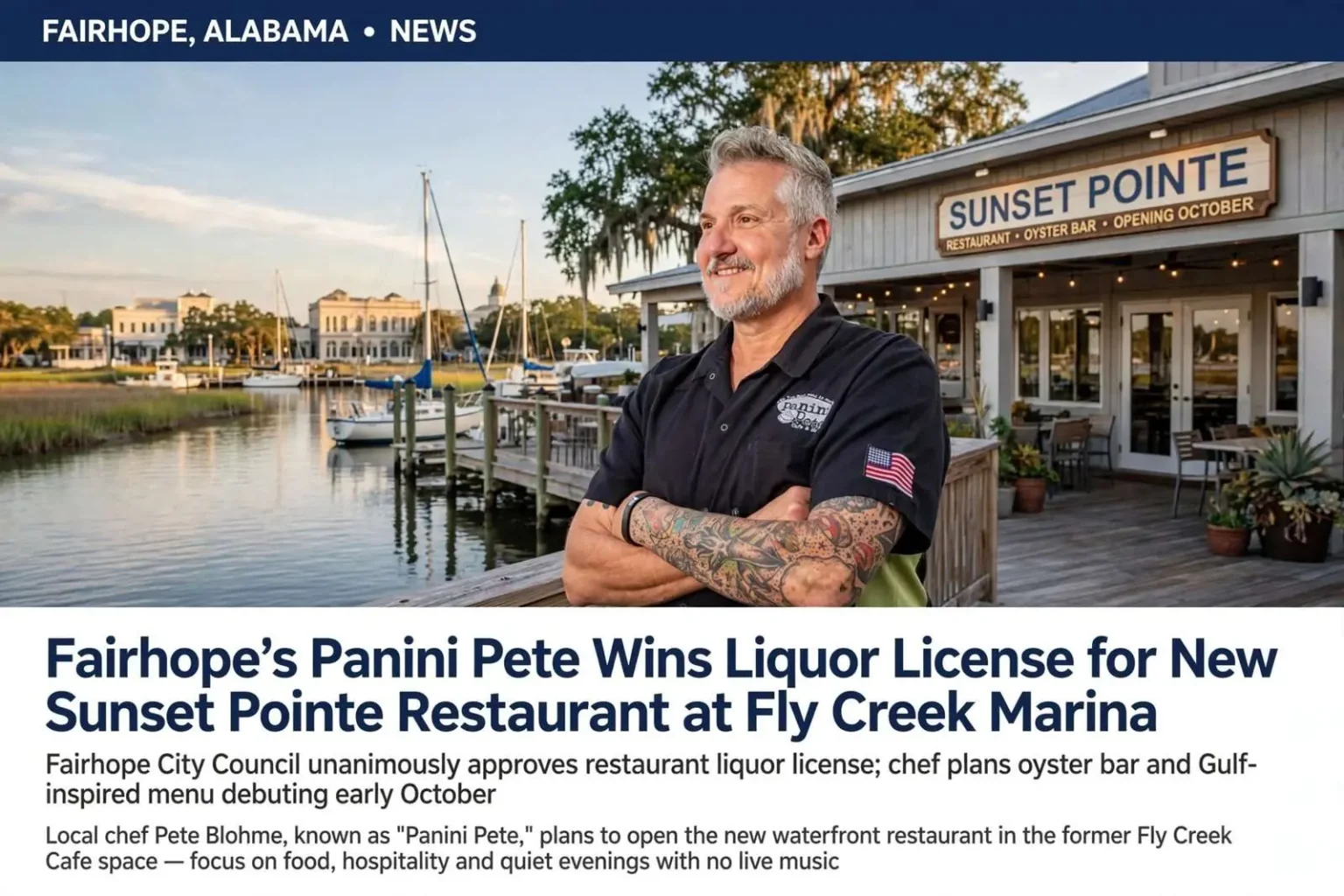
FAIRHOPE, Alabama — Local chef Pete Blohme, better known around the Eastern Shore as “Panini Pete,” is preparing to open a new restaurant called Sunset Pointe at Fly Creek Marina, taking over the space once occupied by the shuttered Fly Creek Cafe on North Section Street.
The project ties one of Fairhope’s best-known culinary names to one of its most scenic — and most contested — waterfront corners. Fly Creek Marina sits on the tidewater just north of downtown, where the creek widens toward Mobile Bay and sailboats fill the slips a few minutes’ walk from the shops of the French Quarter district. A restaurant at the marina inherits both the view and the history of a site that has produced some of the city’s most contentious public meetings.
Council Approves Liquor License
The Fairhope City Council voted unanimously this week to approve a restaurant liquor license for the new venture. During the discussion, Councilman Mike Ford raised the site’s history of noise ordinance complaints and asked whether Blohme planned to bring live entertainment to the location. Blohme said no, telling the council with a laugh that he had tried to book high-profile acts for opening night but couldn’t land anyone loud enough to matter, before making clear his real plan is to keep the focus on food, hospitality and the marina’s water views rather than live music.
The license vote is the hinge that turns a lease into a restaurant, and the unanimous outcome signaled how much goodwill the chef carried into the room. Restaurant liquor licenses in Alabama cities give the council discretion, and applicants with a history of complaints can face pointed questioning. Blohme faced the noise question directly and answered it with the same disarming humor that has made him a fixture on the Eastern Shore dining scene — while making a commitment that the marina’s evenings would be quieter than its past.
A Location with a Complicated Past
The site carries some baggage from a contentious 2011 fight over the city’s noise ordinance, a dispute rooted in neighbors’ complaints about the previous restaurant at the location. That earlier business, Fly Creek Cafe, closed in October 2012 amid a bitter lease dispute. Stricter noise limits passed by the council at the time were vetoed by Mayor Tim Kant, leaving the current standard at 85 decibels during the day and 65 decibels after 10 p.m. — well above the roughly 50 decibels of a normal conversation.
The fight over those decibel numbers divided the town for months. Residents who lived near the marina and downtown’s music venues argued that late-night sound carried across the water and through the neighborhoods in ways the old ordinance never anticipated; musicians, bar owners and their patrons countered that a walkable, lively downtown was part of what made Fairhope Fairhope. The council passed tighter limits, the mayor vetoed them as too restrictive, and the compromise that remained — 85 decibels by day, 65 after 10 p.m. — has governed the marina district ever since. For reference, the numbers describe the difference between a busy street and a library-quiet room, and measuring them at property lines became the era’s recurring courtroom science.
One council member floated the idea that live music could return to the marina if the noise ordinance is loosened in the future, a comment that visibly caught other council members, including Council President Jack Burrell, off guard. The remark showed how raw the old dispute remained, even as the city welcomed a new tenant whose plans — by his own account — contained no stage at all.
A Local Chef with a National Profile
Blohme has run the popular Panini Pete’s Cafe and Bakeshop in Fairhope’s French Quarter since 2006 and opened a second location in downtown Mobile in 2011. His food has drawn national attention through appearances on Food Network programs including “Diners, Drive-Ins and Dives” with Guy Fieri.
The tiny cafe tucked into the Fairhope’s French Quarter streetscape became an unlikely landmark: a pressed-sandwich counter whose beignets and muffuletta-style panini drew lines on weekends and pilgrims from across the region after the Food Network cameras visited. For Fairhope, the national exposure was worth more than any marketing campaign — a small town on the Eastern Shore shown to a national television audience as a destination worth the drive. Blohme’s second location, on Dauphin Street in downtown Mobile, extended his reach across the bay and proved the concept could travel.
Blohme has also spent recent years traveling with a group of chefs who call themselves the “Messlords,” cooking for U.S. troops stationed at military bases in places like Japan, Djibouti and Guam. The volunteer trips take civilian cooks into mess halls on remote installations, where a familiar plate of food from home carries more weight than any menu innovation. The experience shaped the chef as much as any kitchen, he has said, and the flavors he encountered — Gulf-meets-global seasoning, seafood prepared with influences picked up halfway around the world — are expected to inform the new restaurant’s menu.
A Different Kind of Seafood Menu
At Sunset Pointe, Blohme said he wants to steer away from the fried seafood already common throughout the area and instead lean on techniques and flavors he picked up cooking overseas. The menu is expected to include an oyster bar along with what he described as good quality, regionally inspired dishes, plus a solid drink selection.
The positioning is a deliberate bet on the Eastern Shore’s maturing palate. The coast’s seafood houses have long built their reputations on platters — fried shrimp, fried oysters, fried fish with hushpuppies — and they do it well. But Fairhope’s diners, who support a downtown full of independent kitchens, have shown a growing appetite for seafood treated with lighter hands: raw bars, grilled catch, Gulf oysters dressed with more than cocktail sauce. An oyster bar overlooking the marina, where the day’s shells come across the counter shucked to order, gives Sunset Pointe a centerpiece that few restaurants in the area can match for freshness or setting.
The drink selection matters in a building whose past life was defined, fairly or not, by noise. A well-built beverage program and a food-first identity give the marina venue the atmosphere of a neighborhood gatherer rather than a nightlife destination — the precise distinction the council’s noise debate has turned on for years.
Renovation and Opening Timeline
Renovation work on the marina building was underway as of early September, with Blohme targeting an early October opening and telling the council he wants the restaurant to make both his hometown and Fairhope proud.
The compressed timeline — roughly a month from mid-renovation to opening night — is characteristic of the pace at which the chef has always worked. The building itself needs a new identity after years vacant, from kitchen equipment to dining room finish, and waterfront work carries its own wrinkles: humidity, salt air and the wear of a location at the end of a causeway lane. Early October would land the opening at the start of the Eastern Shore’s most reliable season, when fall festivals bring crowds to Fairhope’s streets and the marina’s evening weather is at its best.
Neighbors who weathered the old fights will watch the first months closely, and Blohne’s pledges to the council — no live entertainment, food and hospitality as the focus — will be the standard against which the restaurant is measured. If the early October opening goes as planned, Fairhope’s marina gets a second culinary life: this time, built to be tasted rather than heard.
The restaurant also rounds out Blohme’s Fairhope footprint, but the significance runs deeper than one kitchen. Small waterfront cities live and die by the health of their marinas, and a working restaurant at the head of Fly Creek gives boat owners a destination, visitors a reason to linger and the city a taxpaying tenant in a building that had sat dark for nearly a year. Marina restaurants, when they succeed, become the kind of unofficial harborside institutions that define a town’s postcard image; Fairhope already has the pier, the shops and the bluff, and a settled, successful restaurant at the marina closes the loop between downtown and the water.
The unanimity of the council vote will be remembered as the moment the marina’s noise wars finally gave way to something more productive. Ford’s question gave the old complaints their day in the light; Blohme’s answer — food first, no stage — and his track record gave the neighbors what no ordinance revision had delivered: a specific operator with something to lose, promising a quieter room.
For a chef who built a national following on pressed sandwiches and powdered sugar, Sunset Pointe represents both a homecoming and a step up — a bigger room, a broader menu and a setting that few Gulf Coast restaurants can claim. His stated goal, to make his hometown and Fairhope proud, doubles as the yardstick by which residents will judge the result when the doors open in early October and the first trays of oysters come out over the water.