Hurricane Planner Named to Lead Alabama’s Emergency Management Agency
Gov. Bob Riley appointed Brock Long, a former FEMA hurricane program manager for six southeastern states, as director of the Alabama Emergency Management Agency, putting a storm specialist atop the state's disaster response.
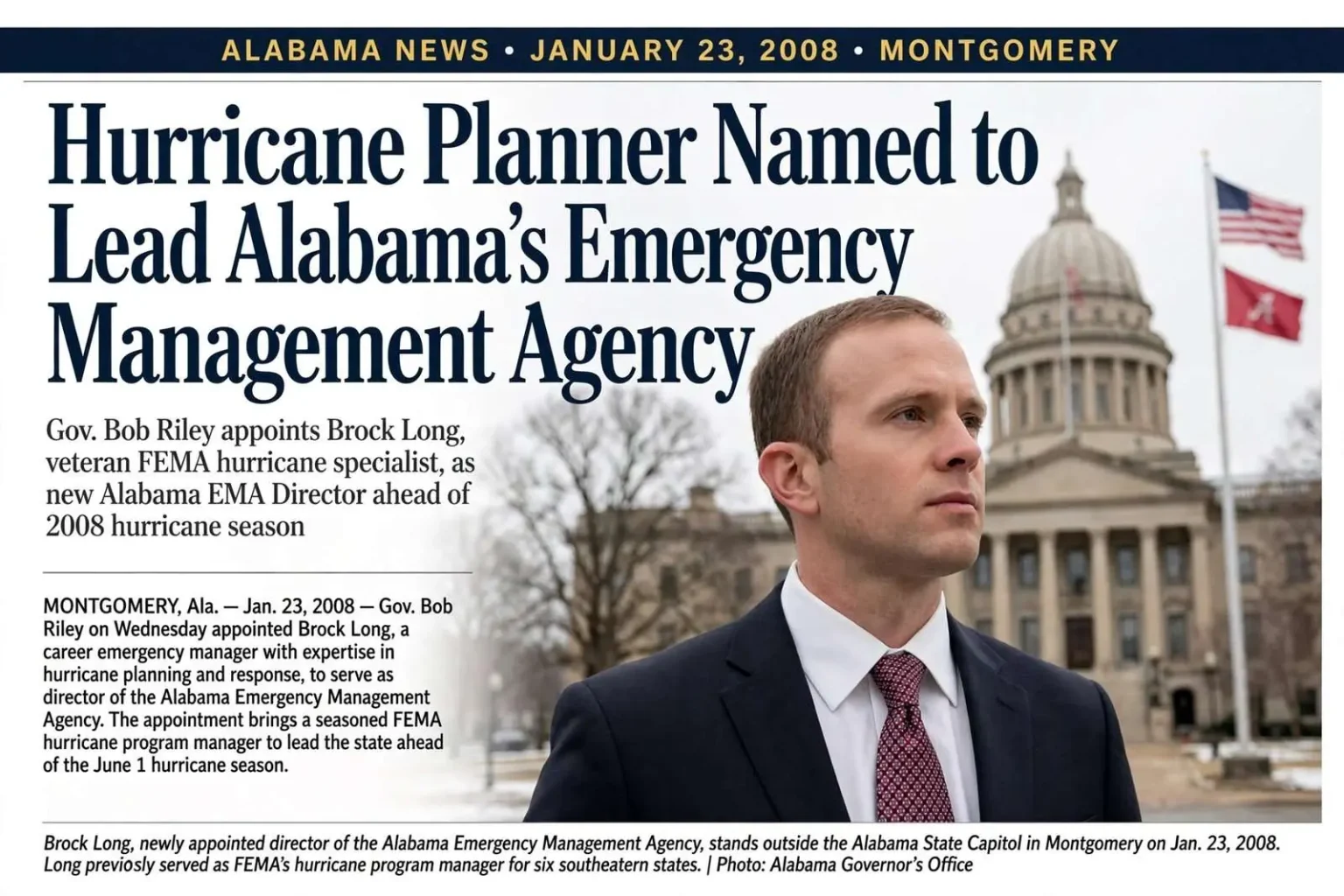
Gov. Bob Riley on Wednesday, Jan. 23, 2008, appointed Brock Long, a career emergency manager with a specialty in hurricane planning and response, to serve as director of the Alabama Emergency Management Agency.
The choice mattered more on the Gulf Coast than anywhere else in the state. Mobile and Baldwin counties sit at the sharp end of every evacuation order, every shelter opening and every federal assistance request Alabama makes. The person running the state EMA determines how quickly those decisions get made — and how well they hold up under pressure.
A Resume Built on Storms
Long came to the job with experience at both the state and federal levels. He had served as FEMA’s hurricane program manager for six southeastern states, overseeing hurricane emergency planning, preparedness, response and assistance across Alabama, Florida, Mississippi, Georgia, South Carolina and North Carolina. In that role he helped design hurricane evacuation plans for those states, and he received FEMA awards for outstanding achievement in four consecutive years.
Before that, Long worked for the Georgia Emergency Management Agency as a statewide emergency planner and hurricane specialist, supervising emergency operations plans for 55 counties. At the Georgia agency he also focused on school safety, developing training and response plans for education officials in 70 counties.
The resume read like a job description for the Alabama post. As FEMA’s regional hurricane program manager, Long had personally worked with the state and county officials he would now direct — the same evacuation studies, the same shelter plans, the same federal grant programs that funded coastal preparedness. That familiarity cut both ways, and it was mostly the good way: coastal emergency managers got a director who already knew which roads flooded first, which communities would not evacuate, and how the federal reimbursement machinery worked from the inside. Alabama was hiring, in effect, the man who had been designing its hurricane response from Washington.
The school-safety work, easy to overlook on a hurricane résumé, addressed a real gap in Alabama planning. Public schools double as shelters and evacuation assets across the state, and superintendents are forced decision-makers in every storm — deciding when to close, when to bus, when to shelter in place. A director who had spent years building training for education officials understood a slice of disaster response that never makes the emergency-broadcast cut but determines how a storm goes for thousands of families.
The Context of the Appointment
The job Long inherited had been reshaped by the previous four years. Hurricane Ivan came ashore near Gulf Shores in September 2004 and pushed damage far up the Alabama river systems. Dennis followed in July 2005. Katrina arrived six weeks later, drowning Bayou La Batre, flooding downtown Mobile and exposing failures in coordination among local, state and federal responders that dominated national politics for years afterward.
Those storms turned emergency management from a technical backwater into a career-ending post for anyone who got it wrong. Alabama’s coastal counties had spent the years since rebuilding shelters, rewriting evacuation timetables for the Bayway and the causeway, and hardening communications systems that failed when they were needed most.
Katrina’s lessons defined the job’s terms. The storm’s aftermath made “coordination” a word with consequences: the failures in Louisiana and Mississippi — breakdowns in communication between parishes and the state, delays in requesting federal help, shelter systems overwhelmed — became case studies every emergency manager in the country studied, and Gulf Coast agencies studied them closest of all. Riley’s administration had spent the intervening years under pressure to show that Alabama’s own house was in order, and the EMA directorship was where that showing happened. The appointment came in January, deliberately in the quiet season, giving the new director a full spring to review plans before the June 1 opening of hurricane season.
What the State EMA Does
The Alabama Emergency Management Agency coordinates the state’s response to disasters of every kind: hurricanes and tornadoes, floods, industrial accidents and hazardous material spills. It runs the state emergency operations center, serves as the conduit for federal disaster declarations and reimbursements, and works alongside county EMA offices — including the Mobile County and Baldwin County agencies — that carry out preparedness and response at the local level.
The structure matters for understanding the director’s role. Alabama’s system is legally bottom-up: response authority begins with local government, and the state’s job is to coordinate, resource and escalate. In a hurricane, that means the EMA director is the person who decides what the state pre-positions and where — generators, debris contracts, National Guard liaison, state police escorts for fuel tankers — and who speaks to FEMA when a disaster declaration is requested. The director is also the voice that either calms or panics the state when a storm is five days out in the Gulf and the models disagree, a communication role that the 2004 and 2005 seasons had shown could matter as much as any logistics decision.
For south Alabama, the practical questions were always the same. How early does an evacuation order go out for Dauphin Island, Bayou La Batre and the low-lying communities along the Mississippi Sound? Who opens shelters and who staffs them? How fast can debris crews, generators and ice reach the delta communities north of Mobile after the wind stops? A director who had spent his career writing hurricane plans for the same coastline was an appointment coastal officials were prepared to welcome.
Each of those questions carried years of accumulated scar tissue. Dauphin Island’s evacuation turns on a single road across a barrier that hurricanes have repeatedly cut; Bayou La Batre’s waterfront housing had been destroyed twice in twelve months by Ivan and Katrina; the Mobile-Tensaw delta communities sit at the end of roads that flood from storm surge moving up the bay, not just down from the Gulf. Shelters that worked on paper had proven short on generators and staff in 2004, and the ice-and-water distribution failures that followed Katrina became the local benchmark of what never to repeat. A director judged on those specifics, not on general credentials, was what coastal counties had asked the governor for.
A Name That Would Carry Further
Long’s tenure in Montgomery would prove to be a step in a longer career. He later returned to the private sector and, in 2017, was confirmed as administrator of the Federal Emergency Management Agency, the same organization where he had cut his teeth as a regional hurricane planner. In that role he oversaw the federal response to a punishing series of hurricanes and wildfires before leaving the post in 2019.
That trajectory — state emergency management director to FEMA administrator — was itself a rarity, and it marked how much the profession had changed in the years after 2005. Emergency management in the post-Katrina era became a discipline with national expectations, and Alabama, sitting on hurricane-prone ground with a tornado-prone interior, produced managers tested across the whole catalogue of hazards. The Gulf Coast experience Long brought to Montgomery in 2008 — evacuation planning at regional scale, federal grant administration, the hard lessons of the 2004 and 2005 seasons — was the same experience he would later carry back to Washington.
In January 2008, though, he was simply the new man at the Alabama EMA, and the storm season was four months away.
Four months is both a long time and none at all in that job. A director can review every plan, walk every shelter and telephone every county director in four months — and still face a June storm that renders the plans theoretical. What coastal officials took from the appointment was simpler than any plan: the state had put a hurricane specialist, one who had written the Southeast’s evacuation plans from the FEMA side, in the chair where the Gulf Coast’s calls get answered. For the communities that had spent two and a half years rebuilding from Ivan and Katrina, that was the point of the announcement — and the measure by which the new director would be judged the next time the cone pointed at Mobile Bay.
Emergency Management as a Post-Katrina Profession
The appointment also reflected how the profession itself had been remade since 2005. Before Katrina, state emergency management directorships were frequently patronage posts; afterward, governors across the hurricane zone faced scrutiny over credentials in a way the job had never drawn. Riley’s choice of a career emergency manager — a man whose entire working life had been disaster planning rather than politics — was a statement to both the federal government and the coastal counties that Alabama intended to meet the new standard.
The state’s hazard profile demanded it. Alabama’s emergency managers contend with more than hurricanes: the state sits in the heart of Dixie Alley, the tornado corridor that produces the deadliest spring outbreaks in the country; the Tennessee Valley floods; the industrial corridor along the Gulf and the rivers carries chemical and fuel risks; and winter ice storms close North Alabama highways with regularity. The EMA director’s calendar is full before hurricane season even begins, and the agency’s credibility with county directors — the people who run the local operations centers during every one of those events — is the currency the job trades in.
Long’s own history fit the modernized profession’s profile. He was young for a state director but had come up through the working levels — county planning, state planning, federal regional programs — rather than arriving from outside the discipline. Emergency managers around the Southeast knew him from the joint hurricane exercises and evacuation studies that FEMA’s regional office ran with the states, the working relationships that determine how a multi-state response actually functions when a storm threatens more than one state at once, as Gulf storms routinely do.
The announcement itself offered the public a first look at how the Riley administration framed the pick: a specialist for a coastline that had absorbed two catastrophic years, named in the off-season so the plans could be reviewed and tested before the next test came from the weather. For Mobile and Baldwin county officials, the measure would come with the first named storm of the new director’s tenure: how fast the state emergency operations center activated, how early the evacuation calls went out, and whether the confidence expressed in January survived the first week of June.