Bail Denied for Mobile County Man Awarded New Trial in 2000 Killing
A Mobile County judge delayed a bail decision for a death row inmate granted a new trial, as prosecutors weigh whether to again pursue the death penalty.
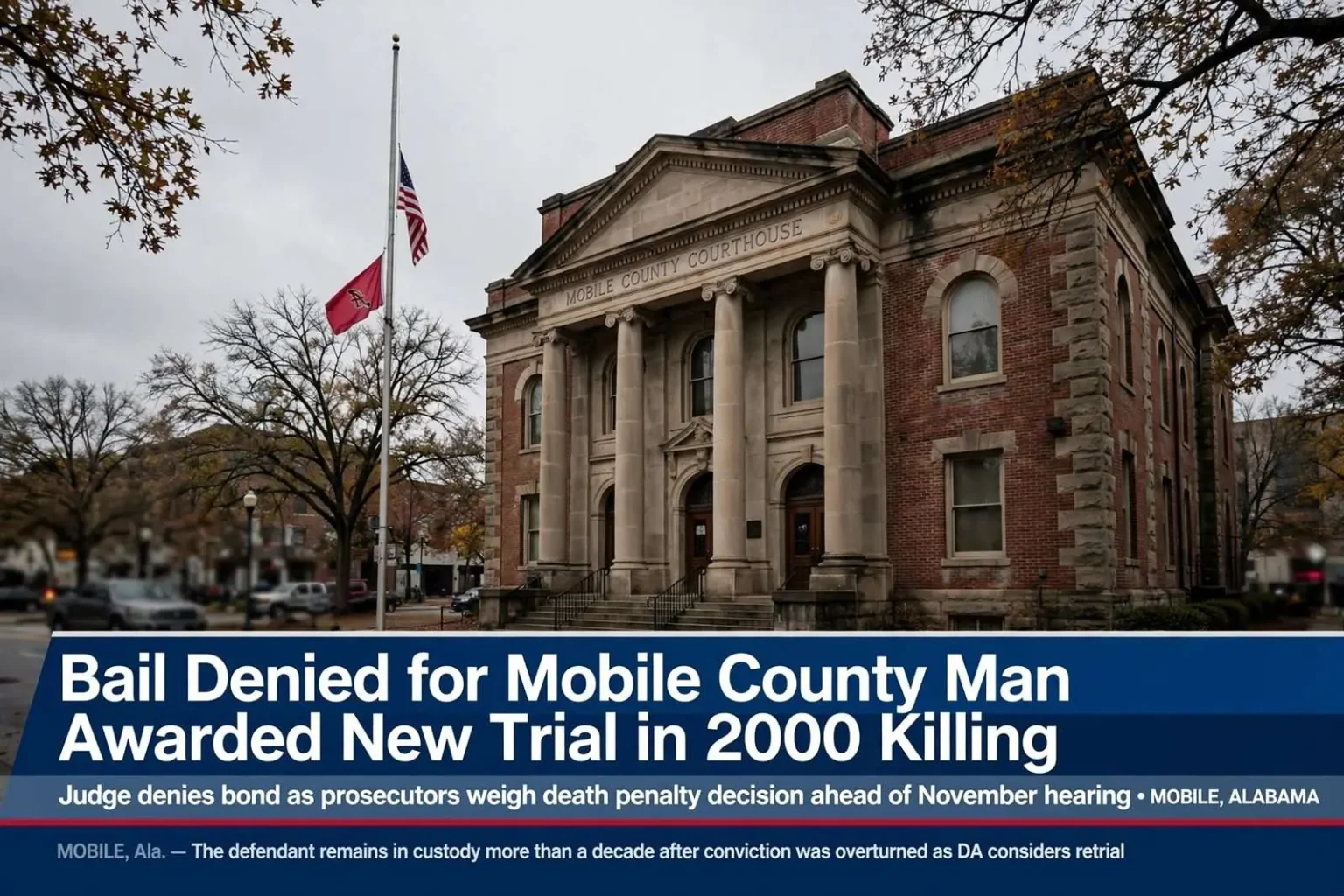
MOBILE, Alabama — A man who spent more than a decade on death row before a judge threw out his conviction was visibly frustrated this week after learning he still would not be released on bond while prosecutors decide how to proceed with his case.
A Conviction Unraveled by a Scathing Ruling
The defendant appeared before a Mobile County circuit judge for a status hearing after the same judge issued a lengthy ruling roughly a year earlier granting him a new trial. In that 218-page decision, the judge found serious problems throughout his original 2001 trial, including failures by his own defense attorneys, one of whom was found to have discarded key evidence, and by investigators and prosecutors who did not turn over evidence favorable to the defense.
The judge also found that a detective’s trial testimony was false and that the prosecution knew or should have known it at the time. Both the original prosecution and defense teams have denied wrongdoing.
A ruling of that breadth is rare in Alabama capital cases. Orders granting new trials typically identify a single error serious enough to require a do-over; a decision running to 218 pages, cataloging failures on both sides of the courtroom, reads instead as an indictment of the trial as a whole — the investigation, the preparation, the representation and the evidence that reached the jury.
The discarded evidence described in the ruling struck at one of the foundations of any defense: the files a lawyer builds to challenge the state’s case. When the judge found that a member of the original defense team had thrown away key materials, the finding meant the defendant had lost not only a fair fight against the prosecution but the raw material that might have made the fight winnable.
The discovery violations compounded that loss. Prosecutors are required under long-standing U.S. Supreme Court precedent to hand over evidence favorable to the accused, including material that could undermine witnesses or point to alternative suspects. The judge found that requirement went unmet, and that a detective’s sworn testimony at trial was untrue — with the prosecution bearing responsibility for knowing, or needing to know, the difference.
Neither the original prosecutors nor the original defense attorneys accepted those findings. Both teams have denied wrongdoing, leaving the ruling to stand as the court’s account of what happened while those involved maintain their own.
Bail Question Pushed to November
At this week’s hearing, defense attorneys asked the court to allow their client to post bond for the first time in more than a decade. But an assistant district attorney told the judge prosecutors still needed more time to decide whether they will again seek the death penalty in a retrial, which would affect whether bail is even an option. The judge reset the matter for a hearing in late November.
The distinction matters under Alabama law. Capital murder defendants facing the death penalty are generally not eligible for bail; defendants charged with capital offenses where the state forgoes execution can, in some circumstances, argue for release pending trial. Until prosecutors decide which path they are taking, the question the defense wants argued cannot be fully heard — which is why the bond request now waits on the district attorney’s office.
The delay left the defendant in the same place he has occupied since the conviction was thrown out: in custody, charged but untried, more than fourteen years after the killing that put him there. His aunt and legal guardian expressed frustration after the hearing, saying she had expected him to come home and questioning why prosecutors, after so many years, were still not prepared to move forward.
A Brutal Killing That Has Stretched On for Years
The case stems from the February 2000 killing of a west Mobile man, whose body was found beaten and stabbed more than 100 times in a wooded area, his throat also slashed. Prosecutors originally argued the stabbing followed a racial slur made by the victim, and that the defendant led a group of four people involved in the killing.
Three other men were later convicted in connection with the case, with two of them testifying against the man now awaiting retrial. The testimony of co-defendants — men whose own fates depended partly on their cooperation with prosecutors — formed a pillar of the original case, and it is one of the elements now viewed differently after the witness recantation.
Defense attorneys say their strategy has shifted since a key prosecution witness recanted testimony in 2010 that she had heard the defendant threaten the victim the night before the killing, a reversal defense attorneys argue undercuts the original theory of the crime. The threat testimony had helped establish intent and organization in the state’s account of the killing; without it, the defense argues, the prosecution’s story loses its spine.
The recantation arrived a decade after the trial itself, in 2010, and became part of the record that the circuit judge weighed in the new-trial ruling. It also placed the case among the capital prosecutions in Alabama where the evidence supporting a death sentence has been re-examined years after the jury’s verdict — a review process that in this instance ended with the conviction set aside entirely.
What happens next depends on choices neither the court nor the defense controls. Prosecutors can take the case to a second trial, negotiate a resolution, or dismiss it — and their decision on whether to seek the death penalty will shape not only the punishment the state pursues but whether the defendant has any realistic chance of release before that retrial begins.
Victim’s Family Vows to Keep Showing Up
Family members of the victim, who were present in the courtroom, said they remain confident in the strength of the case against the defendant and described him as unchanged in his demeanor since the original trial more than a decade ago. They said they intend to continue attending hearings through the November bail decision and into a potential retrial expected sometime next year.
Their presence is a fixture of capital litigation in Mobile County, where victims’ relatives routinely fill the gallery through years of pretrial hearings, rulings and appeals. A retrial expected next year would mean another round of that endurance — hearing the details of the killing repeated, watching witnesses take the stand again, and waiting through deliberations a second time.
The family’s confidence stands against the court’s findings, and the two convictions that came from the original investigation remain on the books. For the victim’s relatives, the case has always been straightforward: a man was killed with extraordinary violence, four people were charged, and the courts held three of them accountable. The prospect of the fourth walking free on bond before a retrial is what brought them to the courtroom this week.
Between now and the November hearing, the decision rests with the district attorney’s office. If prosecutors announce that they will seek the death penalty again, bond is all but foreclosed and the case moves toward a capital retrial. If they do not, the defense gets its chance to argue that fourteen years of custody — one conviction thrown out, no new trial scheduled — is more than enough, and that the defendant should spend the months before his second trial at home.
Either way, the hearing in late November will mark another entry in a case that has already outlasted a generation of Mobile’s juries, judges and prosecutors, and that neither side shows any sign of letting go.
What a New-Trial Ruling Means in Practice
A new-trial ruling does not declare a defendant innocent, and the judge in this case did not. It declares that the first trial failed — that errors, omissions and false testimony accumulated to the point where the verdict could not stand. The practical effect is to return the case to the starting line: the charges remain, the state may try the defendant again, and everything the first jury heard must be presented fresh to a second one.
For the defendant, that means the past year has been a strange kind of limbo. The death sentence that once hung over him is gone, vacated with the conviction it was attached to, yet he remains in the custody that conviction produced. Every hearing since has been about what comes next rather than what already happened.
The 218-page ruling now functions as a roadmap for both sides. Prosecutors preparing a retrial know exactly which weaknesses the court identified — the discarded defense files, the withheld favorable evidence, the false testimony — and can build their second case with those findings in view. The defense, for its part, can cite the ruling’s conclusions in every argument that follows, from bond to the admissibility of the old evidence.
Retrials after capital convictions are themselves unusual. Most death sentences in Alabama move through appeals that either affirm the conviction or turn on narrower legal questions; a full do-over granted by the trial court, on grounds this sweeping, places the case in a small category where the state must decide whether it can win the same fight twice.
The pending question about the death penalty is central to that calculation. Seeking execution again would commit the district attorney’s office to the highest and most expensive tier of prosecution, with additional penalties-phase proceedings if a second jury convicts. Declining it would open the possibility of bond and narrow the stakes of the retrial to a sentence of imprisonment.
For the aunt who has served as the defendant’s legal guardian through the process, the choice was simpler than the law’s. She had sat through the hearing expecting the word “home,” and left with a November date instead — another hearing, another month in the custody the first trial produced, and a question prosecutors have been considering for a year without answering.