Former Prosecutor Michel Nicrosi Joins Herman Thomas’s Legal Team
Mobile attorney Michel Nicrosi, who won an acquittal in the Siegelman corruption trial, joined the defense of former Judge Herman Thomas as the district attorney pressed a criminal investigation.
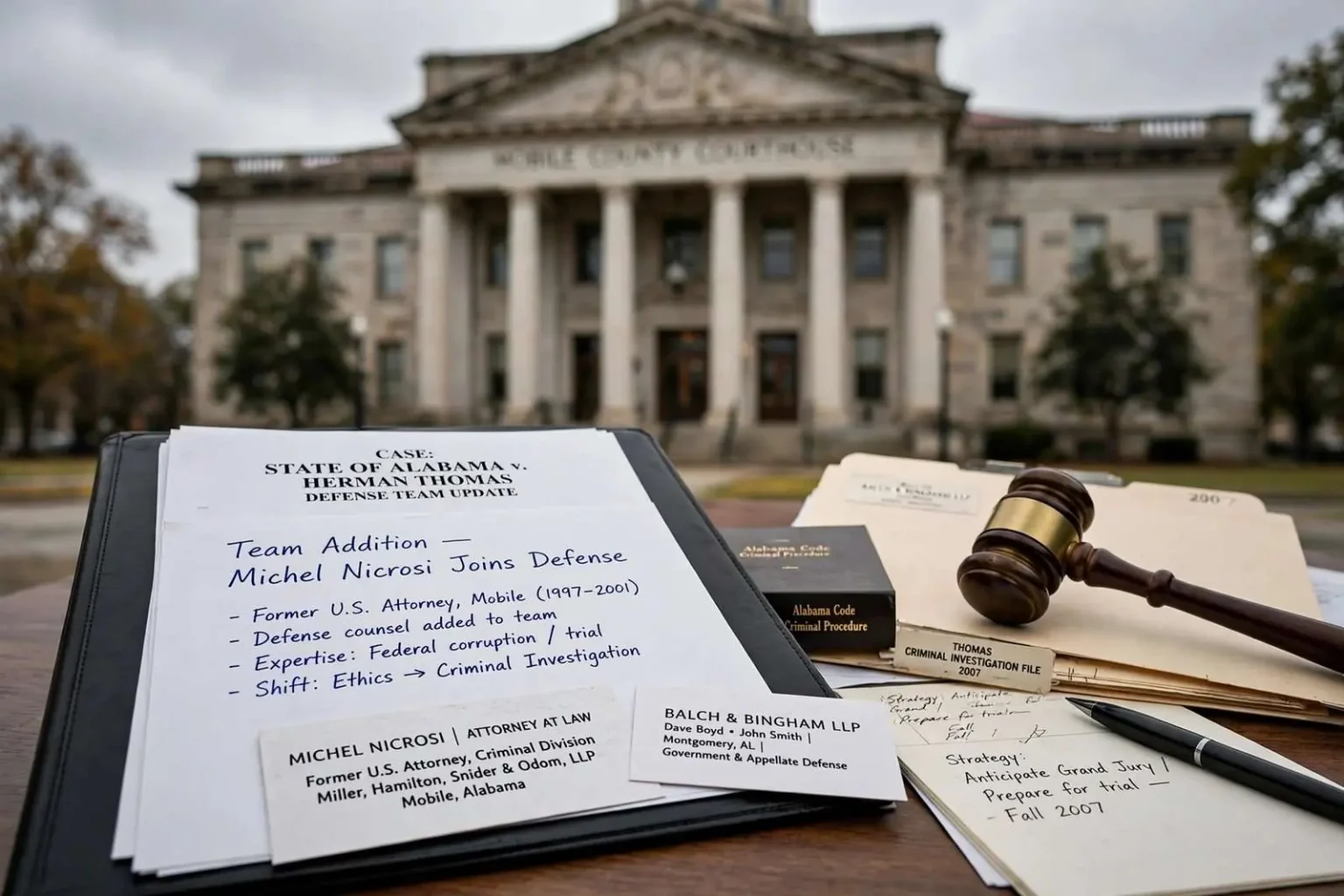
Mobile attorney Michel Nicrosi joined the legal team representing former Mobile County Circuit Judge Herman Thomas, a significant addition at a moment when the ex-judge’s exposure was shifting from ethics charges to a possible criminal case. Nicrosi joined Dave Boyd and John Smith of the Montgomery firm Balch & Bingham on Thomas’s defense, assembling a group that combined statewide governmental experience with a proven federal trial record.
The move came at a pivotal moment in one of the most closely watched legal sagas in recent Mobile County history. Thomas, who had resigned from the bench days earlier amid mounting ethics charges, was no longer facing only the machinery of judicial discipline. A criminal investigation was reportedly continuing, and the kind of lawyer needed to answer a district attorney’s inquiry is a different animal from the one needed to navigate a judicial ethics proceeding.
Why the Team Was Changing
Thomas resigned from the bench days earlier, amid mounting ethics charges. The resignation had an immediate legal effect: it interrupted the Alabama Judicial Inquiry Commission’s investigation, stripped the commission of jurisdiction and pulled the plug on a trial before the Alabama Court of the Judiciary that had been set for Oct. 29.
That ended one threat. It did not end the others. Mobile County District Attorney John Tyson was reported to be continuing a criminal investigation into the former judge’s activities — a matter of an entirely different order from a disciplinary proceeding, and one that called for a different kind of lawyer.
The distinction matters for understanding the defense strategy. The Judicial Inquiry Commission and the Court of the Judiciary exist to police the conduct of sitting judges, and their potential sanctions — reprimand, suspension, removal from office — lose their force the moment a judge gives up the robe. Criminal prosecution, by contrast, follows a former official regardless of title, carrying potential prison time and a permanent record. Resignation bought Thomas an exit from the first system, but it did nothing to shield him from the second.
The charges Thomas had faced before the commission were sweeping. He stood accused of roughly 30 counts of ethical misconduct, alleging that he used his office to favor friends, relatives and the politically connected, and that he pulled cases from other judges’ dockets in order to change their outcomes. His colleagues on the Mobile County bench had pressed for those charges to be aired publicly rather than mediated privately, a sign of how seriously the local judiciary viewed the allegations.
A Defense Lawyer With a Notable Win
Nicrosi brought exactly that background. She headed the criminal division in the U.S. Attorney’s office in Mobile from 1997 to 2001 before entering private practice, and was a partner in the 30-year-old Mobile firm of Miller, Hamilton, Snider and Odom.
Her most prominent recent work had come in the biggest public corruption case in modern Alabama history. Nicrosi successfully defended Paul Hamrick, former chief of staff to Gov. Don Siegelman, in the federal prosecution that also targeted Siegelman himself and former HealthSouth chief executive Richard Scrushy.
After a nine-week trial, the jury acquitted Hamrick on every count — racketeering, mail and wire fraud, and obstruction of justice. That result made her, in the estimation of the Mobile bar, precisely the sort of attorney a client facing a corruption investigation would want: a former federal prosecutor who had already beaten the government at trial in a case of enormous political weight.
The Siegelman prosecution, which ended in 2006 with convictions for the governor and Scrushy, remains a defining episode in Alabama legal circles, and the fact that Hamrick walked away from the same courtroom is a rare outcome in federal corruption cases, where acquittals on all counts are uncommon. Defense lawyers around the state point to that verdict when clients ask what separates a negotiated plea from a fight, and Nicrosi’s willingness to take the government to trial for two months without compromise is the credential that followed her back into private practice.
Her years running the criminal division of the U.S. Attorney’s office in Mobile gave her the other half of the equation: an insider’s command of how federal investigators build a case, when prosecutors decide to charge, and how the offices involved sequence indictments. In an investigation being run by a district attorney rather than federal prosecutors, that experience translates into an ability to anticipate charging decisions and to counsel a client on what cooperation, silence or public statements will mean down the road.
Corporate and political clients across Alabama have long sought out exactly that combination of prosecution-side experience and defense-side results. Former federal prosecutors occupy a distinctive niche in the state’s legal market: they know the agents and agencies personally, they can read an indictment for what it signals about the strength of the evidence, and they are less likely to be surprised by trial strategy that would unsettle a lawyer who has never sat on the government’s side of the table. Nicrosi’s hiring was read along those lines by observers of the case.
The Road Ahead for Thomas
Thomas had faced roughly 30 counts of ethical misconduct before the Judicial Inquiry Commission, alleging that he used his office to favor friends, relatives and the politically connected, and that he pulled cases from other judges’ dockets in order to change their outcomes. His colleagues on the Mobile County bench had pressed for those charges to be aired publicly rather than mediated privately.
By stepping down, Thomas ended that process before it reached trial. But resignation is not immunity, and in Alabama the district attorney’s authority to pursue criminal charges against a former public official does not depend on whether a judicial disciplinary body ever finished its work.
The Alabama Judicial Inquiry Commission, based in Montgomery, investigates complaints against the state’s judges, and the nine-member Alabama Court of the Judiciary hears the cases it files, with the power to suspend or remove sitting judges. The system is designed to move faster than criminal prosecution, but it has one fundamental limit: its jurisdiction runs only to those who hold judicial office. The moment Thomas resigned, that framework lost its grip, and the courthouse conversation shifted entirely to whether a grand jury would follow.
For Mobile County, the saga had already been extraordinary. Thomas was a fixture of the local bench, a judge whose courtroom was a regular stop for lawyers and whose cases touched thousands of litigants over the years. The allegations that he had reached across the docket system to redirect cases, and that favors had flowed to the connected, struck at the core of how residents expect their courts to operate, and his fellow judges’ insistence on a public airing reflected an institution defending itself.
The criminal investigation being continued by District Attorney John Tyson’s office would operate under different rules and with different stakes. A district attorney’s office can present evidence to a grand jury, seek indictments on charges ranging from official misconduct to theft or worse, and pursue a public trial with the full record of a judge’s conduct on display. Defending against that prospect requires the federal-style trial experience that Nicrosi’s hiring was calculated to supply.
The composition of the defense team also said something about the nature of the expected case. Balch & Bingham, one of Alabama’s oldest and largest firms, maintains a Montgomery office steeped in governmental and appellate work, and lawyers like Boyd and Smith bring fluency in the state’s ethics statutes, court administration and the institutions now circling the former judge. Nicrosi’s role was the trial-lawyer complement: if charges came and the case went to a jury, hers would be the name associated with beating the government.
Thomas was later indicted on charges arising from his conduct on the bench. He was tried in 2009 and acquitted of the counts he faced, an outcome that closed the book on a legal fight that had begun with the ethics complaints and stretched across years, two separate systems of accountability and one of the most consequential resignations in Mobile County judicial history.
Looking back, the assembly of his defense team in the fall of 2007 — a Montgomery firm with deep appellate and governmental experience, joined by a Mobile trial lawyer with a federal acquittal on her record — was a fair signal of what the former judge and his advisers expected to be up against. Cases that begin in judicial discipline and end in criminal court demand lawyers who can work both ends of that spectrum, and the team put together for Thomas was built for exactly that range.
For Mobile County residents, the episode remains a case study in how Alabama’s overlapping systems of accountability work: a commission that investigates judges, a court that can remove them, a district attorney who can indict them and juries that ultimately decide. Thomas moved through every one of those systems, and the outcome at each stage — resignation, the end of the ethics case, and finally an acquittal in criminal court — shaped how the story was remembered along the Gulf Coast.