Dauphin Island Ferry Captain Recalls Hurricane Frederic Aftermath
Mike Thierry recalls riding out Hurricane Frederic aboard his boat, then running Dauphin Island's makeshift passenger ferry service for months afterward.
When Hurricane Frederic tore through the Alabama coast in 1979, it didn’t just batter Dauphin Island — it severed the island from the mainland entirely, ripping apart the bridge that had connected the two since 1955. For the three years it took to rebuild a new bridge, one man’s fishing boat became a lifeline for the island’s residents, and he still lives on Dauphin Island today with the story to tell.
Frederic arrived in September 1979 as one of the most destructive storms ever to strike the Alabama Gulf Coast, and its damage map had a single point of failure: the causeway and bridge linking Dauphin Island to the mainland. When the bridge went, the island’s several hundred residents lost their road, their power, their phones and, for a time, their certainty about how supplies would reach them.
Mike Thierry rode out the storm aboard his 60-foot sport fishing boat, the Terolyn II, alongside a friend, after motoring roughly 30 miles up the Alabama River to find shelter from the approaching hurricane.
He anchored the boat with three separate lines, kept the engine engaged to ease the strain, and wrapped the ropes in chafing gear to keep them from snapping against the hull through the night.
“It was a rough night,” Thierry recalled. “You pray to keep yourself safe.”
Running the storm out on the river
The decision to take the Terolyn II upriver was a charter captain’s calculation. A 60-foot sport fishing boat draws more water than a runabout, handles open water that would swamp smaller craft, and carries the ground tackle — anchors, line, chain — to hold in a storm surge. Thirty miles up the Alabama River put the vessel behind the delta’s banks and marshes, away from the open Gulf and the worst of the wind-driven water.
Even so, the preparations tell what the night was like: three lines instead of one, an idling engine holding slack out of the rode, chafing gear wound where the ropes crossed the hull. Every measure addressed a specific way a moored boat dies in a hurricane — the line parts, the anchor drags, the hull saws through its own mooring. Thierry had seen storms from the deck of a working boat before, and he rigged accordingly.
Coming back down the bay
When the storm passed, Thierry and his friend made their way back down Mobile Bay toward Dauphin Island as soon as conditions allowed. The scene along the way told the story of the storm’s force.
“Coming down Mobile Bay, I remember seeing roofs and a lot of debris floating,” Thierry said.
The bay that morning was a ledger of Frederic’s passage — rooftops from houses whose walls had stayed behind, insulation, lumber, boats dislodged from their slips, the floating wreckage of a coast that had stood in the storm’s northeastern quadrant for hours. Frederic’s winds had been recorded at more than 100 miles an hour along the immediate coast, and the debris field on the bay was what that meant when the water carried it.
Back on the island, his wife Ann described their home as largely intact structurally but filled with 18 inches of mud, silt, and displaced sea life.
“There was mud and muck and silver eels and other dead things,” she said.
With no working phones and the bridge destroyed, Ann said it was days before she even heard from her husband, though she never doubted he’d made it through safely given his experience on the water.
A fishing boat becomes a ferry
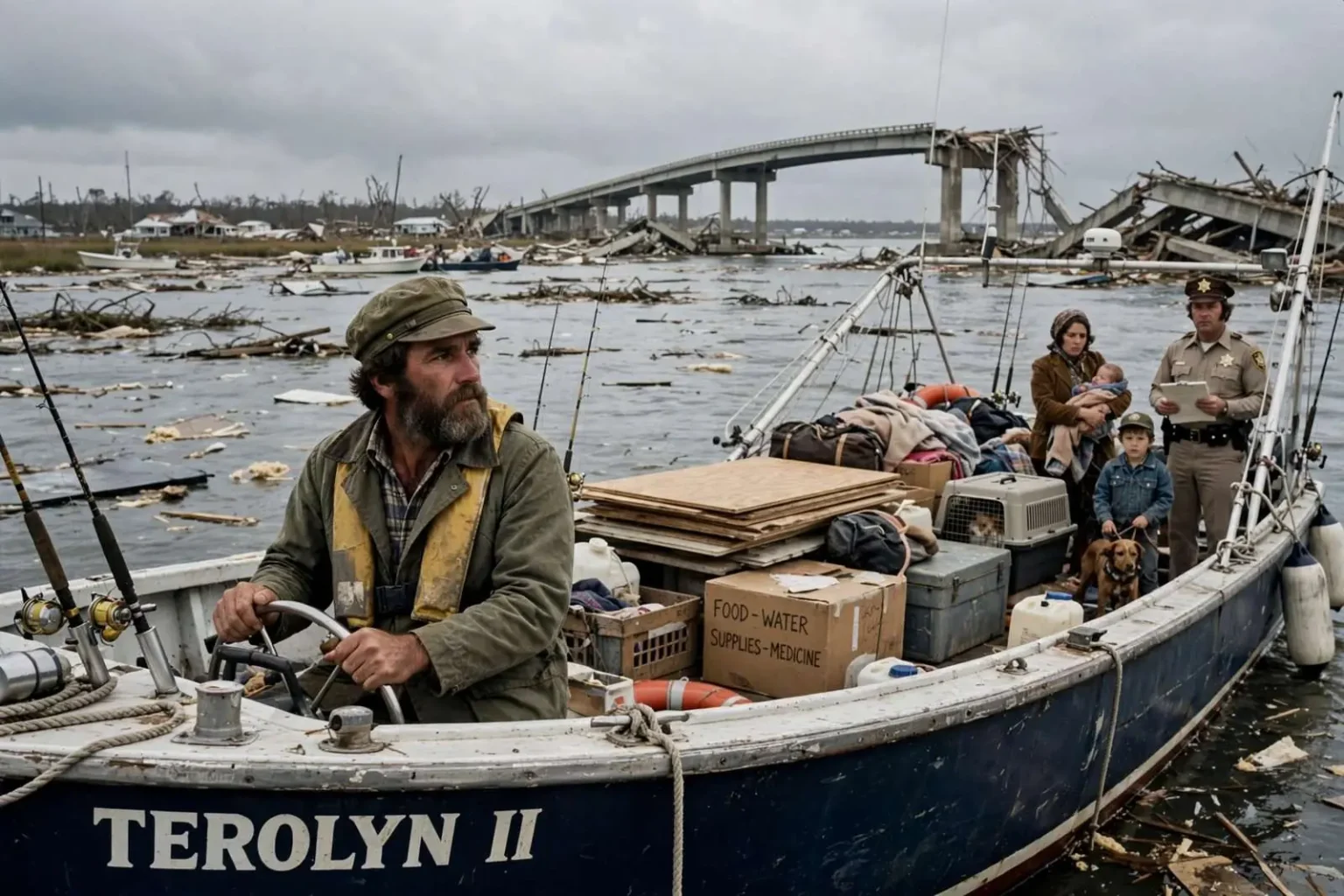
In the storm’s aftermath, the state of Alabama turned to Thierry’s boat to help solve an urgent problem: getting people and supplies on and off an island suddenly cut off from the mainland. With room for roughly 49 passengers, the Terolyn II was fast enough and large enough to serve as a makeshift people ferry.
What officials initially expected to be a temporary arrangement lasting a few weeks stretched into about four months of continuous runs. Thierry made three round trips a day, each leg taking roughly an hour and 15 minutes, ferrying island residents, first responders, and a steady stream of cargo.
“We transported everything: people, babies, dogs, cats, plywood,” he remembered.
The schedule alone made the operation a working ferry line. Three round trips a day meant a crew loading and unloading at both ends six times daily, on a route that ran across the open water where the old bridge had stood — past the broken spans and the salvage crews working below, in weather that could keep anyone else’s boat at the dock. The island’s school-age children, its workers, its rebuilding contractors and its groceries all moved at the tide of that schedule.
A priority system gave island residents and emergency crews first access to seats, and two sheriff’s deputies rode along on every trip to help manage the operation.
The deputies served as order-keepers and record-keepers both: deciding disputes over cargo space, keeping manifests, and providing the security presence that a relief route crossing open water required. The priority list — residents and emergency personnel first, contractors and freight after — was the closest thing the run had to a fare system.
Months without a bridge
The four months of ferry runs covered the first and hardest stretch of the island’s recovery: debris clearance, temporary roofing, the restoration of utilities, and the steady arrival of the insurance adjusters and contractors who would rebuild what Frederic had taken. Every one of them crossed by boat, because the state’s engineers had concluded that replacing the bridge would take years, not weeks.
The final toll of the storm’s aftermath measured itself in ordinary logistics. An island community that had relied on a ten-minute drive to the mainland now planned its week around boat schedules — prescriptions, vet visits, building permits, all of it routed through a 49-passenger charter boat that had been rigged for deep-sea fishing in August and pressed into public transit by October.
Life after the ferry
During the ferry months, the Thierrys stayed with friends on the island before eventually relocating temporarily to Mobile, running their fishing business out of Fowl River once a car ferry took over the transportation duties.
But neither ever considered leaving the island community for good.
“Never any doubt I was going to stay here and stay in the fishing business,” Thierry said.
As soon as the new bridge opened, the couple rented a house on the island’s west end before building a permanent home and moving their business back to Dauphin Island, where they’ve now lived for roughly four decades.
The return followed the rhythm of the island’s own recovery. The car ferry restored the flow of vehicles while the state rebuilt the bridge; the rebuilt bridge restored the routine of island life; and the Thierrys, who had kept the island supplied and moving when nothing else could, resumed the charter business that had brought them to the water in the first place.
The storm that redrew the coast
Frederic’s September 1979 landfall remains a dividing line in the modern history of the Alabama coast — the storm that ended one era of beachfront construction and started another. The bridge out to Dauphin Island was its most enduring casualty, but the same system flattened or heavily damaged buildings from the island’s west end through Mobile’s eastern shore and deep into Baldwin County, and its aftermath reshaped how the coast planned, insured and built.
For the island specifically, the three years without a bridge created a memory that residents of a certain generation all share: the ferry schedule, the rides across the gap in the causeway, the sight of the replacement bridge rising over the water. The Terolyn II’s four months were the opening chapter of that period, when the connection between the island and the mainland was maintained by one captain, one crew and one boat that had been built for billfish, not bicycles and groceries.
Still on the water
Today, Thierry still runs charters out of Dauphin Island’s marina aboard a boat called the Lady Ann.
The name, like the Terolyn II’s, belongs to the family’s story — a fleet of two vessels spanning a career that began before Frederic and continues decades after it. Charter fishing out of Dauphin Island means the same waters Thierry has worked since the 1970s: the nearshore rigs and reefs south of the pass, the deep blue water beyond the sandbar shelf, the seasons of snapper, cobia and tuna that bring anglers to the island’s docks each year.
As for the Terolyn II, the vessel that once served as the island’s lifeline, Thierry believes it’s still out on the water somewhere, possibly working the East Coast under new ownership.
Boats like that seldom retire. A 60-foot sport fishing boat changes hands, changes ports and keeps working long after its famous months, which is why the ferry’s history survives in the memory of the man who ran it rather than in the vessel itself. The state’s records note the emergency transport operation; the island’s residents remember the boat; and the captain remembers the night on the river that started it all.
Dauphin Island rebuilt, and the connection Frederic broke was replaced with a bridge that has carried the island’s life back and forth ever since. But the story of the weeks in between — when the link was a fishing boat making three round trips a day with babies, dogs and plywood aboard — remains one of the island’s defining accounts of what it takes to hold a community together when the water takes the road away.