Battle of Mobile Bay Reenactment Draws Big Crowd to Fort Gaines
Hundreds of costumed re-enactors staged a mock battle at Fort Gaines on Dauphin Island, marking 150 years since the Battle of Mobile Bay.
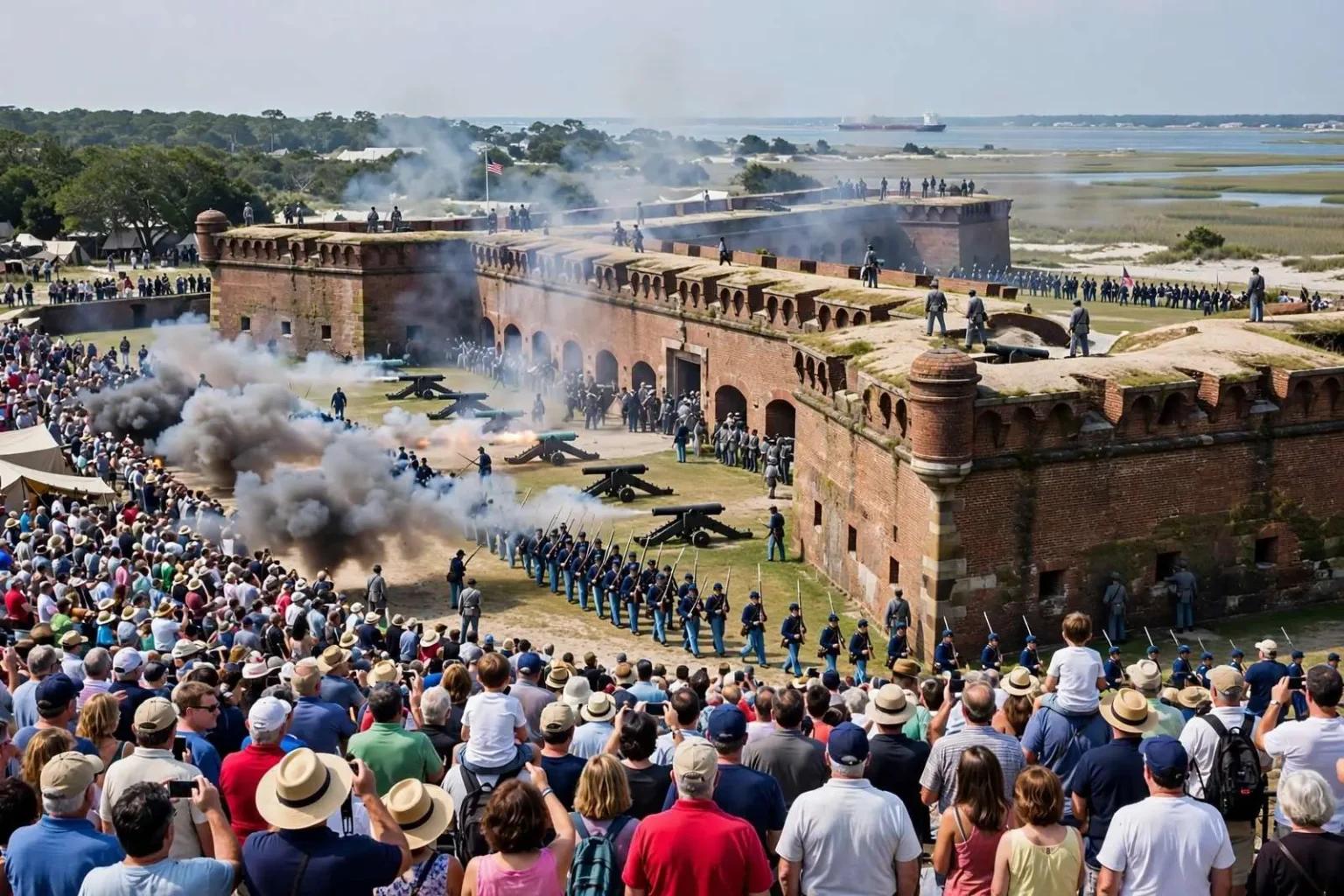
Dauphin Island’s Fort Gaines once again fell to Union forces on Aug. 3, 2014 — this time in a friendly reenactment marking the 150th anniversary of the Battle of Mobile Bay, one of the pivotal naval clashes of the Civil War. The sesquicentennial event drew visitors from across the Gulf Coast to the historic brick fort at the eastern tip of the island, where volunteer re-enactors recreated the assault that helped seal the fate of the Confederacy’s last major Gulf port 150 years earlier.
Roughly 275 costumed re-enactors staged the daylong event for a crowd estimated at 1,000 spectators, according to Matthew W. Capps, executive director of the Dauphin Island Park and Beach Board, which oversees the historic fort. Capps called the land battle portion of the event especially impressive, crediting the volunteer re-enactors for bringing the history to life. Enthusiasts from Louisiana, Mississippi, Alabama and Texas gave up a summer weekend to march in wool uniforms in the August heat, and organizers said the turnout of participants matched anything the site had hosted for a commemorative event.
The original battle unfolded on Aug. 5, 1864, when a Union fleet under Adm. David G. Farragut fought its way past the defenses guarding the entrance to Mobile Bay, including Fort Gaines on Dauphin Island and Fort Morgan across the channel on Mobile Point. Farragut’s famous order — remembered in legend as “Damn the torpedoes, full speed ahead” — sent his ships through the minefield protecting the channel, and his force went on to defeat the Confederate ironclad CSS Tennessee and capture the defending vessels. Fort Gaines held out for several more days before surrendering, and the Union victory closed Mobile Bay to blockade runners, tightening the noose around one of the South’s last open ports.
Cannons, Smoke and a Stormed Wall
Just before noon, Union vessels opened fire on the fort, staging an assault meant to echo the original 1864 battle before troops came ashore to storm the walls. Cannon and rifle fire produced clouds of smoke as modern-day spectators, many recording the action on phones and cameras, watched from atop the ramparts alongside costumed Confederate defenders. The black-powder volleys rolled across the island, giving the crowd a sense — however distant — of the noise and confusion that marked the real engagement.
As Union “soldiers” pushed up the beach, some in the crowd jokingly urged them to turn back, only to watch reenactors playact the fort’s surrender once the invading force breached the gates. The scripted sequence carried the audience from the naval bombardment through the ground assault to the white flag, compressing days of historical action into a demonstration that lasted through the afternoon.
Kevin Plant, a Union Navy re-enactor from Baytown, Texas, said storming through the back entrance caught onlookers off guard, since most expected the assault to come from the water side. The flanking move sent blue-coated troops through a landward approach rather than the direction spectators had been watching, and Plant said the surprise drew a strong reaction from the crowd as the attackers appeared inside the fort’s defenses.
Bruce Allen Pate of Grand Bay, portraying a Confederate Marine Corps officer, said the event came together smoothly despite the logistics of coordinating hundreds of participants in period uniforms in the August heat. Moving that many re-enactors, along with their weapons, tents and gear — not to mention water and medical support — across a barrier island site is a considerable undertaking, and Pate credited the planning team with keeping the day on schedule.
History With a Few Practical Adjustments
Organizers acknowledged a few details, such as the exact landing spot on the beach, were adjusted slightly from the historical record for practical reasons, according to Shawn Baker, who portrayed a Union Marine from the USS Brooklyn. Shifting sands, tides and safety considerations make an exact replication impossible at a working historic site, and re-enactment units regularly adapt terrain features while preserving the sequence and spirit of the original action.
Those adjustments are standard practice in the hobby, where safety officers supervise every volley and commanders rehearse movements before the public arrives. The goal, organizers said, is not to claim a perfect recreation but to give audiences a physical sense of the event — the weight of the weapons, the noise of the artillery, the geometry of an assault against fortified walls — that no museum exhibit can convey.
Brien McWilliams, a coordinator with the 6th Alabama Cavalry who helped plan the anniversary events, said one goal was to highlight lesser-known aspects of the war, including growing disillusionment among Southern soldiers and civilians as the conflict dragged into its final year. By 1864, shortages of men and supplies had strained the Confederate war effort, and the fall of Mobile Bay in August of that year delivered another demoralizing blow to a region already feeling the war’s weight.
Re-enactors and site staff used the weekend’s talks and demonstrations to put the battle in that larger context, explaining to visitors how the loss of the bay affected blockade running, supply lines and civilian morale across the Gulf South. Many attendees, organizers noted, know the battle chiefly through Farragut’s famous quote; the anniversary programming aimed to fill in the strategy, the technology and the human experience behind it.
Living history events also serve an educational mission for the younger visitors in the crowd. School-age children in the audience watched artillery crews load and fire full-scale cannon, saw infantry formations maneuver and could question re-enactors about everything from camp food to battlefield medicine. Site staff have long used such demonstrations to make textbook history tangible, and the anniversary crowd gave volunteers an unusually large and engaged audience of families.
The Fort That Watched the Bay
Fort Gaines itself is a principal character in the story. Begun in the early 1820s and named for Gen. Edmund P. Gaines, the pentagonal brick fort guarded the Mobile Bay channel for a century and saw its finest — and final — hour in August 1864, when its garrison endured the Union bombardment before surrendering. The fort’s massive walls, tunnel system, bastions and original cannon still stand at the eastern end of Dauphin Island, making it one of the best-preserved coastal forts on the Gulf.
Today the fort is operated by the Dauphin Island Park and Beach Board and functions as a museum and event site, hosting school groups, summer camps, living history demonstrations and annual commemorations. Its position beside the ship channel means modern visitors can watch oceangoing freighters pass within yards of ramparts that once traded fire with Union warships, a juxtaposition that site staff often use to connect past and present.
The 150th anniversary gave the site one of its largest audiences in years. Sesquicentennial commemorations across the country drew heightened interest in Civil War history between 2011 and 2015, and Gulf Coast sites leaned into the milestone with expanded programming. For Dauphin Island, whose economy is closely tied to tourism, a thousand-visitor day in August — historically a slower season between summer crowds — represented a meaningful boost for the island’s restaurants, shops and rental properties.
Why the Battle Still Resonates
Historians regard the Battle of Mobile Bay as one of the decisive naval actions of the Civil War. The victory gave the Union a Gulf port from which to operate, shut down what remained of the blockade-running trade through Mobile and, combined with Sherman’s advance in Georgia that same season, demonstrated that the Confederacy’s days were numbered. Farragut’s triumph also cemented his place in naval history and delivered a morale lift for the Union in an election-year summer.
For the volunteers who staged the 2014 reenactment, the anniversary was personal as much as historical. Units from across the region train for months to coordinate infantry drills, artillery crews and naval demonstrations, and the Mobile Bay anniversary held special meaning for Gulf Coast reenactors whose hometowns — Grand Bay, Baytown, Mobile — sit within the battle’s old footprint.
The anniversary also underscored the region’s broader Civil War footprint. Mobile remained in Confederate hands for most of the war precisely because its defenses, including Fort Gaines and Fort Morgan, kept the Union navy at bay until 1864, and the city’s later capture in the spring of 1865 came only after the bay itself had fallen. The sites that tell that story — Fort Gaines, Fort Morgan, historic churches and cemeteries across Mobile and Baldwin counties — form a trail that heritage tourism promoters hope anniversary visitors will continue to explore.
Organizers said they hoped the sesquicentennial crowd would leave with more than a spectacle. Between the bombardment, the beach assault and the surrender, visitors walked the same ground the soldiers of 1864 did, and they heard from reenactors and historians why a fleet action 150 years ago still shapes the history of Mobile Bay. For a fort that has weathered hurricanes, erosion and a century and a half of change, the day was both a commemoration and a reminder of why the site is worth preserving for the next anniversary crowd.