Cannons Roar Again as Reenactors Mark 150th Anniversary of Battle of Mobile Bay
Reenactors staged a weekend siege and grand bombardment at Fort Morgan and Fort Gaines to commemorate 150 years since the Battle of Mobile Bay.
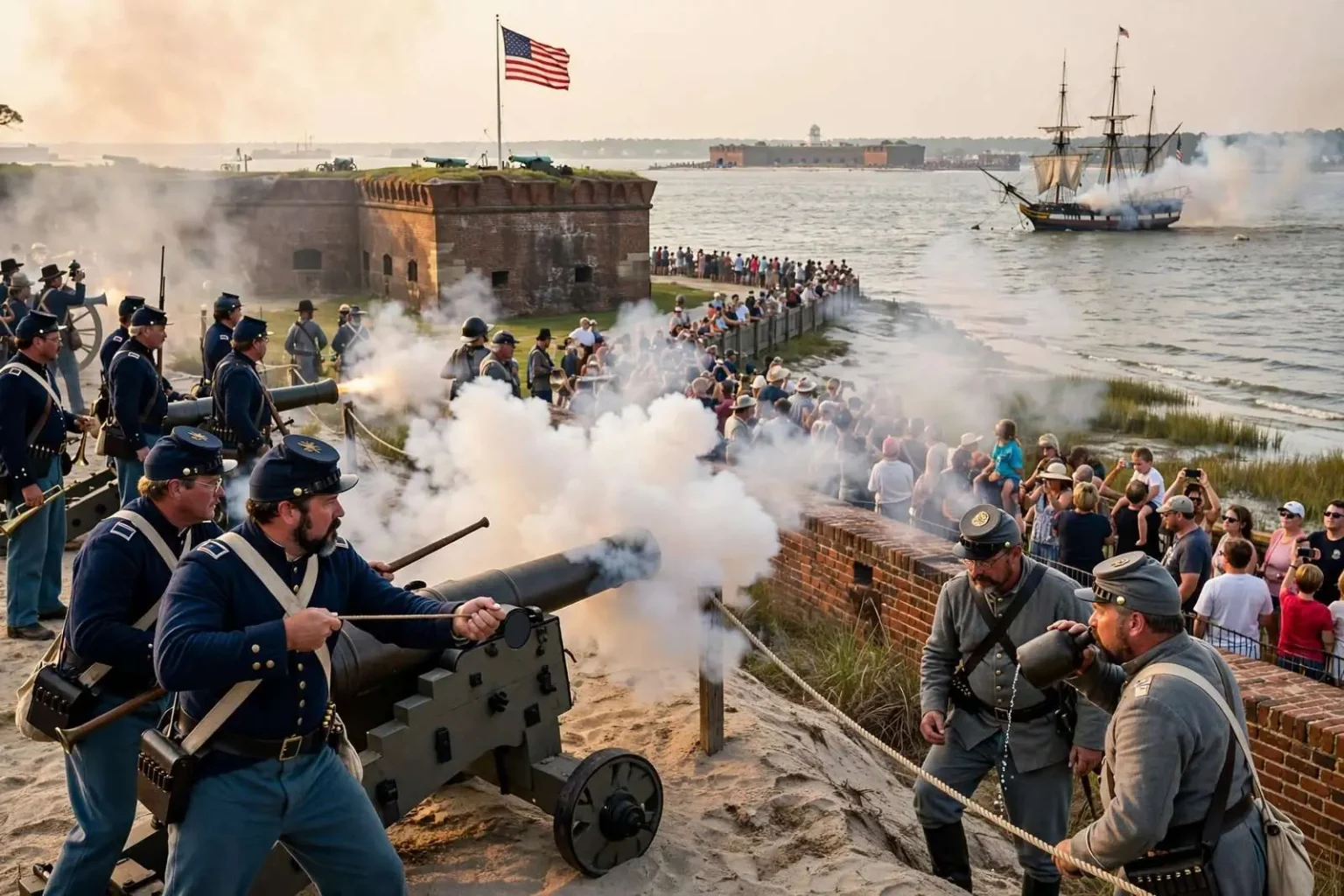
Union and Confederate reenactors packed the shores of Mobile Bay this weekend as thousands gathered to mark the 150th anniversary of one of the Civil War’s most famous naval engagements. The commemoration split its focus between two historic strongholds — Fort Morgan on the Baldwin County side of the bay and Fort Gaines across the water on Dauphin Island — recreating the siege that helped seal the Union’s control of the Gulf Coast in August 1864.
Saturday’s action opened with artillery volleys traded across the lines as tall-masted reenactment vessels eased toward shore, drawing crowds who lined up along the beach to watch cannon crews load and fire. Confederate gunners at Fort Gaines, including participants who had traveled from as far away as Tennessee, worked historic-style artillery pieces while spectators snapped photos and shared updates throughout the day.
Organizers built in regular breaks for the volunteer soldiers, sounding a bugle call every 15 minutes so the costumed participants — many wearing heavy wool uniforms in the August heat — could take on water. The heat and humidity of a Baldwin County August approximate conditions the original garrisons endured, and reenactment organizers on the Gulf Coast treat hydration breaks with the seriousness that any safety officer would demand.
By early afternoon, the mock siege had settled into a rhythm of exchanged fire punctuated by short lulls, with Confederate lines holding back before advancing later in the day. The choreography of a planned reenactment is a compromise between historical narrative and crowd spectacle: the scripted phases of the battle unfold on schedule so spectators on both sides of the bay see something from where they stand, while the commanders on each line improvise within the plan.
The Grand Bombardment
As the sun went down Saturday, the pace intensified. A push across the field by Confederate reenactors was met by advancing Union troops, and volleys of ground charges sent up small grass fires near Fort Morgan that volunteer firefighters quickly doused. Organizers paused the fighting overnight, promising a “grand bombardment” the following evening.
That bombardment came Sunday night, with cannons booming from both the siege line and support vessels anchored offshore as darkness fell over the fort. Confederate colors caught the evening breeze while crowds gathered for the finale, trading good-natured jabs with reenactors from both sides between rounds of cannon fire. Night artillery, with muzzle flashes lighting the water and the sound rolling across the bay, gave the audience on both shores the closest thing to the original battle’s sensory experience that a century and a half of time allows.
The weekend event, tied to the broader 150th anniversary commemoration of the August 1864 battle, drew living-history enthusiasts and history-minded families from across the region to two of the Gulf Coast’s best-preserved Civil War-era forts. For many in Baldwin and Mobile counties, the reenactment offered a rare chance to see the century-and-a-half-old fight for control of Mobile Bay brought back to life just a few miles from where it actually happened.
What Happened in August 1864
The battle being commemorated remains one of the defining naval actions in American history. In August 1864, Rear Adm. David G. Farragut led a Union fleet of more than a dozen wooden ships and four ironclad monitors into Mobile Bay past the forts guarding the entrance, in the face of the Confederate ironclad Tennessee and a field of torpedoes — the naval mines of their day — planted across the channel. Farragut’s famous order, rendered by tradition as “Damn the torpedoes, full speed ahead,” preceded the run past Fort Morgan that sealed the bay’s fate; later that day the monitors overwhelmed the Tennessee, and within weeks Fort Morgan surrendered, closing Mobile as a blockade-running port.
The capture of Mobile Bay denied the Confederacy one of its last functioning ports on the Gulf, tightening the blockade that strangled Southern trade and contributing to the pressure that would end the war the following spring. Mobile itself did not fall to Union forces until the closing weeks of the war in 1865, but the bay — the city’s lifeline to the sea — was effectively lost in a single August morning and afternoon.
The Forts That Still Guard the Bay
The two fortresses anchoring the reenactment are the same earthworks and brick walls that anchored the battle. Fort Morgan, at Mobile Point on the Baldwin County side, is a pentagonal masonry fort completed in 1834, and its walls still face the channel through which Farragut’s fleet ran. Fort Gaines, on the eastern tip of Dauphin Island, guarded the western flank of the entrance; its ditch-and-sally-port design remains largely intact, and both forts are preserved today as state historic sites operated with museums, blacksmith shops and interpretive staff.
Between them sits the channel where the U.S. Navy’s defeat of the Tennessee ended Confederate naval power on the Gulf, and the wreck of the sunken ironclad — the USS Tecumseh, one of the monitors that struck a torpedo and sank with most of its crew at the battle’s opening — still lies in the sands near Fort Morgan, marked by a buoy and honored by a permanent naval commemoration.
That geography is what makes the sesquicentennial reenactment unlike commemorations held elsewhere: the artillery fired across the bay this weekend sounded over water that the original combatants could recognize, between fortifications that still stand where they stood in 1864.
The People Who Bring the Battle Back
Reenactments of this scale depend on a volunteer army that arrives days before the public does. The reenactors who manned Fort Gaines and Fort Morgan this weekend — including the units that traveled from Tennessee — represent a hobby culture with its own standards of authenticity: hand-stitched uniforms of period wool, correct reproduction artillery with certified crews, and drill rehearsed from the infantry and artillery manuals of the 1860s. Many participants have spent years, in some cases decades, studying the units they portray, and the best among them can explain to a visitor not just what a cannon crew did but why each step of the drill existed.
The logistics behind the scenes are considerable. Artillery pieces must be inspected and their crews safety-certified before firing; blank charges are prepared in controlled quantities; and the battlefield is laid out so that the public — including the children who always stand closest to the rope lines — stays clear of the muzzle blast zones. The bugle call every 15 minutes that sent wool-clad soldiers to their water coolers was the modern safety plan meeting the Gulf Coast’s August weather, which in August 1864 was every bit as punishing as it was this weekend.
The tall-masted vessels that eased toward shore carried their own crews of maritime reenactors, whose involvement recalls the naval dimension that makes the Mobile Bay battle unique among Civil War commemorations. Gun crews on the water, signals between ship and shore, and the smoke of the bombardment rising over the fort recreate the combined land-and-sea character of the original fight better than any land-only encampment can.
What the Sesquicentennial Means for the Coast
The 150th anniversary of the Battle of Mobile Bay arrived at a moment when heritage tourism has become a meaningful part of the coastal Alabama economy. Visitors who come for the forts also spend nights in Gulf Shores and Fairhope, eat in Dauphin Island’s seafood restaurants and ride the ferry that crosses the bay between Fort Morgan and Fort Gaines — the same water the battle was fought over. Commemorations of this scale put both forts in the regional spotlight and remind residents of Baldwin and Mobile counties that the Gulf Coast’s Civil War history is an economic asset as well as a story.
The anniversary has also driven a wave of permanent investment at the two sites. State historic site staff have expanded interpretation of the battle in the years around the sesquicentennial, from the museum exhibits at Fort Morgan that walk visitors through Farragut’s run to the guided tours at Fort Gaines that explain how a garrison of a few hundred men was expected to hold a brick fortress against a fleet. School groups from across the two counties cycle through both forts each year, and summer camps and living-history demonstrations keep the sites active far beyond one anniversary weekend.
For the volunteers and the thousands who watched, the weekend’s value is best measured in the moments the script cannot plan: the quiet between volleys at Fort Gaines, the crowd’s reaction to the night bombardment, and the good-natured bartering between Blue and Gray reenactors after the final round. A century and a half after the real thing, the fight for Mobile Bay still draws people to the water’s edge — this time, on both sides at once, to watch history instead of making it.