Remembering the Ironclad Tennessee’s Desperate Charge at Fort Morgan
As Mobile Bay's 150th anniversary approached, historians revisited the Confederate ironclad Tennessee's doomed charge near Fort Morgan in 1864.
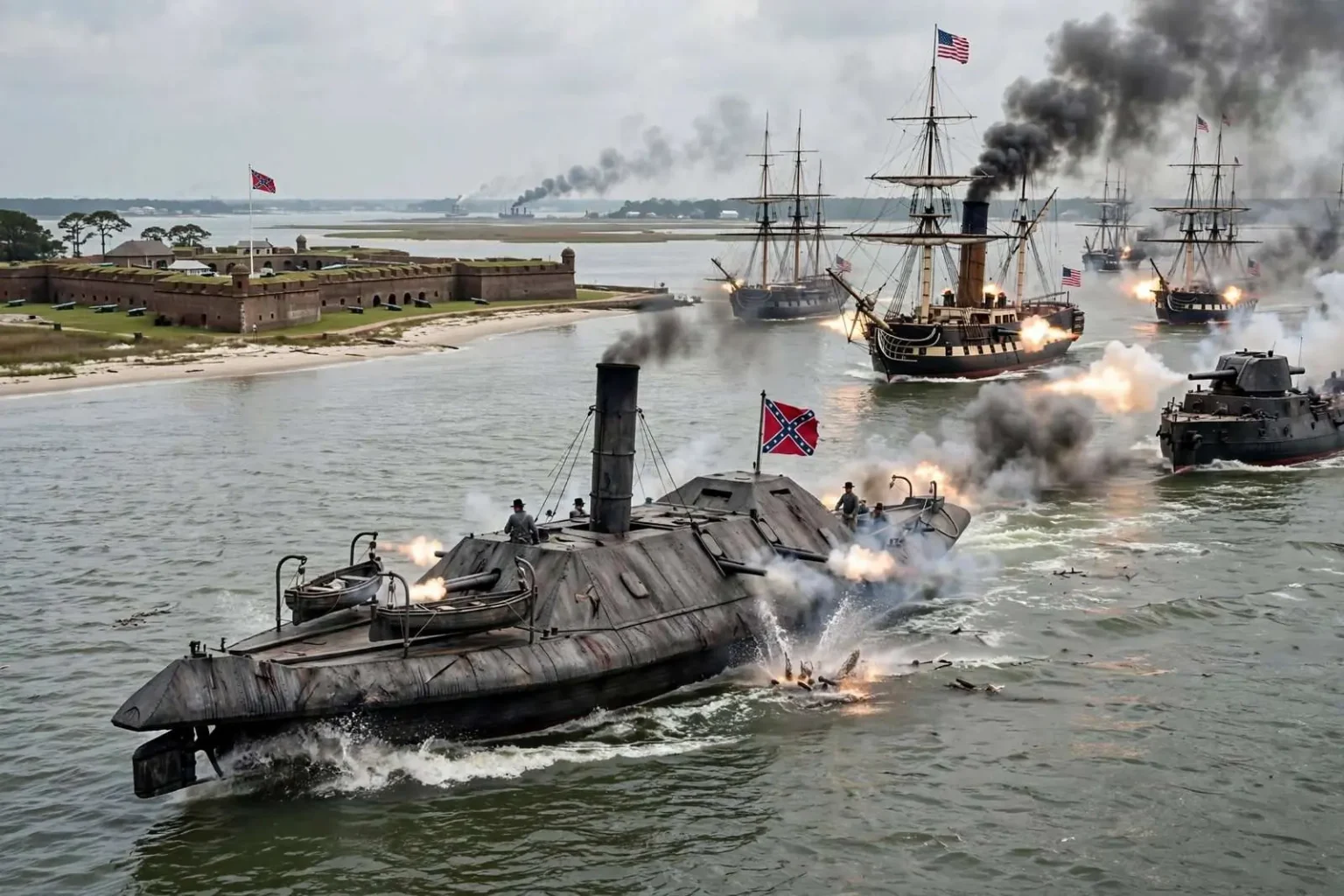
FORT MORGAN, Alabama — Ahead of the 150th anniversary of the Battle of Mobile Bay, local historians have been revisiting one of the most dramatic moments of the Civil War fight that unfolded just off Fort Morgan’s shoreline: the Confederate ironclad Tennessee’s decision to abandon the safety of the fort’s guns and charge directly into the heart of the Union fleet.
The Battle of Mobile Bay, fought on Aug. 5, 1864, was one of the decisive naval actions of the Civil War and the closing chapter of the Union campaign to seal the Gulf Coast’s last major Confederate port. Mobile had sheltered blockade runners throughout the war, its bay protected by a ring of fortifications and minefields that had deterred Union assault for three years. By the summer of 1864, with Atlanta under threat and the blockade tightening elsewhere, Rear Adm. David Farragut’s fleet finally forced the issue, steaming past the forts in a run that entered naval legend.
For the communities around Mobile Bay, the battle’s anniversary carries a local resonance few other Civil War events can match. Fort Morgan still stands at the tip of the peninsula guarding the main ship channel, its brick walls open to visitors who walk the parapets where the garrison watched the Union fleet approach that August morning. The waters where the ironclads collided are a short distance offshore, visible from the fort on a clear day, making this stretch of the Alabama coast one of the most intact battlefields of the war.
The fort itself is a work of history older than the battle it is remembered for. Completed before the Civil War as part of the nation’s third-system coastal defenses, Fort Morgan was named for Revolutionary War hero Daniel Morgan and garrisoned Alabama’s strategic point at Mobile Point for decades before the war forced its baptism by fire. Confederate forces seized and strengthened it at the war’s outbreak, adding the outerworks and batteries that anchored the bay’s defenses alongside Fort Gaines on Dauphin Island across the channel.
A Calculated Gamble Under the Fort’s Guns
The Tennessee had positioned itself only a few miles from the approaching Union ships, sheltered by the heavy artillery at Fort Morgan. Rather than wait, the ship’s commander, Admiral Franklin Buchanan, chose to push forward and confront the fleet directly. According to accounts drawn from historical works on the Mobile campaign, Buchanan later explained that he wanted to avoid the fate of another famous Confederate ironclad that had been destroyed by its own crew rather than face capture, and instead hoped a bold, unexpected strike into the Union line might inflict real damage before the numerically superior fleet could respond.
Buchanan was no stranger to ironclad warfare or to bold action. The Maryland-born officer had commanded the Confederate ironclad Virginia — the rebuilt Merrimack — at Hampton Roads two years earlier, where he fought the epic first duel between ironclads before being wounded. His assignment to Mobile placed him in charge of the bay’s naval defenses, and the Tennessee, the most powerful ironclad yet built by the Confederacy, was his weapon of last resort.
The ship itself was a formidable product of Southern industry. Built at Selma on the Alabama River and completed after months of delays in matériel and labor, the Tennessee carried armored casemates of thick iron plate over massive timber, sloped to deflect shot, and mounted heavy guns at each corner of her casemate. Slow, nearly unstoppable by direct fire, and commanded by officers determined to sell their ship dearly, she represented the Confederacy’s best chance to break the Union fleet’s momentum in the channel.
An Attack That Lost the Element of Surprise
Buchanan had hoped to catch the Union fleet off guard by steering the Tennessee toward the USS Hartford, the flagship of Admiral David Farragut. Union lookouts, however, had already spotted the Confederate squadron’s movements and repositioned before the ironclad could close the distance. Historical accounts describe Buchanan’s small squadron, which included the gunboats Morgan, Gaines and Selma alongside the ram Tennessee, forming a line and advancing together toward the approaching Union warships, together fielding roughly twenty guns and several hundred sailors against a much larger opposing force.
The imbalance was stark. Farragut’s flotilla numbered more than a dozen major vessels, including four new ironclad monitors built specifically to counter Confederate rams, mounting heavy guns whose shot could crack armored casemates that smaller weapons could not. The Union fleet had already run past Fort Morgan’s batteries in the morning’s main action, with the monitor Tecumseh lost to a mine — the torpedoes Farragut’s famous order had warned of — and the wooden warships lashed into pairs to make the passage. Now, with the fleet inside the bay, the Confederate squadron attacked into the teeth of it.
The disparity in speed made the odds worse. The Tennessee could manage only a few knots, while the Union wooden sloops could steam rings around her under full canvas and steam. Buchanan’s gamble depended on the ironclad’s ability to absorb punishment while closing to ram, but once the Union ships learned to keep their distance and concentrate fire, the mathematical reality of one slow vessel against an entire fleet asserted itself.
Collisions in the Channel
As Buchanan pressed his attack toward the Hartford, the Union warship Monongahela struck the Tennessee directly, part of a Union tactic of ramming the heavily armored Confederate vessel rather than relying solely on gunfire. The Tennessee had gotten off shots at her attackers as she advanced, but the blows began to accumulate — ram after ram and broadside after broadside converging on a single ship that could not run and could not hide.
The ramming attacks testified to how difficult the Tennessee was to stop by any other means. Union vessels struck her at speed, hoping to shake her armored structure loose or disable her steering, while the monitors pounded her casemate at close range with their heavy guns. Shot from the largest weapons cracked and dented her armor, disabled gun ports, and eventually carried away her stack and steering chains, leaving the ironclad struggling to maneuver as the battle ground on through the morning.
For the sailors on both sides, the fighting in the channel was close, brutal work. Crews worked guns in smoke so thick that ships appeared as shadows, wooden vessels shattered by shot that punched through planking while the armored Tennessee shrugged off attacks that would have sunk any ordinary warship. The spectacle of a single ironclad trading blows with an entire fleet made the battle an instant story across the country, retold in illustrations and veterans’ accounts for decades afterward.
The end, when it came, was a matter of arithmetic. With her steering disabled, her smokestack shot away and her engine slowing, the Tennessee could no longer fight or flee. Buchanan, wounded in the action, and his surviving officers struck the colors, and the Union fleet took possession of the most powerful Confederate ironclad afloat. The gunboats Morgan and Gaines had already been disabled or driven off, and the Confederate naval defense of Mobile Bay was finished by mid-morning.
The day’s result changed the war’s strategic map. With the forts cut off and the bay closed to blockade runners, Mobile’s role as the Confederacy’s last major Gulf port was effectively ended, and the Union gained a protected harbor for its Gulf operations in the final year of the fighting. Fort Morgan itself held out for weeks under siege before its garrison surrendered, but the naval battle had decided the campaign in a single morning.
Why the Charge Still Captures the Imagination
Historians debating Buchanan’s decision have generally settled on the constraints he faced rather than recklessness as the explanation. The Tennessee could not have survived at anchor under the fort’s guns indefinitely while the Union fleet landed troops and prepared to subdue the defenses; a sortie offered the only chance, however slim, of damaging the fleet enough to delay the inevitable. Buchanan’s own account, as preserved in the historical literature on the campaign, framed the attack as a choice between a hopeless defense and a bold bid — between destruction without a fight and destruction with a chance of consequence.
That framing is what draws anniversary visitors to Fort Morgan today. The ruin of the engagement is written in the landscape: the channel where the monitors closed in, the stretch of water where the wooden fleet wheeled, the fort whose batteries watched the whole drama unfold beyond range of their largest guns. Walking the fort’s ramps during the sesquicentennial commemorations, a visitor can stand where the garrison stood and see nearly all of the battlefield at once — a rare completeness among Civil War naval sites.
The 150th anniversary observances have given local historians their largest audience in years, with programs at the fort revisiting the ships, the commanders and the morning when Mobile Bay’s defense was gambled on one armored ship and lost. The Tennessee’s charge remains the battle’s defining image: a single vessel, outnumbered and outrun, steaming straight at a fleet — and, in the memory of the coast it defended, going down fighting.