Fort Morgan Unveils First Memorial Marking 150 Years Since Mobile Bay Siege
Thousands gathered at Fort Morgan in Baldwin County to dedicate the fort's first-ever memorial marking 150 years since the Battle of Mobile Bay.
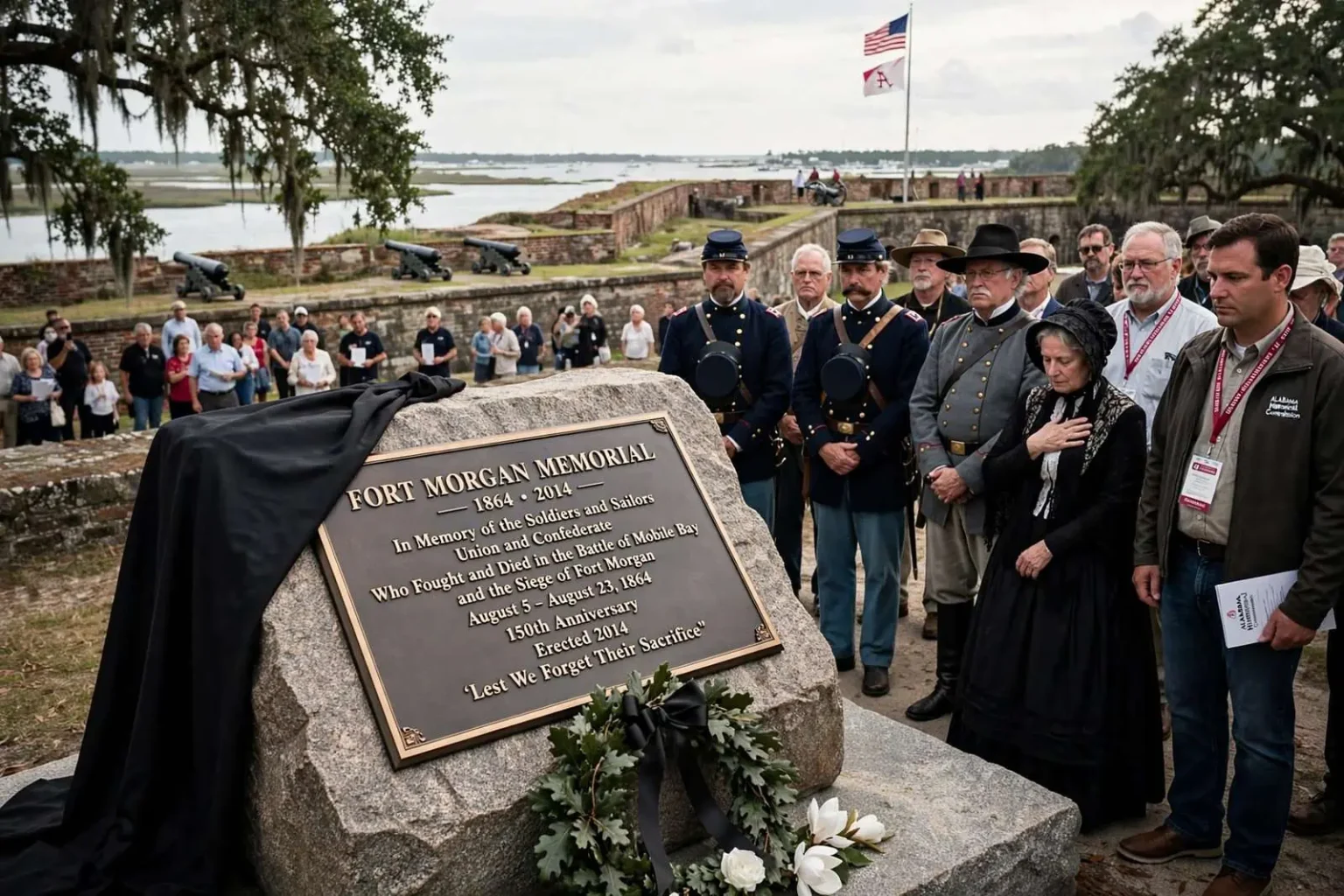
FORT MORGAN, Alabama — Thousands of visitors converged on the grounds of Fort Morgan to mark a somber milestone: a century and a half since the Battle of Mobile Bay and the weeks-long siege that followed at the historic coastal fortification. The gathering centered on the dedication of Fort Morgan’s first permanent memorial commemorating the men who fought and died there, paired with a large-scale re-enactment that filled the bay and shoreline with the sound of cannon fire much as it would have echoed a century and a half earlier. Organizers said the event was designed to be a moment of reflection rather than spectacle.
The commemoration capped a year of sesquicentennial observances held around Mobile Bay, drawing history enthusiasts, descendants of the soldiers and sailors who fought, and curious visitors from across the Gulf Coast to the star-shaped masonry fort at the mouth of the bay. Fort Morgan, completed in the 1830s and long guarded by the Alabama Historical Commission as a state historic site, remains one of the most intact fortifications of its era on the eastern seaboard and the Gulf, and its grounds offered a fitting stage for the anniversary.
For many in attendance, the day carried a weight that went beyond pageantry. The Battle of Mobile Bay, fought on August 5, 1864, was one of the most consequential naval engagements of the Civil War, and the siege that followed reshaped life across the central Gulf Coast for generations. The new memorial ensures that the men on both sides who gave their lives in that campaign now have a permanent place of honor at the site where they fell.
The Campaign That Closed the Bay
Historians on hand placed the fighting in its larger context. By the summer of 1864, Mobile Bay remained one of the last Confederate ports on the Gulf still shipping supplies eastward, and Union commanders had long coveted its capture. A Union fleet under Adm. David Farragut fought its way past the bay’s defenses in early August, famously braving the underwater mines — then called torpedoes — that guarded the channel, while troops landing on the western shore moved to seize the forts that anchored the bay’s defenses.
The naval clash proved far deadlier than the land fighting that followed, killing Confederate and Union sailors alike. The bulk of Union losses came when one of the fleet’s ironclads struck an underwater mine in the channel and sank rapidly, taking many of its crew down with her in one of the worst single-ship losses of the war for the Union navy. Confederate gunboats and the formidable ironclad ram defending the bay were destroyed or captured in the same action, leaving the forts isolated.
Fort Morgan itself held out for roughly three more weeks. Confederate defenders endured a punishing siege before surrendering in late August 1864, closing the port as an effective outlet for blockade runners and tightening the economic noose around the Confederacy’s Gulf operations. Though the city of Mobile itself did not fall until the following spring, the loss of the bay sealed its fate as a supply lifeline.
The human cost of the siege was smaller than the naval battle’s but still profound. Nearly a dozen Confederate defenders and one Union sailor died during the roughly three-week siege of the fort in August 1864. Historical accounts also point to roughly 150 additional Confederate soldiers who died later at a Northern prison camp after the garrison’s surrender, men who survived the bombardment only to perish far from home in captivity.
A First-Ever Marker for the Fort
The new plaque is the first permanent memorial at Fort Morgan dedicated to the men who fought and died in the 1864 campaign. Its text lists the Union naval and army units that took part in the campaign alongside the Confederate vessels, companies and commanders who defended the bay and fort, giving equal historical weight to both sides of the conflict. Organizers said that balance was deliberate, reflecting a modern understanding of the site as a place of shared history rather than a monument to one cause.
A closing inscription drawn from a Union officer’s own words was chosen to honor the fallen rather than glorify the fighting itself. Members of the committee that developed the memorial said the wording was selected after extensive research into accounts of the battle and siege, and that it captures the grief felt on both sides of the trenches once the fighting ended.
Following the plaque’s unveiling, a Fairhope-based painter presented the latest work in an ongoing series of oil paintings depicting key commanders from the battle, adding to a visual record of the campaign that has grown alongside the sesquicentennial commemorations held around Mobile Bay this year. The painting joins a body of portraiture that has paired the anniversary observances with a renewed artistic interest in the campaign’s leading figures, on both the Union and Confederate sides.
The re-enactment that framed the dedication brought hundreds of costumed participants to the fort’s grounds and the waters just offshore. Cannon thundered from the ramparts and from reproduction vessels in the channel, recreating for modern audiences the sensory experience of an assault on the bay. Re-enactors portraying infantry, artillery and naval units staged demonstrations throughout the day, while living history interpreters answered questions about the weapons, uniforms and daily life of a Civil War garrison.
Organizers emphasized that the anniversary programming was built to educate as much as to entertain. Historical societies, museum staff and volunteer interpreters set up exhibits on the fort’s construction, the mining of the channel, medical care during the siege and the experiences of Mobile Bay civilians during the Union occupation. School groups and families moved among the displays, and many visitors took advantage of guided tours that connected the ground they walked to the events of August 1864.
Descendants Reflect on Family Ties to the Siege
For some attendees, the ceremony carried a deeply personal weight. Descendants of soldiers who endured the siege and the prison camp that followed traveled to Fort Morgan specifically to honor ancestors whose names now live on through family history rather than public memorials. For those families, the new plaque represents the first formal recognition their forebears have received at the site, generations after the guns fell silent.
One woman from the Eastern Shore said she came to pay respects on behalf of relatives from Choctaw County who survived captivity in the North, while a family member of theirs did not. Her account echoed those of many Alabama families whose oral histories preserve the hardships of the siege, the surrender and the long train ride to prison camps that so many garrison soldiers never returned from.
Genealogists and park staff said interest in the fort’s 1864 story has surged during the sesquicentennial, with families researching service records, pension files and unit histories to confirm connections to the garrison. The state’s archival records of the Mobile Bay campaign have seen steady use as descendants piece together where their ancestors stood during the bombardment and surrender, and staff at the fort have increasingly served as a first point of contact for that research.
The commemoration also drew veterans organizations and heritage groups from around the region, many of which laid flowers or conducted small observances of their own alongside the official program. Representatives of naval history organizations noted the enduring significance of the battle in American naval tradition, which still references the engagement in discussions of fleet tactics, mine warfare and the hazards of contested channels.
A Day of Remembrance Closes by the Water
As the afternoon light softened over the bay, the ceremony drew to a close with a wreath laid at the water’s edge and the playing of taps, formally concluding a day of remembrance for a battle that helped shape the closing chapter of the Civil War along the Gulf Coast. The notes of the bugle carried across the same channel where the ironclad went down 150 years earlier, and attendees stood in silence as the flag was lowered for the day.
Fort Morgan staff said the new memorial will remain a permanent feature of the site, giving future visitors a fixed point of reflection regardless of whether another major anniversary arrives. Interpretive plans call for the plaque to be incorporated into the fort’s regular tours, so that the hundreds of thousands of visitors who pass through the gates each year will encounter the names of the units and commanders who fought there alongside the fort’s military history.
Local tourism officials said the sesquicentennial year has delivered a measurable boost to the Fort Morgan peninsula and the wider Gulf Shores area, with anniversary events pulling visitors who might otherwise have limited their trips to the beach. Motels, restaurants and vacation rental operators in Gulf Shores reported strong business around commemoration weekends, and the fort itself saw attendance climb well above typical seasonal levels during the anniversary programming.
The economic ripple effects extend to Mobile, where maritime museums, historic churches and antebellum districts have marketed themselves as complements to the fort’s observances. Visitors tracing the story of the bay campaign can now build multi-day itineraries that link Fort Morgan, Fort Gaines on Dauphin Island, the Mobile waterfront and the museum collections downtown, and area tourism agencies have encouraged exactly that kind of heritage travel during the anniversary season.
Historians say the battle’s legacy remains visible across the region well beyond the fort’s walls. Streets, schools and landmarks around Mobile Bay carry the names of the campaign’s commanders and vessels, and the recovered artifacts of the battle — from ship fittings to cannon — populate museum displays on both sides of the bay. The wreck of the sunken ironclad itself rests in the waters of the channel, a protected grave site that divers and archaeologists have documented and that state agencies treat with the reverence owed a military burial place.
Preservation advocates hope the anniversary energy will translate into long-term support for the fort itself. Like many historic sites, Fort Morgan faces ongoing needs for masonry conservation, exhibit upgrades and storm recovery along a low-lying coastline exposed to hurricanes. The visibility that the sesquicentennial has brought, they argue, is a chance to build the membership, volunteer base and funding that will carry the site through its next fifty years.
For the organizers of the dedication, the measure of success was simpler: a memorial raised, a story told with fairness to both sides, and a community gathering that treated the dead of 1864 with dignity. As the crowd filed out past the ramparts at day’s end, the new plaque stood at the water’s edge where the campaign began and ended, ready for the next generation of visitors who will come to Fort Morgan to understand how a single summer of fighting 150 years ago changed the Gulf Coast forever.