Reenactors Settle Into Camp at Fort Morgan Ahead of Battle of Mobile Bay Weekend
Confederate reenactors set up camp at Fort Morgan in Baldwin County as the annual Battle of Mobile Bay reenactment prepares to begin.
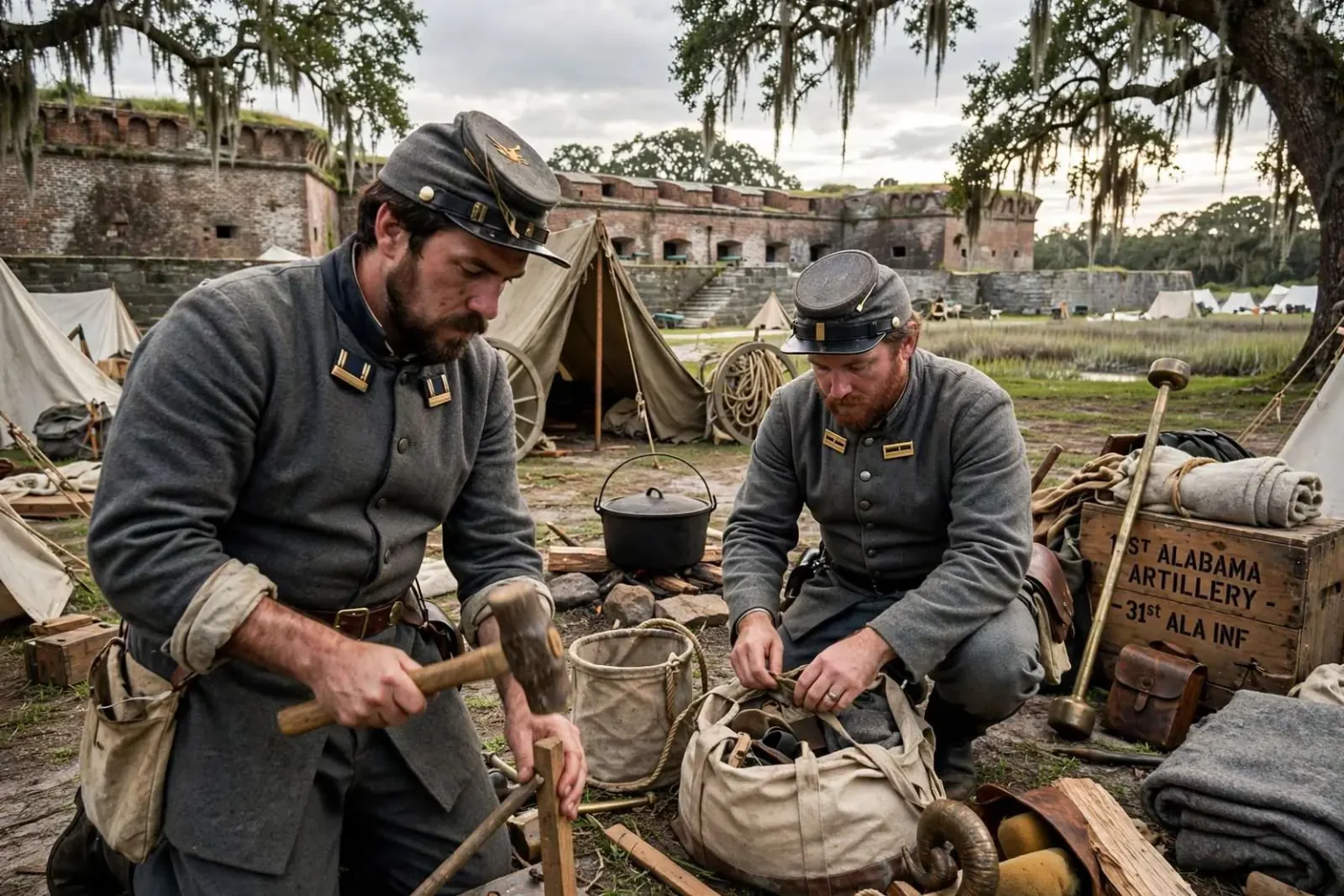
FORT MORGAN, Ala. — With Saturday morning’s reenactment of the Battle of Mobile Bay drawing near, living historians spent Friday settling into camp at the historic Fort Morgan site at the mouth of Mobile Bay, preparing tents, gear and uniforms for a weekend meant to bring 1864 back to life.
Among those setting up were Matt Penhale of Birmingham and Pete Smith of Lineville, two members of a Confederate reenactment unit who have spent years portraying soldiers from the era. Penhale, who serves as captain of the 31st Alabama Infantry, said he has been reenacting for nearly eight years. For this particular event, however, he and Lieutenant Smith stepped into different roles, representing the 1st Alabama Artillery rather than their usual infantry positions.
Penhale explained that the switch reflects how soldiers actually served during the historic siege of Fort Morgan, when troops were commonly trained in both artillery and infantry roles rather than sticking to a single specialty. Reenactors aim to mirror that flexibility during the weekend event, which typically combines elements of naval battle, infantry maneuvers and artillery demonstrations all within a compressed two-day schedule. Organizers and participants alike work to keep the details, from uniforms to tactics, as historically accurate as possible.
The history behind the weekend
The original Battle of Mobile Bay unfolded on August 5, 1864, when a Union fleet under Adm. David Farragut fought its way past the forts guarding the bay entrance and defeated a Confederate squadron in one of the decisive naval actions of the Civil War. Fort Morgan, the masonry work completed in 1834 on Mobile Point, controlled the deep-water channel into the bay and became the focal point of the campaign. After the naval battle, Union forces besieged the fort, which surrendered in late August 1864 after weeks of bombardment, opening Mobile Bay to Federal shipping and tightening the blockade that strangled the Confederacy’s last major Gulf port.
The fort’s setting at the tip of Mobile Point in Baldwin County has made it a natural stage for anniversary commemorations. The site is now operated as a state historic site, drawing visitors who walk the ramparts, explore the tunnels and bombproofs, and watch living history demonstrations throughout the year. Weekend reenactments there typically draw units from across Alabama and the Southeast, along with spectators from Mobile, Baldwin County and beyond who cross Mobile Bay by ferry or drive down the Fort Morgan peninsula to attend.
Why reenactors switch roles
Penhale said the artillery impression used at Fort Morgan matches the way the garrison actually operated during the siege. Confederate soldiers stationed on the Gulf Coast were frequently shifted between manning heavy guns in the fort and fighting as infantry in the trenches, so the weekend program blends artillery firings with infantry drill to show both sides of that service. For reenactors, the change of role also means new equipment: artillery units work around cannons, powder, implements and safety protocols that differ sharply from the muskets and bayonets of an infantry company.
Safety and authenticity govern the demonstrations. Cannon firings follow a scripted sequence, with crews inspecting the bore, serving the piece in measured steps and firing blank charges at scheduled intervals so visitors can experience the noise and smoke that defined 19th-century warfare. Infantry demonstrations cover marching, loading and volley fire, and interpreters often pause to explain to onlookers what each motion would have meant in combat.
For Smith, the appeal of reenacting comes down to a mix of interests: a love of history, time spent outdoors, and the chance to meet fellow enthusiasts from around the region. He is one of roughly 10 to 15 members who make up the 31st Alabama Infantry, a group that travels to a number of reenactment events throughout the year.
The unit portrayed Confederate troops at a Gettysburg reenactment the previous year and had plans to head to Atlanta the following month, though for that event they would trade their gray uniforms for blue, taking on the role of Union soldiers instead. That kind of flexibility is common in the reenactment community, where the size of a scheduled battle often dictates which side needs more troops, and units that can portray either army find themselves in steady demand.
Life in camp
The Friday setup is more than logistics. Reenactors spend the weekend in period encampments, sleeping in canvas tents, cooking over open fires and keeping modern gear out of sight of the public. Living historians describe the camp itself as part of the education, since visitors who arrive early can see soldiers at ease, meals being prepared and drills being run in an atmosphere closer to daily army life than to a staged battle.
The 31st Alabama Infantry’s members come from communities scattered across central and east Alabama, from Birmingham to Lineville, and the unit’s schedule illustrates the travel that hobby demands. A typical year can include events in Alabama, Georgia, Tennessee and beyond, with members hauling tents, wool uniforms, leather gear and weapons to each one. Gettysburg-scale events can draw thousands of reenactors and tens of thousands of spectators, while smaller, site-specific commemorations like the one at Fort Morgan offer a more intimate setting tied to actual ground where history happened.
Fort Morgan as a destination
Fort Morgan State Historic Site occupies a narrow peninsula where Mobile Bay meets the Gulf of Mexico, reachable via State Route 180 from Gulf Shores and paired with the Mobile Bay Ferry, which carries cars and passengers across the mouth of the bay to Dauphin Island. The fort’s star-shaped design, moat, casemates and Bastion cannon platforms give visitors a close look at 19th-century military engineering, and a museum on the grounds interprets the fort’s role from its construction through the Civil War and its later use through World War II.
Events like the Battle of Mobile Bay reenactment weekend are among the site’s best-attended programs, and organizers use them to highlight the role Mobile Bay played in the war’s final year. The capture of the bay in August 1864 helped close one of the Confederacy’s principal supply routes and contributed to the eventual fall of the city of Mobile itself in the spring of 1865.
For the men of the 31st Alabama Infantry, the weekend at Fort Morgan offers a chance to stand where the garrison they portray once stood, working the guns that guarded the channel. For the visitors expected Saturday, it is an opportunity to see artillery fire across the same water Farragut’s fleet steamed through more than a century and a half ago, with living historians on hand to explain how the battle unfolded and why the fort at the mouth of Mobile Bay mattered so much to both sides.
Planning a visit
Organizers encourage spectators to arrive early, bring sunscreen and water, and plan for walking across uneven ground around the fort. The reenactment schedule typically builds through the day, with camp tours and drill demonstrations in the morning and the main battle scenario in the afternoon, when the combined artillery, infantry and naval elements come together in a single scripted engagement. Parking near the fort is limited, and the site’s location on the narrow Fort Morgan peninsula means traffic backs up on event days, another reason locals often take the ferry from Dauphin Island or arrive well before the scheduled firing demonstrations.
The weekend’s blend of naval history, artillery and infantry impressions gives south Alabama one of its most distinctive living history events. Units like the 31st Alabama Infantry provide the manpower that makes such commemorations possible, donating their weekends, funding their own gear and traveling hundreds of miles each year. Whether portraying Confederates at Fort Morgan or, as the unit planned for its Atlanta trip the following month, pulling on Union blue, the members share the same goal: giving the public a detailed, honest window into the lives of the soldiers who fought the Civil War on the Gulf Coast.
Reenactment organizers point out that the educational payoff extends well beyond the battle itself. Throughout the weekend, members of the public can ask questions in camp, watch field hospital demonstrations and hear interpreters describe what civilians on Mobile Point endured when the Union army moved ashore. School groups and families from Mobile, Daphne, Fairhope and Gulf Shores make up a large share of the crowd, and living historians tailor their explanations to visitors encountering Civil War history in person for the first time.
The fort itself remains the star attraction between battle scenarios. Its brick walls, some more than 20 feet thick at the base, absorbed the Union bombardment in 1864, and the wreckage of that siege is still visible in sections of the work left unrestored. Interpretive staff and volunteers connect the weekend’s pageantry to those scars, giving attendees a tangible sense of the violence the site absorbed and the decades of change that followed. For the reenactors of the 31st Alabama Infantry and their fellow units, that setting is precisely why the long drive, the heavy wool uniforms and the weekend of camping are worth it.