Battle of Mobile Bay 150th Anniversary Reenactment Draws Crowds to Fort Gaines
Reenactors and visitors gathered at Fort Gaines on Dauphin Island to mark 150 years since the Battle of Mobile Bay with cannon fire and camp life.
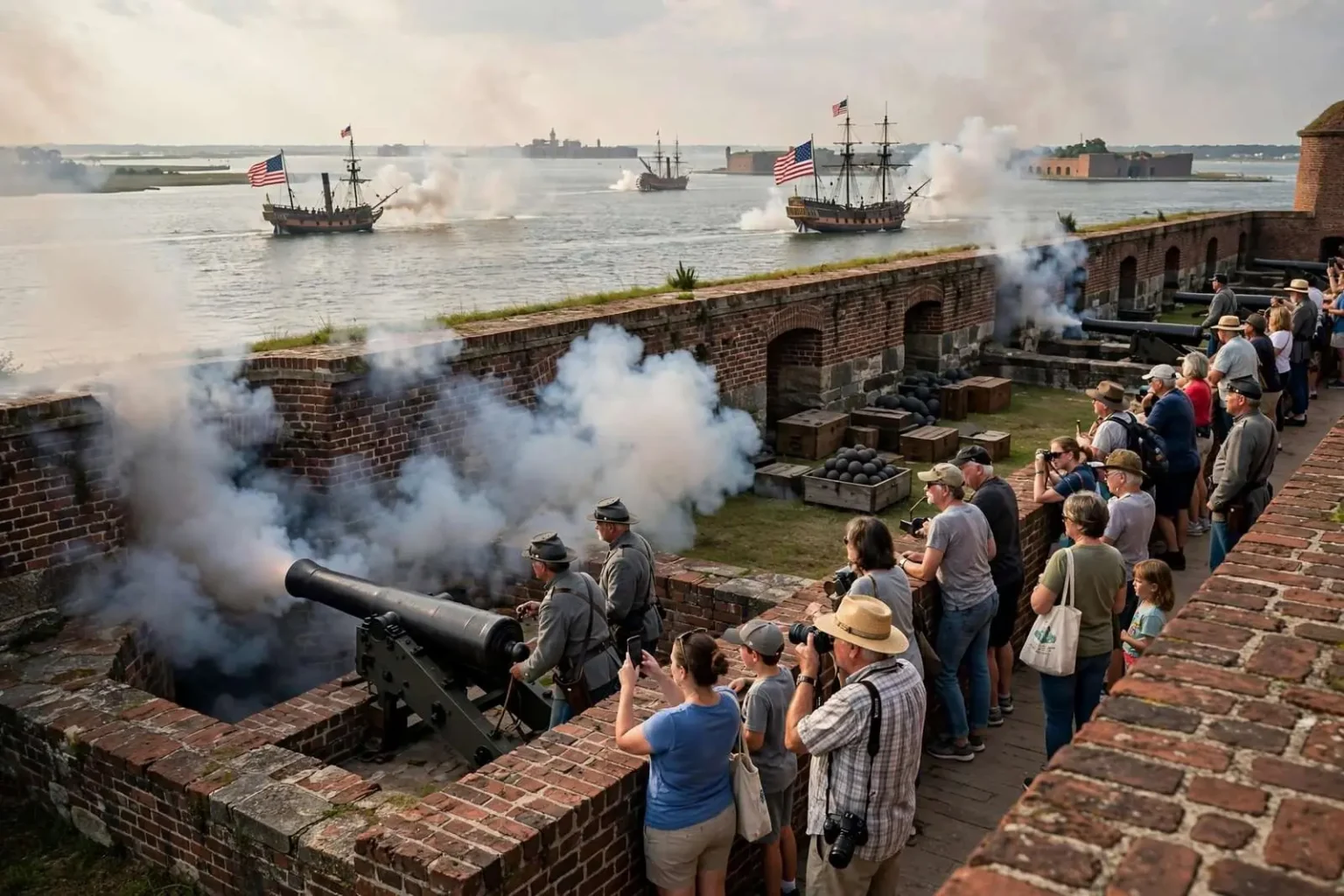
Cannon smoke drifted over Dauphin Island’s western shoreline as reenactors and spectators gathered at Fort Gaines to mark the 150th anniversary of the Battle of Mobile Bay, one of the Civil War’s most consequential naval engagements fought at the mouth of the bay. The anniversary drew history enthusiasts, families and curious visitors to the island for a weekend that turned the fort’s brick ramparts into a working stage for the events of August 1864.
Organizers had planned the day’s mock shelling for early afternoon but pushed the start time up by roughly half an hour, catching some of the costumed artillery crews pleasantly off guard. Union-flagged vessels representing the federal fleet sailed past the fort after staging an attack on Fort Morgan across the water, exchanging fire with Confederate reenactors manning cannons and rifles along the ramparts as onlookers watched from the grounds and the shoreline nearby. The coordinated maneuver recreated the essential geography of the original battle, in which Adm. David Farragut’s fleet ran past the two forts guarding the bay entrance and defeated the Confederate squadron inside.
Visitors described the recreated bombardment as immersive, with the boom of the artillery and the sight of ships firing back creating a sense of stepping into the historical moment rather than simply observing it. Several in the crowd said it was their first time witnessing a full-scale cannon demonstration up close, and the noise and spectacle left an impression even on longtime area residents who grew up near the fort. The concussion of a black-powder cannon carries across open water, and spectators standing along the parapets felt the firing as much as they heard it.
The 150th anniversary carried particular weight among Civil War commemorations. The Battle of Mobile Bay, fought Aug. 5, 1864, closed the Confederacy’s last major port on the Gulf of Mexico east of Texas, tightening the Union blockade and giving President Lincoln’s administration a much-needed victory in an election year. Farragut’s reported order — “Damn the torpedoes, full speed ahead” — entered the national lexicon after his fleet steamed through the minefield protecting the channel.
An Island That Doubles as a Battlefield
Dauphin Island’s setting adds to the atmosphere of an anniversary weekend. The island sits at the mouth of Mobile Bay, reachable by road across the Intracoastal Waterway bridge or by the passenger and vehicle ferry that runs across the bay entrance between Fort Morgan and the island’s eastern end — a crossing that retraces, in miniature, the water route the federal fleet took into the bay. Many anniversary visitors arrived by ferry, watching Fort Morgan recede behind them just as the reenactment’s Union-flagged vessels staged their advance.
The island itself has long balanced its roles as a quiet residential community, a birding destination of national reputation and a heritage tourism site. The Audubon sanctuary protects maritime forest that migratory birds use each spring and fall, while the eastern tip’s historic district anchors the fort and its grounds. Events like the sesquicentennial reenactment bring those audiences together, filling the island’s vacation rentals and restaurants during a weekend that otherwise sits in the late-summer lull between peak beach season and fall migration.
Local officials have promoted heritage tourism as a steadier economic pillar than beach traffic alone, and Civil War anniversaries are among the strongest draws. Visitors who attend a battle commemoration tend to stay longer, tour both forts and return for other island events, spreading spending across the community rather than concentrating it on the sand.
Living History Inside the Walls
Once the staged shelling wound down around early afternoon, activity at the fort continued with living-history demonstrations meant to show visitors how a Civil War-era soldier actually lived day to day, from camp routines to equipment and daily rations. Reenactors cooked period meals over open fires, demonstrated the loading and care of muskets, and talked visitors through the uniform, gear and pay of a garrison soldier stationed on the island a century and a half ago.
Living-history demonstrations are the quieter half of any reenactment weekend, but they are often where visitors ask the most questions. A child watching a cannon fire sees a spectacle; a child watching a soldier fry salt pork and explain hardtack sees what war actually demanded of ordinary people. The fort’s grounds lend themselves to that kind of teaching, with the barracks, tunnels and gun emplacements still intact for visitors to walk through.
Several reenactors said they view the events primarily as an educational opportunity, noting that many people living in the area today know little about the war or the battle fought practically in their backyard. Schools across Mobile and Baldwin counties cover the Civil War in the classroom, but reenactors argued that standing inside a fort that actually exchanged fire with a federal fleet teaches something a textbook cannot — the scale of the guns, the thickness of the walls and the distance across the channel to Fort Morgan, visible on a clear day across Mobile Point.
For some participants, the connection ran deeper than history-book interest. One reenactor traveling from Louisiana said her husband takes part specifically because a Confederate ancestor served with an Alabama reserve unit and fought at Mobile Bay as a teenager, making the annual commemoration a way of honoring family history rather than just historical curiosity. Stories like hers are common in reenactment circles, where family genealogy often supplies the initial spark that turns a weekend hobby into a decades-long pursuit.
Other participants, including infantry reenactors who traveled from out of state, said they simply enjoy the camaraderie and tradition of the living-history weekend, with plans to continue the demonstrations into the following day. Units that camp together at events across the Southeast form friendships that persist across generations, and anniversary events like the Mobile Bay sesquicentennial draw the largest turnouts precisely because they gather dispersed units in one place.
Fort Gaines and the Story of the Bay
The anniversary event drew visitors from across the Gulf Coast to Fort Gaines, a well-preserved 19th-century masonry fortification that has become one of Dauphin Island’s most visited historic landmarks and a touchstone for understanding Mobile Bay’s role in Civil War history. Built beginning in the early 1820s on the island’s eastern tip, the fort guarded the bay’s western channel and, together with Fort Morgan across the entrance, formed the defensive pair the Union fleet had to run past in August 1864.
Today the fort preserves much of its original fabric: the brick walls, spiral staircases, gun mounts, kitchens and the tunnels that connected sections of the interior. Its position at the gateway to Mobile Bay places it at the center of the island’s tourism, alongside the Audubon bird sanctuary that covers much of the rest of the island and the beaches along its Gulf shore. Visitors who come for a reenactment weekend typically leave with a fuller picture of the island’s layered history, from French colonial settlement through the Civil War to the fishing village it remained for a century afterward.
Why Mobile Bay Mattered
The battle reenactors commemorated was a turning point with consequences far beyond the Gulf. Mobile Bay was the last major Gulf port open to Confederate blockade runners, and its capture by Farragut’s fleet severed a lifeline that had funneled supplies through the bay and up the Alabama rivers. Combined with the fall of Atlanta in the same season, the victory at Mobile Bay buoyed Northern morale ahead of the 1864 presidential election and helped close the ring around the Confederacy in its final year.
For the communities around the bay, the engagement’s legacy remains visible — in the forts that face each other across the entrance, in the shipwrecks and artifacts that divers and archaeologists have documented, and in museums in Mobile that interpret the battle and the blockade. Sesquicentennial events like the one at Fort Gaines connected those sites for a new audience, pairing the artillery spectacle on the water with the quiet, detailed education happening inside the walls.
By the time the smoke cleared and the camps settled for the evening, organizers had delivered what the crowds came for: a fleet on the water, guns on the ramparts and history close enough to feel. The demonstrations were set to continue the next day, giving weekend visitors a second chance to watch the bay’s most famous battle come back to life at the fort that witnessed it. For the reenactors who traveled from across the region and the residents who watched from their own shoreline, the sesquicentennial closed with the same lesson it opened with — that the story of Mobile Bay is best understood standing where it happened, with the wind off the water and the guns still echoing in memory.