Saraland’s School Breakaway Stalls as State Deadline Arrives
Saraland Superintendent Paul Sousa said negotiations to separate from the Mobile County school system had gone silent, with a state deadline days away and a new high school waiting on a deal.
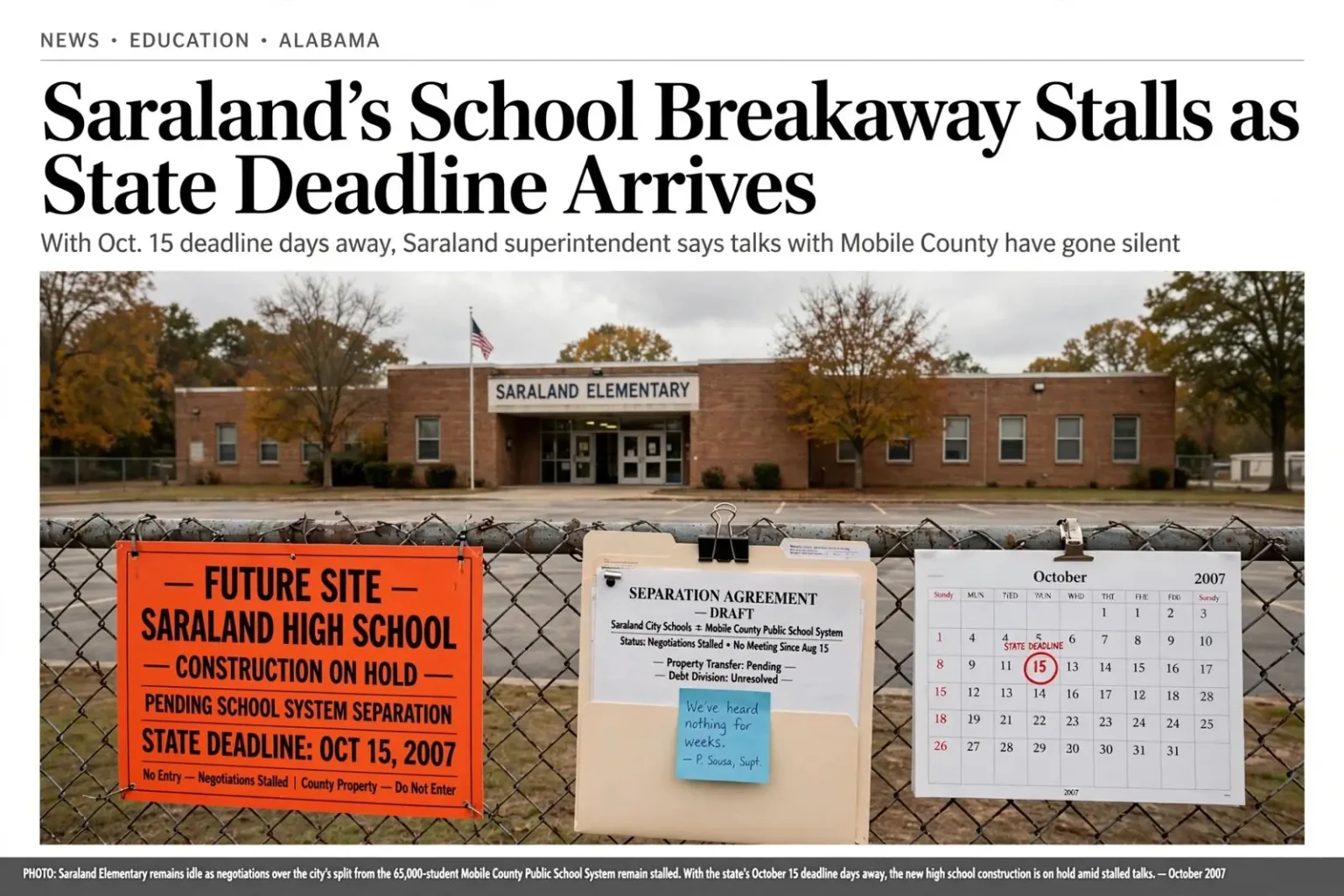
Negotiations over Saraland’s split from the Mobile County Public School System had gone quiet, and the city’s superintendent said he was running out of time. State School Superintendent Joe Morton had directed the two sides during the summer to complete the necessary transactions by Oct. 15. With that deadline days away, Saraland School Superintendent Paul Sousa said his side had heard nothing for weeks.
The standoff left one of the most ambitious municipal undertakings in south Alabama hanging on paperwork neither side seemed able to finish. Saraland had voted to leave the state’s largest school system, had begun collecting its own taxes to pay for a new one, and had a construction schedule keyed to a start date that would not wait.
‘We’re just sitting here waiting’
“We met several times, their group and our group, and made a lot of progress,” Sousa said. Then, on Aug. 15, Mobile County Superintendent Harold Dodge informed him that the county system’s attorneys had taken the documents, and that there would be no more meetings while the lawyers had them.
“We wrote letters and asked to continue the negotiations to no avail,” Sousa said. “Then we got a letter with their version. We looked at it and said, ‘Okay, we agree with a lot of this, but it needs further clarification and fine-tuning.’ We asked to sit down again and finish this thing.”
County officials, according to Sousa, replied that the deal could be finalized by letter. Sousa did not believe it. Only a face-to-face meeting, he said, would be productive and conclusive.
“We sent back a document with all our concerns in writing and we’ve heard nothing since then,” he said. “We’re going to run out of time. We’re concerned. We’ve got to build a high school and we can’t move forward until we have a school system. We’re just sitting here waiting.”
Sousa expected the state to assign a mediator to force the sides to an agreement. Mediation was the obvious next step under the state’s oversight role: once the state superintendent sets a deadline and the parties cannot meet it, the Department of Education can intervene to move a separation along. What Saraland wanted, Sousa said, was not a fight but a finish line.
“Saraland has done everything it could do,” he said. “We didn’t want to fight. We just wanted to negotiate.”
What Saraland was trying to build
Saraland residents voted in June 2006 to break away from the 65,000-student Mobile County Public School System, the largest in Alabama. No other municipality in the county had sought to leave. The vote made Saraland the first city in the county to attempt an exit, an undertaking that required approval from the state legislature, the state board and the county system itself before a single classroom could change hands.
The new city board sought to take over two schools it did not yet own — Saraland Elementary and Adams Middle School, both then belonging to the county system — in the fall of 2008. It planned to build a new high school, roughly $18 million and about 1,100 students, to open at the start of the 2009 school year. That timeline is what made the delay so costly: no deal meant no system, and no system meant no way to move forward on the building.
The money was already in motion. “There are 64 city school systems in Alabama, 12 in Jefferson County,” Sousa said. “We’re not reinventing the wheel here. Saraland is committed to this. The city is already collecting taxes to fund the system.”
That tax stream was a signature of the city’s commitment. City school systems in Alabama typically rest on dedicated local property and sales taxes approved by the municipality, and Saraland had put its own revenue in place before the separation was complete — a signal to state officials that the new system would stand on its own financing from day one rather than depending on a county contribution.
Why separations are hard
Splitting a school system is less an educational decision than a property settlement. Buildings, buses, land, employee contracts, debt and federal desegregation obligations all have to be divided, and the county system giving up territory has little incentive to make it easy. Every student who leaves takes state funding along, and every building transferred is an asset lost.
The desegregation obligations alone can stall a separation for years. Systems operating under federal desegregation orders must show that a split will not undo progress toward unitary status, which puts every transfer of attendance zones and facilities under a federal court’s shadow. Financial questions are nearly as thorny: how to value half a century of county investment in buildings inside the city limits, how to divide debt, and what the departing city owes for bonds the county issued on behalf of students it would no longer teach.
Alabama law allows municipalities to form their own systems, and dozens have done it across the state’s history, but the process is negotiated rather than automatic. The two systems must agree on the terms, and the state Department of Education must approve the plan. Where the parties cannot agree, the state’s leverage — deadlines, mediation, and ultimately the superintendent’s authority over the process — is what usually breaks the logjam.
That is what made the silence of late summer so consequential. With the Oct. 15 deadline Morton had set, the state had already built the scaffolding for an agreement. What was missing was simply the two parties in a room, which was precisely what Sousa said he could not get.
How the story ended
Saraland officials still hoped to begin operations with the 2008 school year. They did. The Saraland City Schools opened as an independent system in the fall of 2008, and Saraland High School opened the following year — roughly on the schedule Sousa was defending when the talks stalled.
The resolution vindicated the city’s insistence on the timeline. Students who had started the summer under the county system crossed into a new city system in August 2008, and the high school — the project that could not move forward without a system to own it — opened its doors on the 2009 schedule the city had promised voters. The $18 million, roughly 1,100-student campus became the centerpiece of a system that began with two inherited schools and one new one.
In the years since, the Saraland system has grown well beyond its start-up configuration, adding facilities and programs as the city’s population has climbed. The gamble that once looked precarious — a small city taking on an entire school system — became the template that other municipalities in the county would follow.
The city’s departure proved to be the first of several in Mobile County. Satsuma and Chickasaw each voted to form their own systems in the years that followed, reshaping the map of public education north of Mobile.
Those later separations benefited from the road Saraland cleared. The precedents it set on financing, on the division of property and on negotiating with the county system became reference points for city leaders in Satsuma and Chickasaw as they made the same argument Saraland had made: that a community willing to tax itself for its schools has both the right and the means to run them.
What the standoff left behind
The episode remains a case study in how Alabama school separations actually get done — not by statute alone, but by weeks of negotiation over buses and buildings, tempered by a state deadline and the willingness of a city to hold its ground. Sousa’s complaints in the fall of 2007 read, in hindsight, as the low point of a process that ended where he said it would: with a system, a high school, and a schedule kept.
For Mobile County, the secessions changed the arithmetic of a 65,000-student system that had grown up as the state’s largest. Each departing city took students, buildings and funding with it, and each new system added a separate administration, board and tax base to the region’s education landscape. The split that stalled in the autumn of 2007 was, within a few years, simply the first chapter of a remade map of public education north of Mobile.
The road to a 2006 vote
Saraland’s push for its own system did not appear out of nowhere. The city, sitting just north of Prichard along U.S. 43 and Interstate 65, had been growing for years as families moved up the Mobile County map in search of newer housing, and its schools were the first thing new residents asked about. Support for a city system followed the growth: a municipality that generates its own sales tax revenue and plans its own development eventually wants direct control of the classrooms its children attend.
The June 2006 vote put that sentiment to the test, and residents answered decisively in favor of the split. From there the hard part began — the negotiation with the county system over everything the split would touch, and the state review that would determine whether the plan met Alabama’s requirements for a new city system.
State education officials had seen city separations before. Systems in the Birmingham area had fractured over decades — hence the dozen city systems clustered in Jefferson County — and municipalities elsewhere in the state had gone through the same arduous process of dividing a county system. What made Saraland unusual was not the concept but the location: no city in Mobile County had ever done it, and the county system, unused to being on the other side of such a negotiation, had every reason to move slowly.
What a new system has to assemble
Launching a school system from scratch involves far more than taking keys to two school buildings. A new board has to be seated, a superintendent hired, buses purchased, cafeterias staffed, insurance secured, curriculum chosen, and payroll established for every teacher and aide who transfers over. Each of those items is also a negotiation point with the system being left, which is why the documents Sousa referred to grew so thick.
Employees face their own decision. Teachers and staff who live in Saraland but work for the county system generally choose between following the transfer into the new system or staying with the county at whatever school they are assigned. A new system’s opening-year roster depends on how those choices fall out, and recruiters must fill the gaps in the months before classes begin.
None of that machinery can legally start, however, until the separation itself is complete. The city could collect taxes and buy land, as Saraland did, but the high school it had designed could not open under a city board that did not yet exist as a school system. The legal sequence — settle first, build second — is what turned a document dispute into a construction deadline.
When the deal was finally done, the two inherited schools anchored the start-up year. Saraland Elementary carried the city’s youngest students, Adams Middle School the middle grades, and the new high school took the upper school the following fall, completing in one year the three-tier structure most Alabama systems take for granted.