New Chancellor Bradley Byrne Sees Better Days Ahead for Bishop State and the Two-Year System
Chancellor Bradley Byrne said Alabama's community colleges were living through the best of times and the worst of times, promising accountability while laying out plans for new Bishop State campuses in Mobile County.
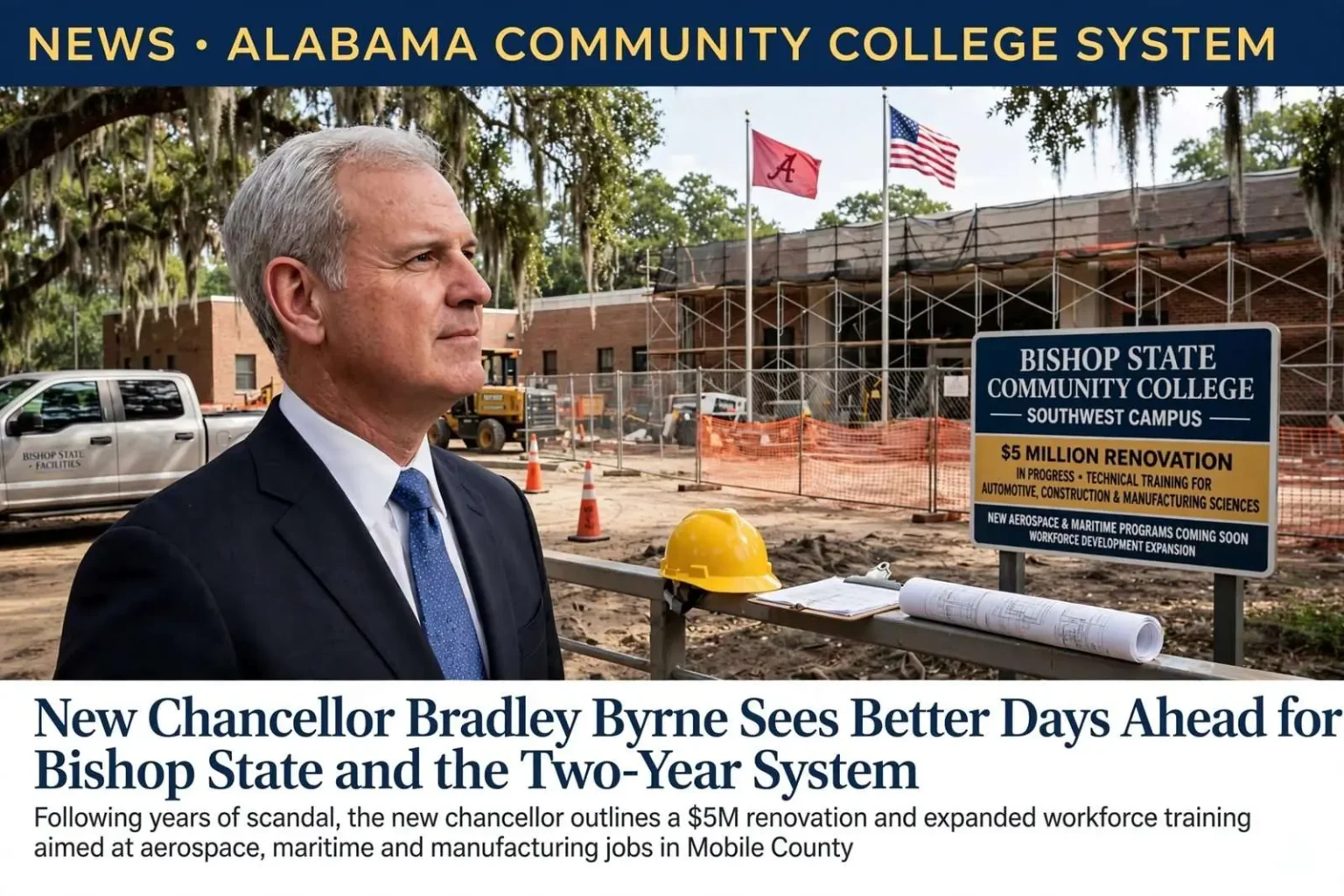
It was, with apologies to Charles Dickens, the best of times and the worst of times in Alabama’s community college system, according to its new chancellor, Bradley Byrne. The scandals that had shaken public confidence in the two-year schools still had to play out to their dispiriting conclusion, Byrne said. But the system’s many undeniable strengths could be brought out of the shadows — encouraging the good teachers, administrators and staff, and persuading the public that the foolishness of the past was over. Byrne took over the two-year system at a moment when the legislature and the governor’s office were both committed to clean up what had become a series of embarrassing corruption cases across multiple campuses. Bishop State Community College in Mobile had been one of the most visible faces of those scandals, and Byrne was candid about both the damage and the work ahead.
The Bad News, and the Other News
The bad news would linger a while, Byrne acknowledged, as state and federal corruption investigations ran their course and new leadership was installed across the system. Alabama’s two-year colleges had been engulfed by revelations of double-dipping legislators on college payrolls, no-show jobs and contract abuses — and Bishop State Community College in Mobile had become one of the most visible faces of that scandal. But the negatives, he said, would now have to compete with genuinely good news. He pointed to a $5 million renovation of the Southwest Campus of Bishop State, along with the creation of new campuses in north, south and west Mobile County. Virtually ignored and untouched since the 1960s, the Southwest Campus was to become home to technical training in automotive repair, auto body work and the construction trades.
Training for Aerospace and Maritime Jobs
“We may also put the Manufacturing Sciences Center at Southwest if the engineering studies come back positive on the drainage for the part of the property we’re considering,” Byrne said. If the site proved unsuitable, that center would likely go to Bishop State’s new Brookley Campus, where an Aviation Sciences Center was planned as the centerpiece. A site off Highway 43 in north Mobile County had been offered as a donation for an adjunct campus. A Maritime Sciences Center was also envisioned, possibly on the Causeway just east of the tunnel. The expansion plans reflected Byrne’s argument that community colleges needed to align their programs with the industries that were actually growing in the region, including the Airbus final assembly operation then ramping up at Brookley and the long-established shipbuilding presence along the Mobile River.
Building a Workforce for the Boom
The building plans Byrne outlined were ambitious, even by the standards of a system that had historically been underfunded in Alabama. The two-year colleges, he argued, needed to be at the center of the state’s workforce development strategy, particularly in regions like Mobile where major industrial expansions were creating new demand for skilled technicians. Airbus’s arrival, combined with ongoing hiring at Austal USA and Huntington Ingalls Industries, was already reshaping the kinds of credentials employers expected from new hires. Community colleges, with their shorter programs and lower tuition, were positioned to deliver those credentials more quickly than the state’s four-year universities, but only if they had the physical infrastructure and the modern equipment to do the job.
The Shadow of the Scandal
Bishop State’s involvement in the broader two-year college scandal had been particularly damaging to the institution’s reputation in Mobile. Several former administrators and employees had been charged with various crimes related to misuse of funds and conflict-of-interest schemes, and the bad publicity had eroded confidence among the students the college was trying to serve. Byrne acknowledged that regaining that confidence would take time, but he pointed to the investments being made in physical facilities as one sign that the system was committed to the Mobile campuses. He also argued that Bishop State’s role as a historically Black college gave it a particular responsibility to serve the African-American community in Mobile, and that meeting that responsibility would require sustained investment in faculty, programs and student services. The challenge was not only to clean up the corruption but to make the case that the two-year system, and Bishop State in particular, was worth the public’s continued support.
What Byrne Brought to the Job
Byrne came to the chancellor’s job with a background in law, business and Republican politics. He had served in the Alabama State Senate representing the Mobile County area and had been a candidate for higher office before being named chancellor. That mix of legislative experience, business background and familiarity with Mobile made him a natural fit to lead a system that needed to rebuild relationships with both the governor’s office and the legislature. Byrne’s appointment was widely viewed as a signal that the state was serious about turning the page on the scandals and that the new leadership would have the political connections necessary to push reforms through the legislature. He was also seen as someone who understood the local dynamics of Mobile County, where Bishop State and other two-year colleges played an outsized role in workforce training.
The Two-Year System in Alabama
Alabama’s community college system includes two-year colleges scattered across the state, from the urban campuses of Lawson State in Birmingham to the rural campuses of coastal Alabama. Each college is governed by a local board of trustees but reports to the state chancellor on policy matters, funding allocations and statewide initiatives. The system has long been a stepping stone for students who plan to transfer to four-year universities, but it also plays a critical role in workforce training, particularly in industries like healthcare, manufacturing and construction. In Mobile, the two-year system’s presence is anchored by Bishop State, Faulkner State (now Coastal Alabama Community College) and the University of South Alabama’s community college partnerships. Together, those institutions serve thousands of students each year and are deeply tied to the local economy.
What Comes Next
Byrne’s tenure as chancellor would be defined in part by whether he could deliver on the ambitious plans he outlined for Bishop State and the other Mobile-area campuses. The renovations, new construction and program expansions he proposed required both state funding and continued local support, neither of which was guaranteed. Byrne argued that investing in the two-year system was essential to the state’s economic future, and that the scandals of the past should not be allowed to derail that investment. Whether the legislature and the governor’s office shared that view would determine how much of Byrne’s vision became reality. For the students, faculty and communities served by Bishop State and the other Mobile-area colleges, the stakes were clear: a stronger two-year system would mean more opportunities for local residents and a more reliable pipeline of skilled workers for the industries that drive the regional economy.
For all the ambitious plans Byrne laid out, the immediate challenges facing Bishop State and the broader two-year system remained significant. Years of negative publicity had left many Alabama families uncertain about whether the community colleges were a safe investment of their children’s time and tuition dollars. Byrne’s response was to lean into the visible improvements being made at Bishop State’s Southwest Campus and to argue that the corruption cases, while real, were the work of a few bad actors rather than a systemic failure. That argument carried weight in Mobile, where many residents had personal connections to Bishop State through family members who had attended the college over the decades. Reconnecting the college to that broader community, Byrne suggested, was essential to the institution’s long-term recovery.
A National Context
Community colleges across the country have played an outsized role in workforce development, particularly in regions where four-year universities have not kept pace with the changing needs of local employers. Alabama’s system, while smaller than those in some other states, has long punched above its weight in industries like healthcare, manufacturing and skilled trades. The Mobile-area campuses were particularly well-positioned to take advantage of the region’s industrial growth, but only if the state was willing to make the necessary investments in faculty, facilities and equipment. Byrne’s tenure as chancellor would be judged, in part, on whether he could secure those investments and translate them into programs that prepared Mobile residents for the jobs that were being created across the metro area.
Beyond the immediate Mobile-area plans, Byrne also spoke about the importance of building partnerships with local employers who could help shape the curriculum and provide work-based learning opportunities for students. Those partnerships, he argued, would help ensure that community college graduates left with credentials that employers actually valued, rather than with degrees that reflected what faculty thought students should know. The shift toward employer-aligned programming was happening across the country, but Alabama’s two-year system had been slower to adopt it than some peer states. Byrne’s plans for Bishop State and the Mobile-area campuses would put that approach into practice in one of the state’s most dynamic regional economies.