‘You Can’t Reform a Junkie With More Drugs’: Mobile Business Owners Sound Off on the Sales Tax Plan
Retailers, accountants, builders and executives across Mobile weighed in on the proposed one-cent sales tax increase, with most arguing City Hall must cut spending before reaching into shoppers' pockets.
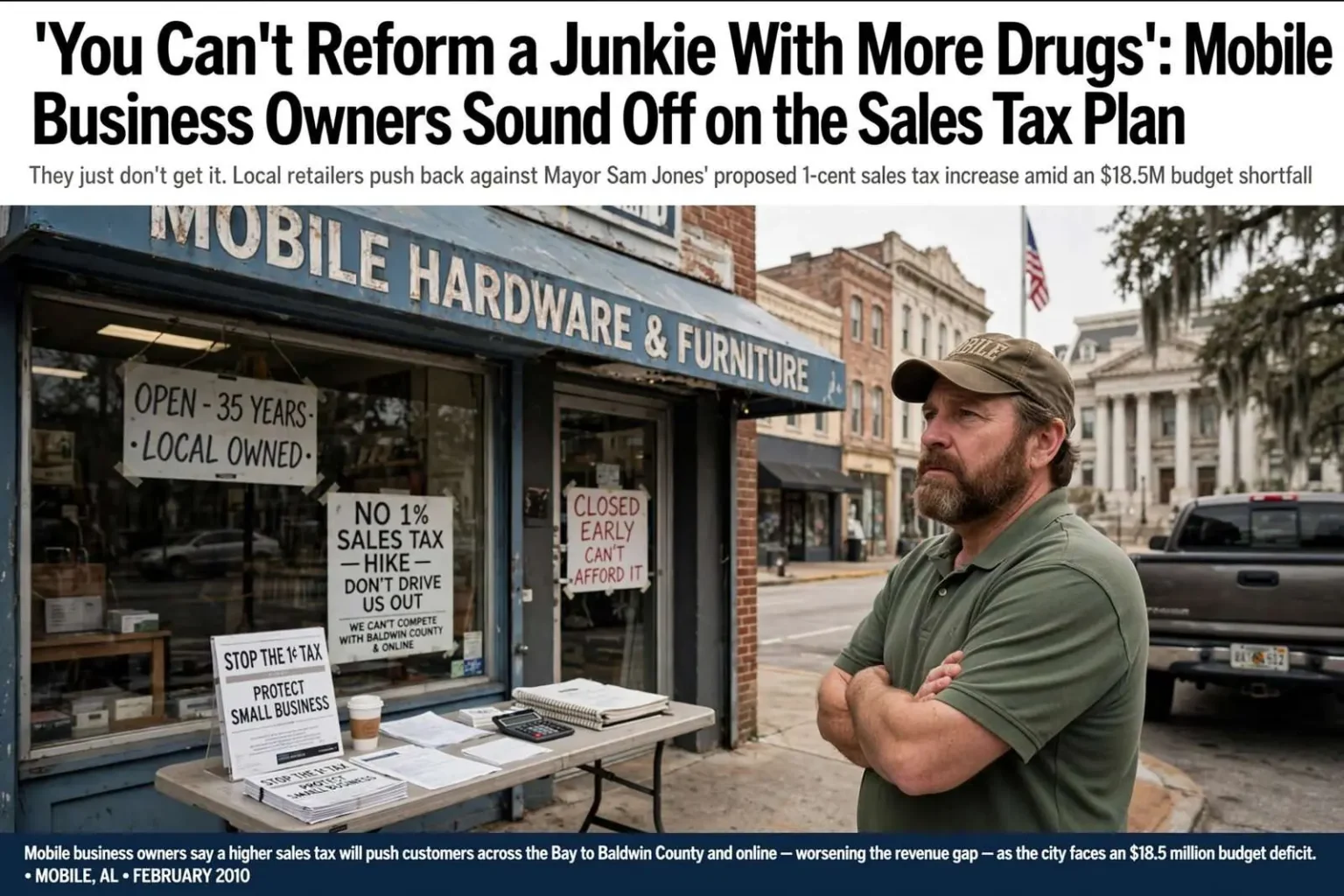
They just don’t get it.
That, in various formulations, is what each side of Mobile’s budget fight says about the other. To decision-makers at City Hall, “they” is an uninformed public armed with assumptions and few facts. To the business community, “they” is a set of politicians and bureaucrats whose ability to vote themselves revenue is as infuriating from the outside as it is comfortable from the inside.
What is not in dispute is the hole: an $18.5 million shortfall in the current budget requiring an immediate $5 million fix, with a larger gap between revenue and expenses looming in fiscal 2011. The recession that followed the financial crisis had hammered the revenue sources a city depends on — sales taxes, business licenses, permits — while the costs of running a growing municipality barely moved.
Most of the public sector has lined up behind Mayor Sam Jones’ call for a temporary one-cent increase in the city’s sales tax, which would run through Sept. 30, 2011. City leaders say they have cut to the bone, and that further reductions would impair basic services, including public safety.
Almost all of the argument to date has come from inside City Hall. We asked people who run businesses in Mobile what they thought. A representative sample of their responses follows, lightly condensed.
Management, not money
A south Mobile businessman who has helped oversee an $80 million budget said the discipline required to keep such a budget on track is considerable and constant.
“I suspect that our leadership has failed us in this regard and now they are asking for a ‘fix’ from our pocketbooks.”
If the mayor and council would first attack waste, mismanagement and outdated programs, he said, “the citizens will be happy to help.” Otherwise, he understood the public’s anger. He closed with an old line: “When your out-go exceeds your income, your up-keep will be your downfall.”
An accountant pointed to Mobile County, which balanced its budget without a tax increase. Millions in performance contracts could be eliminated, he argued, without touching basic services. And he was skeptical of the word “temporary.”
“If the tax is passed, EVERYONE knows that it will not be temporary,” he said. “If there was a referendum on this issue, the vote would not even be close.”
His skepticism spoke to a hard truth of municipal finance: revenue measures written with expiration dates tend to outlive them, because the gap they bridge reappears and the council that repealed them faces a fresh crisis. The county’s balancing act — cutting performance contracts and holding the line on raises — had been his proof that the city’s claim of a cut-to-the-bone budget could not be taken at face value.
The retailers’ warning
Merchants raised the most concrete objection: that a higher rate would drive sales somewhere else.
A retailer with 35 years in the business noted that moving from 9 percent to 10 percent is not a one-point change but an 11.1 percent increase in the tax itself.
“Not only will many more people drive out of the city to make large purchases, but almost everyone will buy more than ever over the Internet.”
The arithmetic of retail borders is unforgiving. Mobile sits within a short drive of unincorporated areas and, across the Bay, Baldwin County, where a sales tax differential shows up instantly at the register on big-ticket items. And the online alternative was already eroding local sales before the recession, with every added point of local tax enlarging the gap between buying in a Mobile store and buying from a warehouse.
His counterproposal was contrarian: cut non-essential services, add a garbage fee, and lower the city sales tax from 4 percent to 3.5 percent to signal that Mobile is open for business.
A furniture dealer described trimming his budgets repeatedly to avoid layoffs, and weeks when he took no paycheck so his employees could keep working. “Please don’t bite the hand that feeds you,” he said.
He and others argued that the city could close much of its gap simply by collecting the sales taxes already owed on purchases shipped into Mobile from outside vendors. The point was about use taxes — the sales taxes owed on goods ordered from out-of-state vendors that consumers rarely report and governments rarely collect. Enforcement of those obligations, the merchants argued, would raise real money without raising the rate at all.
A “big ticket” retailer traced the exodus to west Mobile and Baldwin County partly to the last increase, from 8 percent to 9 percent. “To make the same mistake again is unconscionable.” He proposed a utility surcharge instead, arguing it would fall on the heaviest users rather than landing regressively on every shopper.
The regressive character of sales taxes was the merchants’ recurring theme. A one-cent increase takes the same percentage from a family buying groceries and a company buying equipment, but not the same hardship — and Mobile’s sales tax base already weighed more heavily on the households least able to move their purchases across a county line.
Voices for the tax
Not everyone opposed it. A college professor was blunt: “The one percent tax needs to be passed. This situation has been caused by a failure of the city to meet its revenue projections.”
A construction executive supported a one-cent increase running from May 1 through Sept. 30, while adding that he remained surprised at how little accountability had attached to the mayor. A homebuilder said a combination of new revenue and spending cuts was the only realistic path, and — reluctantly — that a property tax increase might be the sounder long-term answer.
The supporters’ position rested on the alternative: without new revenue, the council’s only other lever was layoffs, and a shrunken police, fire and public works payroll would impose costs of its own. Property tax advocacy carried a political price — Alabama’s property tax rates are among the lowest in the nation, and any proposal to raise them ran against a century of constitutional constraint — but the homebuilder’s point was that property taxes track a city’s actual wealth more honestly than sales taxes do.
A middle course
A former city official offered the most detailed alternative: a reorganization plan from the mayor to cut costs without layoffs; a reduction in council expense allowances; a 5 percent pay cut across the city workforce; and a half-cent sales tax increase set to expire in two years.
“This would be more like everybody participating,” he said, “and not just the tax payer.”
The plan’s central idea — shared sacrifice — put a concrete shape on what many in the business community had argued in principle. If the city workforce absorbed part of the pain through pay cuts, and the council trimmed its own allowances, then a smaller revenue increase would carry political legitimacy that a full-cent tax, falling on shoppers alone, could not.
A public employee made a similar point from the other side, saying he would accept a voluntary 10 percent pay reduction to keep colleagues from being laid off — and noting that a municipality genuinely cannot know its true revenue picture until business license and sales tax numbers arrive in February or March.
His caution about timing reflected the mechanics of municipal budgeting. City budgets are built on projections made months before the money arrives, and a recession does not show up in a forecast until the receipts do. A council deciding in spring on a permanent revenue increase was, in his view, acting on numbers it would not be able to verify until the fiscal year was well under way.
A food broker needed only nine words: “You can’t reform a junkie with more drugs.”
The line — quoted nowhere else in the debate so completely — became the shorthand for the entire opposition. In the merchant’s view, every budget crisis had been met with the same reflex: a vote, a rate, a revenue stream. The rate rose, the gap closed, and the underlying spending problem survived to produce the next gap. Sales tax increases, in that reading, were the drug; City Hall the addict; and the taxpayers of Mobile the ones left paying for the next fix.
The debate itself left a clear map of where Mobile’s politics stood. City Hall had its vote and its expiration date. The business community had its warnings about borders, internet sales and broken promises of temporariness. And between them stood a public whose members — employers, accountants, professors, builders, city workers — could recite both sides’ numbers from memory. The one-cent tax would pass on the council’s strength, as revenue votes generally do. What the merchants had banked was the next chapter: that Mobile’s sales would quietly move to the west side, across the Bay, and onto the Internet, and that when the fiscal 2011 gap arrived on schedule, City Hall would find the same argument waiting for it — with the taxpayers, this time, holding the receipts.