Proposed Beer and Wine Sales at West Mobile Movie Theater Draw Pushback
A liquor license request for the Wynnsong 16 theater in west Mobile has sparked community opposition over alcohol access near teenagers at the multiplex.
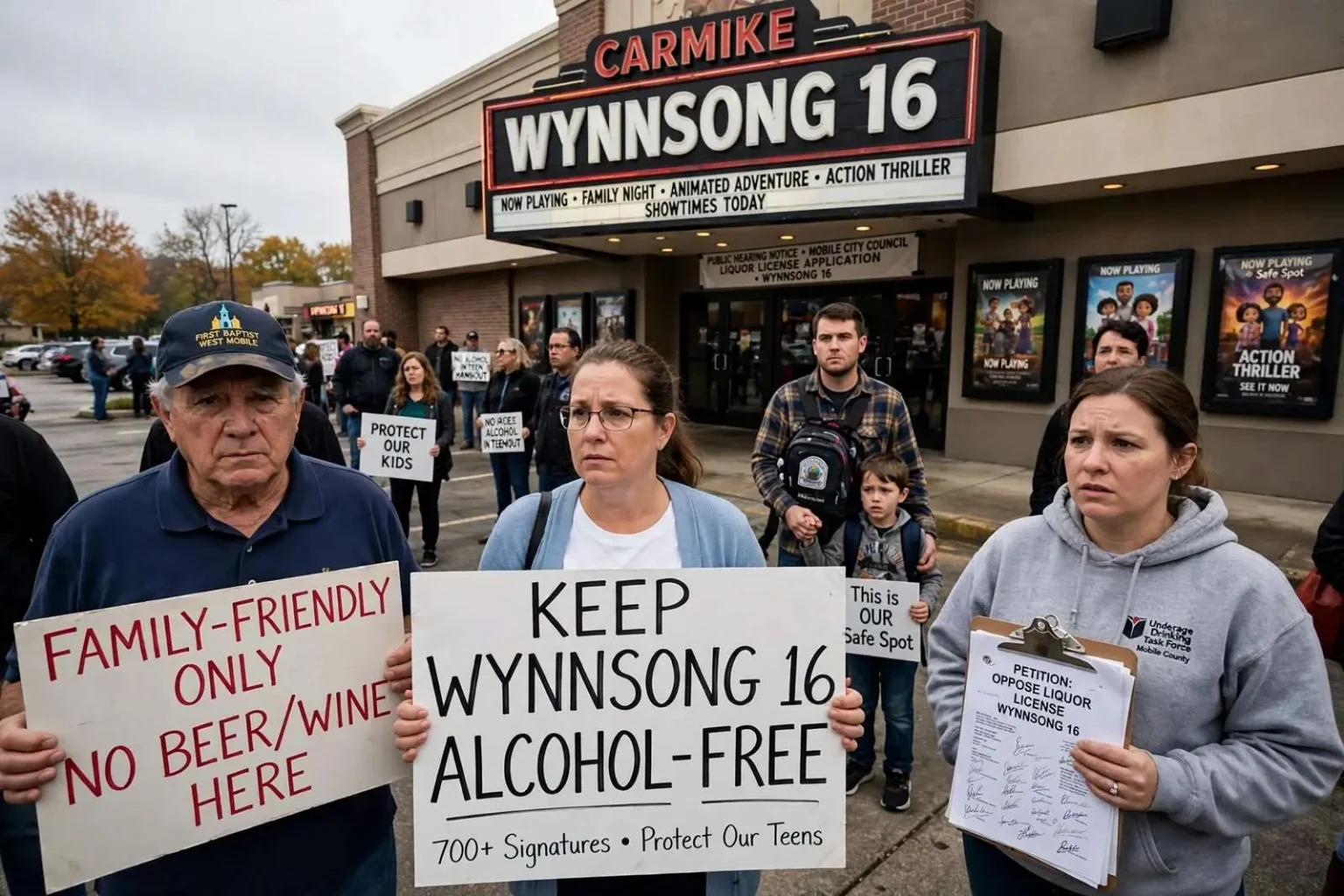
A request to sell beer and wine inside a west Mobile movie theater has turned into one of the more emotionally charged local debates of the fall, pitting a national theater chain against residents who see the multiplex as one of the last alcohol-free gathering spots for teenagers in the area.
Carmike Inc., the Georgia-based company that operates the Wynnsong 16 complex, is seeking a liquor license that would allow beer and wine sales inside the theater. The application has to clear Mobile’s City Council, which holds public hearings on liquor licenses within the city limits, and it has drawn organized opposition unusual for a routine alcohol request.
Opponents, including a local Baptist church that submitted roughly 700 signatures against the license during a recent City Council meeting, argue the theater is one of the few remaining family-friendly businesses in west Mobile that stays free of alcohol. For many families in the fast-growing suburbs along the city’s western edge, the multiplex functions as a default destination for youth groups, school celebrations and weekend outings, and critics of the license said adding beer and wine would change the character of a place they have relied on precisely because of what it does not sell.
Members of Mobile’s Underage Drinking Task Force have raised concerns that adding alcohol sales to a popular teen hangout would create new opportunities for minors to access beer and wine, whether through direct purchase attempts or drinks left unattended in darkened auditoriums. The task force, which brings together school officials, health workers, law enforcement and prevention specialists from across the county, has spent years pushing measures aimed at keeping alcohol away from people under 21, and members told city officials that a multiplex full of teenagers is among the most difficult environments in which to police it.
A debate other Alabama cities have already had
The attorney representing Carmike in its bid for the license said the same objections have surfaced in other Alabama cities weighing similar requests. In Montgomery, the council approved a license for a Carmike IMAX theater over comparable concerns, and the theater has continued to operate with beer and wine available to patrons. In Gulf Shores, the council initially rejected a request before the state Alcoholic Beverage Control Board overturned that decision on appeal, a reminder that local boards do not have the final word when a state license is at stake.
That pattern matters for Mobile because it frames the council’s real choices. A denial can be appealed to the ABC Board in Montgomery, which has shown a willingness to second-guess local rejections, so council members weighing the Wynnsong application know that voting it down may simply move the decision to a state panel with less connection to the west Mobile neighborhoods making the objections.
The dispute also arrives amid a broader shift in the movie theater business. National chains across the country have been adding beer, wine and expanded food service as a way to compete with home streaming, betting that an evening at the theater must offer more than a projection screen to keep customers coming. Carmike, headquartered in Columbus, Georgia, grew into one of the largest theater operators in the United States with a heavy concentration of screens in smaller Southern markets like Mobile, and the company has followed the industry trend of upgrading older multiplexes with amenities once reserved for premium venues.
The safeguards Carmike has offered
To address concerns, Carmike has proposed a list of safeguards for the Wynnsong location. Alcohol sales would be limited to two drinks per patron. Anyone over 21 who purchases alcohol would receive a wristband marking them as a legal buyer, and alcoholic drinks would be served in separate clear cups that are visually distinct from ordinary soft drink cups, making it easier for staff to spot them outside the sales area.
The company also proposed a dedicated cash register for alcohol sales, keeping those transactions separate from the general concession line, and additional security staffing during peak hours such as weekend evenings and movie premieres, when auditoriums fill with the teenage audiences the opponents are most worried about.
The company has also floated the idea of hiring off-duty police officers to help enforce underage drinking laws during busy periods, and has said it would consider installing security cameras covering the sales areas or designating an alcohol-only auditorium if city officials requested it. Taken together, the concessions go well beyond what a typical bar or restaurant offers, and Carmike’s representatives have argued they address the practical scenarios critics describe: a minor attempting to buy a drink, a wristband-less patron ordering, or an abandoned cup left in a dark theater.
What the license would actually allow
The license Carmike seeks covers beer and table wine only, not liquor or mixed drinks, which keeps the request in the lower tier of alcohol permitting and mirrors what the company has sought in its other Alabama theaters. Under Alabama law, a beer and wine license for a business inside city limits is issued by the state ABC Board after the local governing body has had its say, and municipalities routinely attach their own expectations to the businesses that hold them, from hours of sale to on-site conduct.
Selling alcohol to anyone under 21 remains a crime regardless of the license, and vendors bear the liability that comes with it. That legal framework is the backdrop to Carmike’s wristband, clear-cup and staffing proposals, which are drawn from the playbook theaters, stadiums and festivals use in other states where in-theater alcohol sales have been common for years.
The council’s dilemma
For the City Council, the Wynnsong request compresses several pressures into a single vote. Council members answer first to the constituents who packed the hearing and delivered the petitions, and the volume of the opposition to a family multiplex is not something council members in the western districts can easily disregard. At the same time, the council has generally welcomed the investment national chains bring to west Mobile, an area whose growth has been driven by new subdivisions, schools and retail along the corridors west of the city’s older core.
The council also knows the outcome in Gulf Shores: a local rejection there did not end the matter, because the ABC Board reversed the city on appeal. A vote against the Wynnsong license could therefore produce the worst of both outcomes for opponents, leaving the license granted anyway by the state while souring the city’s relationship with a major employer of young part-time workers.
Supporters of the request have framed it that way, arguing that beer and wine at the movies is now an ordinary amenity rather than a moral line, and that Carmike’s voluntary restrictions would make the Wynnsong more tightly controlled than most restaurants in the city that sell alcohol to teenagers’ parents every night. The theater, they note, is not a bar; the alcohol is an addition to a movie ticket, consumed in a supervised commercial setting rather than a drinking establishment.
What both sides expect next
The church that organized the petition drive has said the issue is about protecting young people, and its leaders have indicated they will keep pressing the council to reflect the signatures it received. The Underage Drinking Task Force’s involvement gives the opposition a public-health framing that extends beyond any single congregation, connecting the Wynnsong debate to the wider work of reducing the age at which Mobile County teenagers first encounter alcohol.
Carmike, for its part, has signaled it intends to see the application through, with the fallback of a state appeal if the council says no. Company representatives have pointed to the Montgomery IMAX as evidence that beer and wine sales and a family customer base can coexist, and to the safeguards package as proof the chain is prepared to operate the Wynnsong more restrictively than the law requires.
Whichever way the council rules, the hearing has already established a template for the next such request, whether it comes from another theater, a bowling alley or a family entertainment center: a national operator offering a list of controls, a coalition of churches and prevention advocates delivering petitions, and a council left to decide whether the last alcohol-free gathering places in its growing suburbs should stay that way. For the teenagers of west Mobile, the practical question is simpler, and it is the one their parents came to the council to ask: whether the multiplex where they spend their weekends is about to become one more place where alcohol is for sale.
The debate has also drawn attention from neighborhood associations along the city’s western growth corridors, where civic groups have taken positions on the license alongside the churches. West Mobile has changed quickly over the past two decades, adding rooftops and retail faster than the city’s older districts, and residents there have shown before that they will turn out at Government Plaza when a zoning or licensing question touches their daily routines. The Wynnsong hearing fit that pattern, and the breadth of the response gave the council a clear reading of where its western districts stand on beer and wine at the movies.