Sheriff Hands Off the Nodine Inquiry, and the Rumor Mill Goes to Work
Sheriff Sam Cochran turned an investigation involving County Commissioner Stephen Nodine over to state agents after a substance was found in his county truck. Nodine's lawyer called it a set-up or a prank.
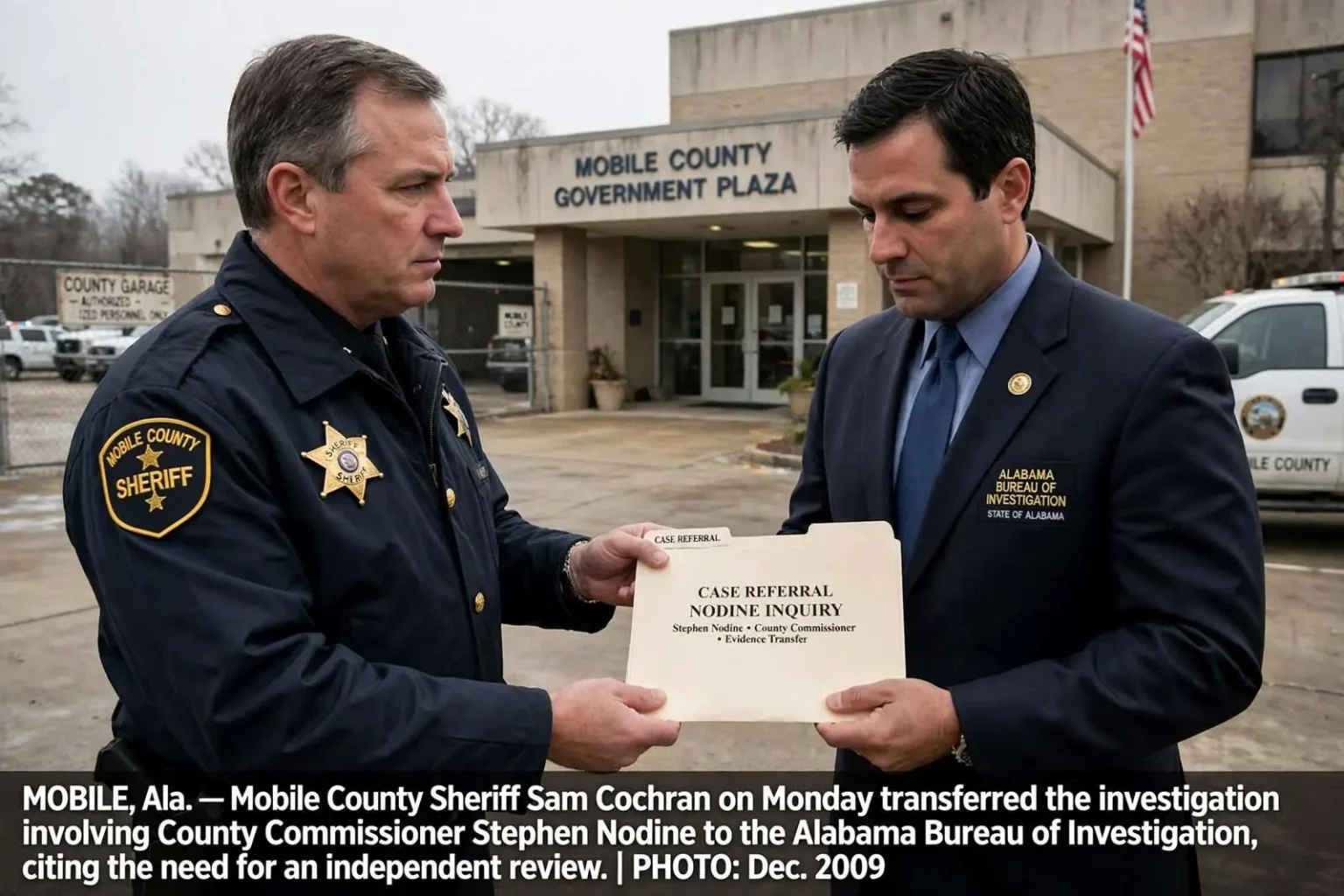
Mobile County Sheriff Sam Cochran gave up jurisdiction over an investigation involving County Commissioner Stephen Nodine and handed the matter to the Alabama Bureau of Investigation — a decision that was, by most readings around the courthouse, both correct and shrewd.
The investigation began last week when what was described as a “leafy, green, plant-like material” was found in Nodine’s county-issued truck while the vehicle was in the county garage for servicing. County and law enforcement sources said surveillance cameras are positioned throughout the garage. The material was reportedly contained in a small prescription bottle belonging to the commissioner. Results of testing on the substance had not been made public.
The referral itself is standard practice in Alabama law enforcement, if not always followed. The Alabama Bureau of Investigation exists precisely for matters a local agency cannot handle cleanly — cases involving local officials, department personnel, or anyone with influence over the investigating agency’s operations and funding. A sheriff’s office that investigates a sitting county commissioner risks tainting any conclusion it reaches; the ABI, answering to the state Department of Public Safety in Montgomery, has no such entanglements with Mobile County government.
The circumstances gave the story legs beyond its substance. A commissioner’s truck, a county garage, a prescription bottle and a laboratory test pending in Montgomery combined into an item that courthouses thrive on — specific enough to repeat, unresolved enough to speculate about, and involving an official known to everyone in the building. By week’s end, versions of the story had traveled far past the Government Plaza offices where they began, gathering detail with every retelling and losing nothing in the process.
Why the sheriff stepped back
Cochran and Nodine are both Republicans, and both were up for re-election in 2010. That alone would have made a sheriff’s investigation of a sitting commissioner awkward. But the sharper reason was budgetary. The Mobile County Commission approves the sheriff’s department budget. A sheriff investigating one of the three people who decide what he can spend is in an impossible position no matter how scrupulously he behaves — and no result he reached, clearing Nodine or charging him, would have escaped the suspicion of interest.
The structural conflict is built into county government. Alabama sheriffs depend on the commission not only for their annual appropriations but for vehicle fleets, jail operations and staffing positions, and every one of those line items passes through the same three-member board that Nodine sat on. A prosecutor reviewing such a case would have faced the same questions; a defense attorney would have raised them the moment a charge was filed. Turning the file over to state agents immunized the eventual result against those attacks before they could be made.
Sending the case to state agents removed the sheriff from a fight he could not win. Cochran was widely regarded as among the less vulnerable local officials facing voters in 2010. That was, if anything, another argument for caution: a controversy of this kind is exactly the sort of material a challenger builds a campaign around.
Sheriffs in Alabama run in partisan elections, and a decade of courthouse scandals across the state had taught political professionals that incumbents rarely lose for the sins of others but can lose for how they handle them. Cochran’s move — announce the referral, say as little as possible, and let the state agency own the case — followed the textbook for insulating an office from someone else’s trouble.
Nodine’s lawyer responds
Criminal defense attorney Dom Soto, representing Nodine, said any high-profile politician — and certainly one as combative and partisan as Nodine — accumulates enemies along with friends. “It sounds like a set-up or a prank,” Soto said. He noted that the vehicle had been loaded that weekend for a Christmas parade.
Soto acknowledged that the rumor mill had been running at full speed since the discovery. His favorite theory, he said, held that the material had been planted by Boeing operatives seeking to discredit the most aggressive local advocate for the Northrop Grumman/EADS bid in the $40 billion competition to build the Air Force’s next refueling tanker — a contract that, if won, would have put an aircraft assembly line at Brookley Field in Mobile.
The theory said as much about the moment as about the defense. The tanker competition was the largest economic prize Mobile had chased in a generation, and the city had been burned before — an earlier round of the contest had gone to Boeing, only for federal auditors to find serious flaws in the process and force a re-competition. Nodine had indeed been among the loudest voices in that fight. Only two weeks earlier he had written a widely circulated letter answering a Washington senator who suggested Alabamians did not build anything.
That letter had made Nodine, briefly, the voice of Mobile’s industrial ambitions — a commissioner arguing that his city’s shipyards, its port and its workforce could build anything Washington needed. The image of the same commissioner’s county truck at the center of a drug inquiry struck those who knew the tanker fight as either tragic irony or, in Soto’s telling, evidence of just how high the stakes had become for the parties bidding.
Serious observers did not credit the Boeing theory, and no evidence of sabotage ever surfaced publicly. But the fact that it circulated at all reflected the temperature of the tanker contest, in which local officials had spent years treating the bid as a civic crusade and its opponents as enemies of the city’s future.
The background friction
The commissioner had also been generating friction closer to home. Earlier in the fall, Nodine reportedly irritated county employees with talk of storm-related and holiday work schedules, adjusted per diems and possible layoffs stemming from the revenue shortfalls then hitting county budgets across Alabama.
The recession had squeezed county finances statewide. Sales tax collections — the backbone of county budgets — sagged with consumer spending, and commissions across Alabama were trimming overtime, freezing hiring and quietly floating layoffs. A commissioner announcing schedule changes and benefit adjustments becomes, fairly or not, the face of every paycheck those decisions touch, and county garages and road crews are close enough to the third floor to keep score.
The employee friction had a political dimension as well. County workers are voters, their families are voters, and the courthouse grapevine carries a grievance faster than any press release. An official planning a re-election campaign cannot fully separate labor decisions from their political cost, and Nodine — never one to soften a message — had delivered his without much padding. In the way of small institutions, the resentment settled into background noise that made every later story about the commissioner easier to believe.
A county government in a recession is a place with a good deal of accumulated resentment in it. That made the set of people with reasons to dislike the commissioner larger than the set of people with reasons to like him, and it gave the rumors a ready audience. In an environment of pay cuts and possible layoffs, any story at a powerful official’s expense found believers quickly.
What it turned into
The discovery in the county garage did not stay a minor story. It was the beginning of a chain of legal difficulties that would end Nodine’s career on the Mobile County Commission within a year and dominate local news coverage well beyond it.
At the close of 2009, though, nothing had been established, no charges had been filed, and the substance had not been publicly identified. What existed was a bottle, a surveillance camera, a commissioner with enemies, and a sheriff who had decided the smartest thing he could do was hand the whole business to somebody in Montgomery.
The gap between those two states — a small oddity in a garage in December, a career-ending legal saga by the next year — is how courthouse stories tend to move. Each step along the way, from laboratory results to prosecutorial decisions to the reaction of Nodine’s colleagues on the commission, would add its own headlines, and each would be judged by an audience that had spent the fall forming opinions from rumors alone.
For Mobile County government, the episode left a longer lesson about the machinery around it. The referral had worked as designed: the local sheriff was protected, the state agency had the case, and the county commission could go on passing budgets without its own conflict sitting at the dais. Whether that cleanliness survives contact with a case this entangled in local politics was the question the new year would answer — and the answer, as events showed, was that some stories follow an official no matter whose desk they sit on.