Wynnsong 16 Liquor License Vote Delayed Amid Resident Pushback
Mobile's City Council delayed a vote on a beer and wine license for the Wynnsong 16 theater after residents packed a meeting to voice opposition.
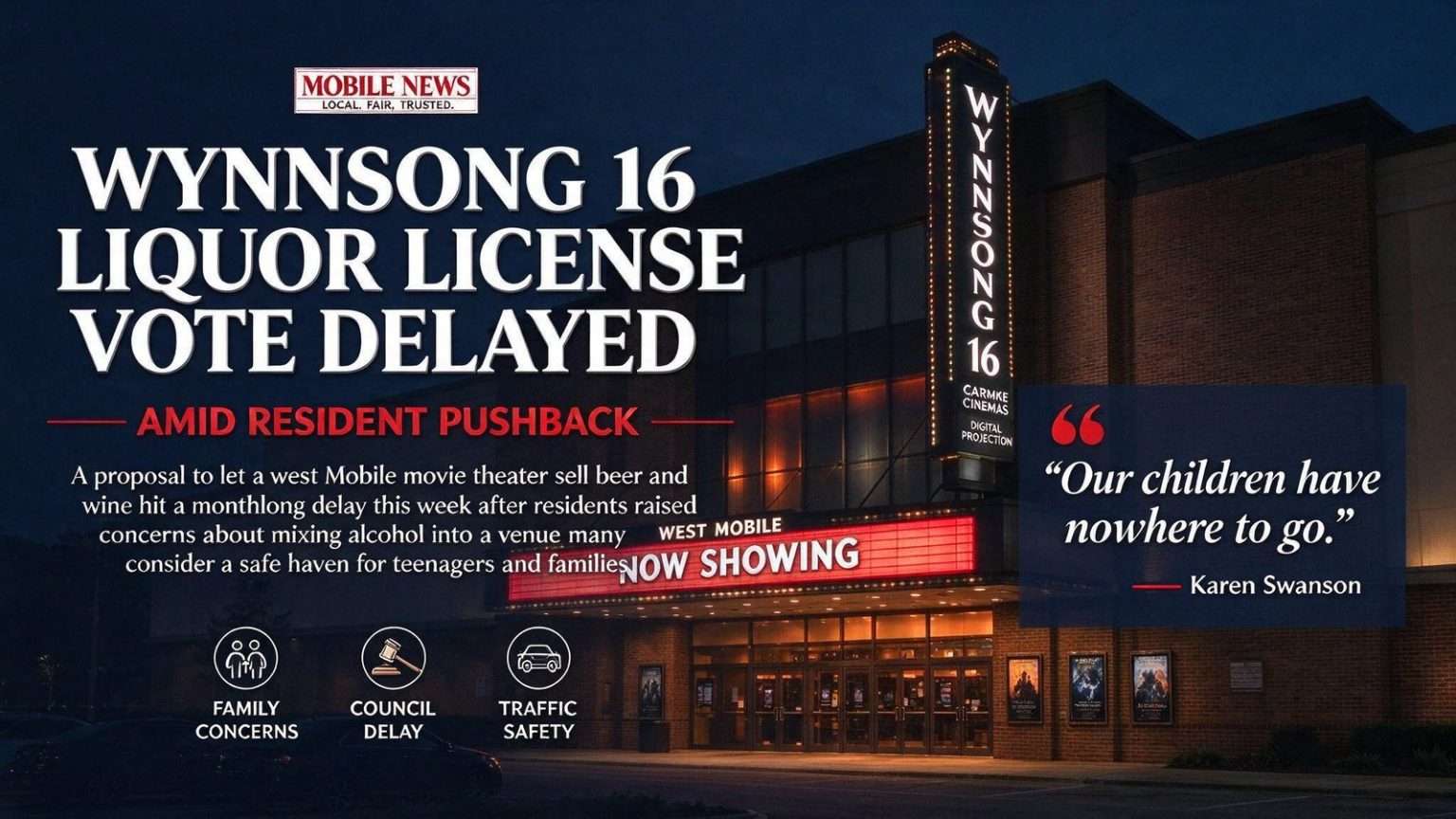
A proposal to let a west Mobile movie theater sell beer and wine hit a monthlong delay this week after residents flooded a City Council meeting with concerns about mixing alcohol into a venue many consider a safe haven for teenagers and families. The crowded public hearing turned the license request into one of the more animated alcohol debates the council has taken up, with speakers lined up on both sides of an issue that touches on family life, traffic safety, and the changing economics of the movie business.
Carmike Inc., which operates the Wynnsong 16 multiplex at 785 Schillinger Road South, is seeking a liquor license that would allow restricted beer and wine sales inside the theater. The Schillinger Road corridor in west Mobile is one of the city’s fastest-developing residential areas, and the Wynnsong 16 has long anchored its entertainment landscape, drawing families, youth groups, and date-night crowds from neighborhoods stretching toward the Mississippi line.
Council members heard extended public comment on the proposal Tuesday, with parents, a local pastor, and other residents raising objections ranging from impaired driving concerns along Schillinger Road to worries about how easily alcohol sales could be monitored inside a large multiplex. The sheer scale of the venue — sixteen screens, multiple concession points, and a steady turnover of patrons between showtimes — was central to the skepticism, with several speakers questioning who would police alcohol use in darkened auditoriums once drinks change hands.
‘Our children have nowhere to go’
Karen Swanson, whose 19-year-old son frequents the theater, told council members the venue is one of the few places she feels comfortable knowing he’ll be away from alcohol. “Our children have nowhere to go,” she said, describing the relief she feels when he says he’s headed to the movies rather than somewhere alcohol might be present. Her testimony captured the argument at the heart of the opposition: for parents of teenagers in west Mobile, the theater is not just a business but one of the last alcohol-free public spaces available to young people.
Mack Morris, pastor of Woodridge Baptist Church, said his congregation alone gathered roughly 700 signatures opposing the license, part of a broader unanimous recommendation against the proposal from more than 100 area Baptist churches he represents. The signature drive gave the opposition an organizational weight that is hard to ignore in a council district where church congregations are among the most active civic institutions, and it signaled that the issue would remain prominent if the license came back for a vote.
Other speakers read aloud text messages and social media comments from residents worried about losing the theater’s family-friendly reputation, concerns about inappropriate behavior escalating once alcohol enters the mix, and skepticism about in-theater alcohol advertising. The themes repeated across dozens of comments: that a multiplex filled with young audiences and dim lighting presents monitoring problems a restaurant or bar does not, and that the character of a venue families trust could change in ways no conditions attached to a license could fully prevent.
Councilwoman Bess Rich, whose district includes the theater, acknowledged the strength of the opposition. “We do need to pay attention to the concerns that have been expressed,” she said. Rich’s district covers much of west Mobile, and her remarks made clear that the council was treating the volume and intensity of the public comment as more than a formality before any decision on the license.
The Mobile County Sheriff’s Office Underage Drinking Task Force has also asked to weigh in before any final decision. The task force, which focuses on preventing alcohol sales to minors across the county, brings an enforcement perspective to the question of whether a multiplex can reliably check identification and control distribution across multiple registers and a large, constantly changing crowd.
The industry argument
Carmike’s attorney, James Pittman, told the council the request reflects a broader industry shift as theater chains face growing competition from streaming services and video-on-demand. The argument he laid out is one that has reshaped exhibition economics nationwide: as home theaters improve and new releases reach living rooms faster, chains have leaned on concessions — long the most profitable line of the business — and on making a trip to the theater feel like a night out rather than just a screening.
He said Carmike is pursuing similar liquor licenses systematically across its Alabama locations and beyond, citing internal research suggesting alcohol availability makes moviegoers more likely to choose a theater over staying home. Framing the request as corporate policy rather than a one-off experiment was meant to answer the suggestion that the Wynnsong 16’s family reputation was being singled out; the company’s position is that the shift is happening across the industry whether or not Mobile participates.
The safeguards on the table
To address safety concerns, Carmike proposed a two-drink limit per patron, wristbands for verified adults over 21, clearly marked cups for alcoholic beverages, and a separate cash register dedicated to alcohol transactions. Each element was aimed at a specific objection: the two-drink cap at excessive consumption, the wristbands at underage sales, the marked cups at concealed drinking in auditoriums, and the dedicated register at staff confusion between alcoholic and standard orders.
If approved, the company also plans to renovate the theater’s lobby into a full-service kitchen offering pizza, salads, and sandwiches. The dining concept follows a pattern adopted by national chains in recent years, pairing expanded food service with alcohol sales to turn the multiplex into a destination that competes with restaurants and streaming nights alike — a pitch that did little to reassure opponents who see the family audience as the theater’s core business.
Pittman said the company would hire a dedicated compliance officer during peak hours and off-duty police officers empowered to arrest anyone caught selling alcohol to minors rather than simply escorting them out. The promise of arrest authority — putting actual police power inside the theater rather than relying on management discipline — was the company’s most concrete answer to the task force and to parents who questioned whether theater staff could enforce the rules on their own.
Mobile Police Chief James Barber said the company has been cooperative in discussing additional security measures. The chief’s assessment carried weight with the council, since the police department would be the agency fielding any increase in impaired driving calls or disturbance complaints along the Schillinger Road corridor if the license is approved.
What happens next
A Public Safety Committee hearing was scheduled for later in September to continue the debate, with the full council set to take a final vote on the license in early October. The monthlong delay gives both sides time to organize — the opposition to rally additional signatures and comment, and Carmike to answer questions from committee members about enforcement, staffing, and how the proposed safeguards would actually work on a Friday night with sixteen screens running.
For the council, the decision involves weighing two legitimate public interests against each other. Alcohol licenses are routine business in Mobile’s restaurants and bars, and the city has generally allowed the market to decide where drinking and entertainment mix. But the Wynnsong 16 case stands apart because of its audience: a multiplex in a family-oriented corridor, serving teenagers on weekend nights, with a track record as one of the few large venues in west Mobile where parents assume their children will not encounter alcohol.
The traffic question adds another layer. Schillinger Road South carries heavy residential traffic, and opponents argued that adding alcohol service to a venue whose patrons largely drive — rather than walk or rideshare from downtown — raises impaired-driving risks on a corridor already busy with family vehicles. Supporters respond that two-drink limits and off-duty officers are designed precisely to keep consumption modest, and that a beer or wine with a movie is a far cry from a night at a bar.
Whatever the council decides in October, the hearing made clear that the residents of west Mobile intend to hold their elected officials accountable for the answer. More than 100 churches have taken a position, hundreds of signatures have been gathered, and parents who rarely attend council meetings came out to speak — a level of engagement that will follow the license question through the Public Safety Committee and onto the floor for the final vote.
The economics cut in both directions, too. Theater operators argue that beer and wine sales can be the difference between a profitable location and a struggling one as audiences migrate to streaming, and that a renovated lobby with a kitchen creates jobs and keeps a landmark business healthy. Opponents counter that no revenue projection is worth changing the character of a venue that thousands of west Mobile families rely on as a safe, alcohol-free outing — and that if the crowds shrink, the theater will still be the theater.