Mobile Sets Sept. 22 Start for I-10 Causeway Ramp Rebuild
A Montgomery contractor will start rebuilding the crash-damaged I-10 Causeway ramp Sept. 22, as Mobile also investigates a sinkhole near the cruise terminal.
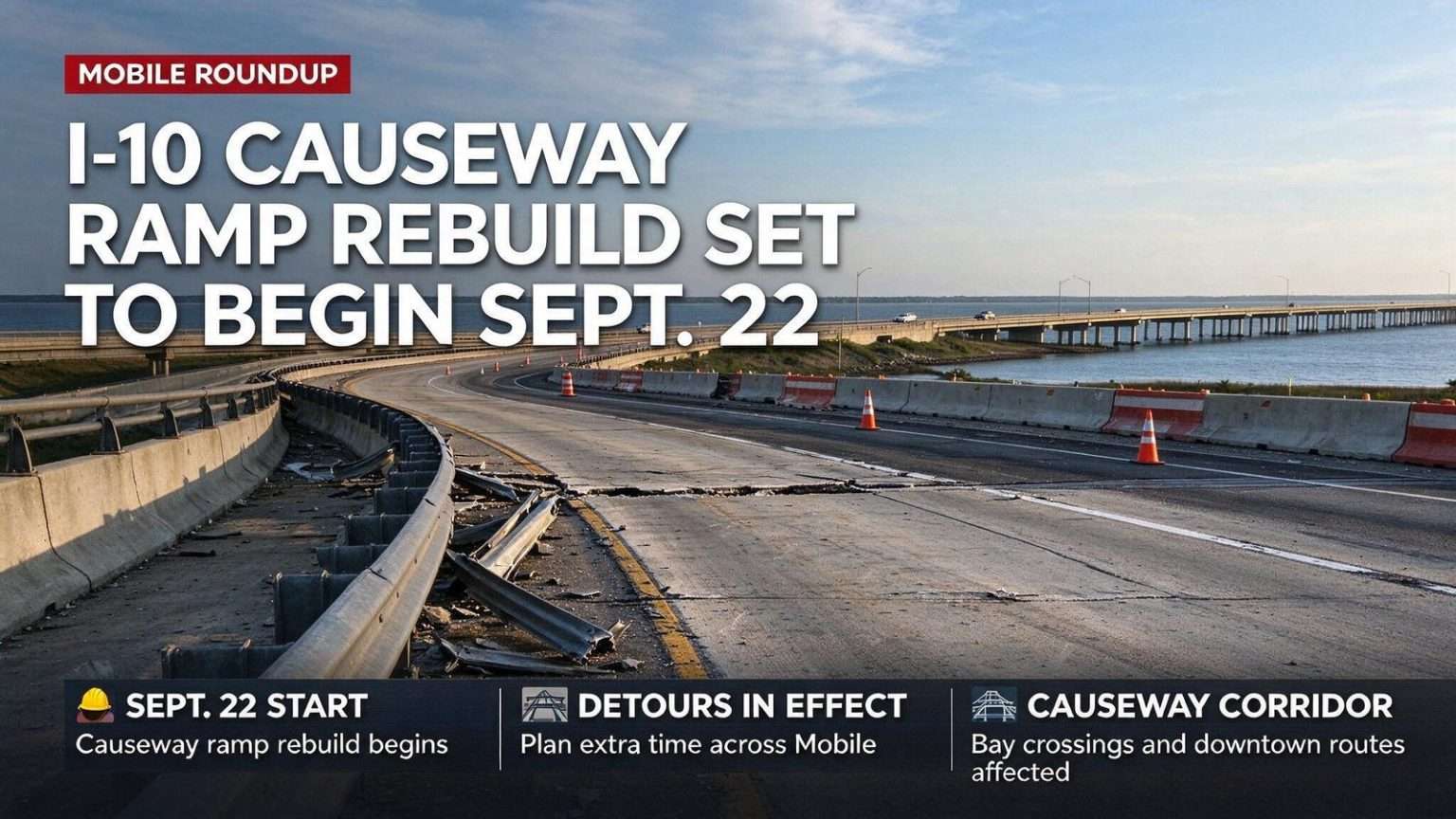
MOBILE, Alabama — Road crews now have a firm start date for rebuilding the Interstate 10 exit ramp leading to the Battleship Parkway causeway, closed since a tanker crash badly damaged the structure in late July. The announcement gives commuters who cross the bay a date to plan around after weeks of detours, and it restores one of the region’s busiest links between Mobile and the Eastern Shore to full service by the end of the year.
A spokeswoman for the Alabama Department of Transportation confirmed that a Montgomery-based contractor is scheduled to begin work on the ramp on Monday, Sept. 22, with the roughly $718,000 project expected to take a couple of months to complete. The ramp has sat closed since a tanker driver lost control and struck the guardrail on July 31, an accident the driver escaped only by kicking out a window of the overturned truck.
A start date, finally
The damage from the crash left the ramp unusable and forced drivers bound for the Battleship Parkway — the causeway route that runs the length of Mobile Bay — to detour through other interchanges while engineers assessed the structure. The $718,000 repair contract covers reconstruction of the damaged ramp, and the couple-of-months schedule would put traffic back on the connector as the holiday travel season approaches, when the causeway route matters most to commuters avoiding tunnel traffic.
The July 31 crash could easily have been fatal. Tanker trucks carry fuel at highway speeds along I-10 daily, and a driver losing control at the exit ramp left the truck overturned against the guardrail with the driver trapped inside. Escaping by kicking out a window, the driver walked away from a wreck that shut down a piece of interstate infrastructure for months — a reminder of how quickly an ordinary commute can damage the roads themselves.
Sinkhole shuts down road near cruise terminal
Closer to downtown, Mobile city engineers are investigating a sinkhole that opened up over the weekend on Eslava Street near the Alabama Cruise Terminal, forcing a closure of that stretch of road while crews determine the cause and scope of the damage. Sinkholes near the waterfront raise particular concern because of the age of buried utilities in the older parts of the city, and engineers typically check whether a failing pipe or drainage line undermined the road before filling the void.
The closure affects a street that carries port and cruise traffic through the western edge of downtown, and drivers heading to the cruise terminal have been routing around the work zone while the investigation continues. The city has not set a reopening date, which depends on what crews find beneath the pavement.
More closures around the city
Elsewhere in the city, Satchel Paige Drive between Government Street and Bolling Brothers Boulevard is closed for about three months while crews widen it to a four-lane divided road, part of infrastructure work tied to construction of the McGowin Park shopping center. The project transforms a corridor that serves major retail development in west Mobile, and the three-month closure pushes traffic onto parallel routes while the new divided roadway takes shape.
Royal Street between Conti and Dauphin streets also remains closed due to ongoing safety concerns, and the Three Notch Road roundabout project at Dawes Lane is still underway and expected to last about two months in total. The roundabout is part of a broader shift toward modern intersection design in Mobile’s growing western neighborhoods, where converting signalized intersections to circular flow is intended to reduce severe crashes and keep traffic moving through one of west Mobile’s busiest junctions.
Together the closures amount to a season of inconvenience for Mobile drivers, with projects scattered across downtown, west Mobile and the causeway at once. City and state officials urge motorists to build extra time into trips that cross the affected corridors and to follow posted detours, since work zones shift as each project reaches its next phase.
State highway work continues across both counties
On the state highway side, resurfacing and safety widening on State Route 163 continues on a 35-working-day schedule, while resurfacing and bridge work on I-10 between Halls Mill Creek and the George C. Wallace Tunnel is ongoing, with crews retrofitting guardrails near the DIP ramps and drivers facing mostly nighttime lane closures through next summer. The I-10 project is the most visible to travelers, touching the main east-west artery through Mobile on a stretch that funnels traffic toward the tunnel and the bay crossings.
Interstate 65 work near Saraland is about 99 percent finished, and resurfacing on U.S. 90 between Halls Mill and Pine Hill Drive should wrap up by December. The near-completion of the Saraland project removes one of the longer-running work zones from the I-65 corridor north of Mobile, while the U.S. 90 resurfacing restores one of the city’s principal east-west surface streets before the year ends.
In Baldwin County, the connector between County Road 68 and the Baldwin Beach Express is more than 90 percent complete, resurfacing on Alabama 181 is expected to finish by October, and the Little Lagoon Pass bridge replacement remains roughly halfway done, with a temporary detour bridge in place through the end of the year. The Baldwin Beach Express connector is a piece of the county’s long-term plan to build out an inland highway network that eases pressure on the coastal highways, while the Alabama 181 resurfacing refreshes a north-south corridor that has grown alongside the county’s population boom.
The Little Lagoon Pass bridge replacement is the largest of the Baldwin projects and the one most watched on the coast. The bridge carries traffic to and from Gulf Shores’ western beaches across the pass that connects Little Lagoon to the Gulf, and its replacement has required keeping a temporary detour bridge in service so residents and visitors can reach the beaches during construction. With the project about halfway done, the detour arrangement will remain in place through the end of the year, spanning the remainder of the beach season and the holiday period when coastal traffic peaks.
What it means for drivers
Taken together, the list of active projects marks one of the busiest construction seasons Mobile-area drivers have faced in some time, spread across the interstate system, city streets and both sides of the bay. The common threads are aging infrastructure — guardrails, bridges, buried utilities — and the growth that keeps adding traffic to corridors built decades ago.
For commuters, the practical advice is the same across every project: expect lane closures and delays, particularly on I-10 where the work is concentrated at night but extends through next summer, and treat posted detours around the closed causeway ramp, Eslava Street, Satchel Paige Drive and Royal Street as the fastest routes rather than suggestions. The causeway ramp repairs, starting Sept. 22, will be among the most consequential for bay-crossing traffic once the ramp reopens a couple of months later.
State transportation officials note that the region’s project list reflects funding cycles that finally reached a backlog of needs: resurfacing that had been deferred, guardrails due for retrofit, and bridge replacements that could no longer wait. As each project wraps up — the Saraland interstate work essentially finished, the U.S. 90 resurfacing by December, the ramp rebuild by late in the year — the map of work zones should thin out, leaving behind roads and structures built to handle the traffic the region now sends across them every day.
The causeway ramp closure has had ripple effects worth noting for anyone who crosses the bay regularly. The Battleship Parkway route is prized by commuters precisely because it bypasses the tunnel bottlenecks on I-10, and with the exit ramp out of service, drivers heading to the causeway from the interstate have been relying on alternate interchanges and surface streets. The rebuild should restore that time-saving option, and transportation officials have pointed to the project as an example of repairing damage from a crash quickly enough to limit the disruption to regional travel patterns.
The sinkhole on Eslava Street, meanwhile, is the kind of failure that city crews handle differently from routine repaving. Until engineers know whether the void came from a collapsed drainage line, a water main leak or simple soil failure, filling it would risk a repeat collapse, so the street stays closed while cameras and excavation answer the question. Downtown drivers should expect the closure to persist until that diagnosis is complete and repairs are designed.
Drivers with trips that cross multiple work zones — a beach run from west Mobile, for instance, or a commute from Saraland to the Eastern Shore — can string together the delays quickly, and transportation planners recommend checking project updates before holiday travel weekends, when lane closure schedules can change and traffic volumes peak across every affected corridor at once.