Crews Pump Sand to Rebuild Little Lagoon Pass Beach
State crews began pumping sand to restore the Little Lagoon Pass shoreline as bridge construction continues, alongside a newly awarded I-10 ramp repair contract.
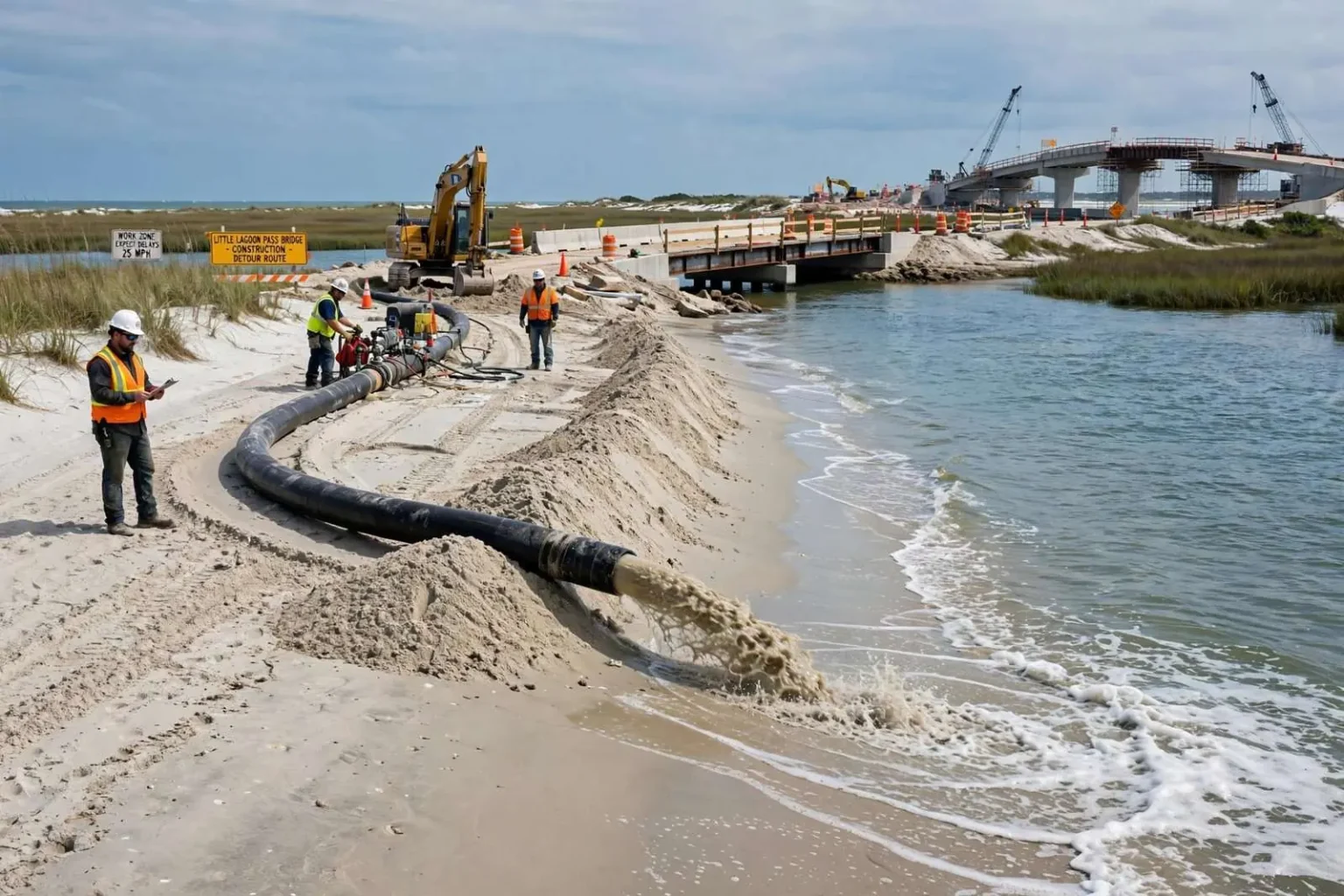
GULF SHORES, Alabama — Crews working on the Little Lagoon Pass bridge project have started pumping sand along the beach this week, part of an effort to restore shoreline that was affected during ongoing bridge construction in Baldwin County.
Beach Replenishment Tied to Bridge Work
The sand-pumping work is being carried out alongside the broader Little Lagoon Pass bridge replacement, which state transportation officials say is roughly halfway finished. A temporary detour bridge remains in place next to the construction site and is expected to stay there through the end of the year, with only minimal delays expected for drivers in the meantime.
Little Lagoon Pass is the narrow channel that connects Little Lagoon to the Gulf of Mexico on the western end of Gulf Shores, and it is one of the most dynamic stretches of coastline in Alabama. The pass shifts naturally with tides and storms, sand accumulates and washes away in cycles, and the bridge crossing it has long been a choke point on the coastal highway that carries residents and beach traffic along the Fort Morgan-to-Gulf Shores corridor.
Replacing a bridge in that environment requires working around moving water and shifting sand, and construction activity itself can alter the shoreline that visitors and marine life depend on. The replenishment pumping is intended to put sand back where construction disrupted it, keeping the beach profile consistent while the new bridge rises beside the old alignment. Crews pump a sand-and-water slurry from offshore or inlet sources onto the affected stretch, where the sand settles into place and the water drains away.
The temporary detour bridge has carried traffic through the heart of the project, and officials say drivers should see only minimal delays until it comes down at the end of the year. Once the new span is complete, the route over the pass will return to a single permanent bridge built to modern standards, ending the juggling act that construction has imposed on the beach road.
Elsewhere in the Mobile Area
Around Mobile, crews with the local water and sewer utility reopened a turn lane on Hillcrest Road at Cottage Hill Road this week after repairing a 12-inch water main that had broken, restoring normal traffic flow through that intersection.
Water main breaks of that size are a familiar disruption in older parts of the city, where utility lines laid decades ago are reaching the end of their service life. A 12-inch main carries a substantial volume for neighborhood distribution, and a break can flood streets, undermine pavement and force lane closures until crews isolate the leak, excavate and repair the pipe. The reopened turn lane on Hillcrest restored full traffic movement at a busy west Mobile intersection.
The same utility continues to manage sewer repair work downtown, where Royal Street between Dauphin and Conti streets remains shut. Replacing or rehabilitating sewer lines in the downtown grid requires closing blocks of historic streets, and the work is part of the broader effort to modernize Mobile’s aging underground network while the surface streets above it carry daily traffic.
I-10 Ramp Repair Contract Awarded
In a significant update on one of the region’s most disruptive closures, state transportation officials confirmed that the contract to repair the Interstate 10 ramp leading to Battleship Parkway, closed since a fiery crash in late July, was awarded earlier this month to a Montgomery-based contractor for just over $718,000. Work on the ramp is expected to begin within a few weeks.
Battleship Parkway — the low-lying causeway across Mobile Bay that carries commuter and tourist traffic between Mobile and the Eastern Shore — depends on its Interstate 10 connections for much of its access, and the damaged ramp has forced drivers onto longer routes since the crash. The parkway serves commuters heading to Daphne and Spanish Fort, visitors traveling to the USS Alabama Battleship Memorial Park, and fishing and boating traffic using the bay’s causeway landings, so the closure has been felt across both counties.
The repair scope covers ramp damage from the fire, and the $718,000 contract reflects the specialized work of restoring a highway structure rather than simply repaving a road. Once the Montgomery contractor mobilizes, the ramp work is expected to proceed on a compressed schedule to return a key bay-crossing connection to service.
The Region’s Longer Road List
Around Mobile, construction continues on the county’s second roundabout at Three Notch Road, Dawes Lane and Dawes Lane Extension, expected to remain closed for about two months.
Roundabouts have become a preferred intersection treatment in Mobile County for intersections with chronic crash history, replacing signal timing with continuous yield-based flow that eliminates the most dangerous collision types. The Three Notch Road project is the county’s second, and the two-month closure of Dawes Lane and its extension reflects the reconstruction required to reshape the intersection around the circular design.
State crews are also resurfacing and widening State Route 163, the artery that links west Mobile neighborhoods to the airport corridor and the I-65 interchanges, and continuing bridge and resurfacing work on I-10 between Halls Mill Creek and the George C. Wallace Tunnel, with lane closures limited mostly to overnight hours through next summer.
The I-10 work between Halls Mill Creek and the Wallace Tunnel touches one of the busiest — and most constrained — stretches of highway in Alabama, where the interstate narrows toward the tunnel beneath the Mobile River. Overnight lane closures have been the operating pattern, designed to keep the commuter and freight flow intact during daytime hours while crews rebuild pavement and bridge components along the approach.
Interstate 65 work near Saraland is nearly finished, at about 99 percent complete, while resurfacing on U.S. 90 between Halls Mill and Pine Hill Drive is expected to wrap up by December.
The I-65 project near Saraland closes out a stretch of interstate reconstruction in north Mobile County, an area where the highway carries a mix of commuter, freight and port-related traffic. The U.S. 90 resurfacing between Halls Mill and Pine Hill Drive renews a parallel corridor that absorbs overflow whenever I-10 backs up, making its December completion a small but practical piece of the region’s traffic puzzle.
In Baldwin County, the connector between County Road 68 and the Baldwin Beach Express is about 90 percent complete, and resurfacing on Alabama 181 between U.S. 31 and U.S. 90 should be finished by October.
The Baldwin Beach Express connector addresses one of the county’s fastest-growing corridors. The Beach Express toll road was built to move summer traffic from I-10 to the Gulf Shores beaches, and connectors like the County Road 68 link extend its reach into the central county, where subdivisions and schools have multiplied along County Road 64 and the Highway 181 corridor. At 90 percent complete, the connector should open to through traffic soon, shortening trips between central Baldwin and the coast and relieving pressure on the older two-lane roads that currently carry that load.
Alabama 181, meanwhile, has become the north-south spine of central Baldwin County as development has pushed inland from the bay. Resurfacing the segment between U.S. 31 and U.S. 90 by October renews a route that carries commuters to the interstate, shoppers to the county’s commercial centers and beachgoers heading south on summer weekends. Combined with the Beach Express connector, the project marks a heavy season of state investment in inland Baldwin infrastructure that historically trailed the coast.
State officials say they will continue providing regular updates on the Little Lagoon Pass project and the other road and bridge work underway across Mobile and Baldwin counties.
What It All Means for Drivers
Taken together, the project list describes a transportation network in mid-transformation on both sides of the bay. On the coast, the Little Lagoon Pass bridge and its beach replenishment address the shoreline infrastructure that the tourism economy runs on. In Mobile, the I-10 ramp repair, the roundabout, the SR-163 widening and the tunnel-approach resurfacing target the commuter and freight routes that the city depends on daily. And across Baldwin County, the Beach Express connector and the Alabama 181 resurfacing keep pace with some of the fastest residential growth in the state.
For drivers, the near-term message is patience with a known end date. The Little Lagoon detour bridge stays through the end of the year; the Dawes Lane closure runs about two months; the I-10 ramp reopens weeks after the contractor mobilizes; and the overnight closures on the tunnel approach continue through next summer. In exchange, the region gets a new bridge at the pass, a restored bay-crossing ramp, its second roundabout and fresh pavement on corridors from Saraland to the beaches.
Residents can follow the state’s project updates through the transportation department’s announcements as milestones approach — the halfway mark at Little Lagoon Pass, the ramp mobilization on I-10 and the October and December completions on Alabama 181 and U.S. 90 — each of which will remove another work zone from the region’s daily commute.