Dauphin Island Regatta Survivors Recall Terrifying Storm on Mobile Bay
Sailors described a desperate fight for survival as a fast-moving storm with near-hurricane winds capsized boats during the Dauphin Island Regatta.
Minutes From Pleasant to Perilous
Survivors of the storm that battered Saturday’s Dauphin Island Regatta described a race that turned from a pleasant afternoon sail into a fight for survival within minutes, as a fast-moving system brought waves reported near 10 feet and wind gusts approaching 60 miles per hour to Mobile Bay. Sailors who had spent the morning adjusting spinnakers in a fair breeze spent the afternoon clinging to hulls.
At least one person died and four others remained missing as search crews combed the bay overnight into Sunday. Families of the missing gathered in a makeshift shelter, hoping for news that their loved ones had been found, as boats and aircraft worked the water into the dark.
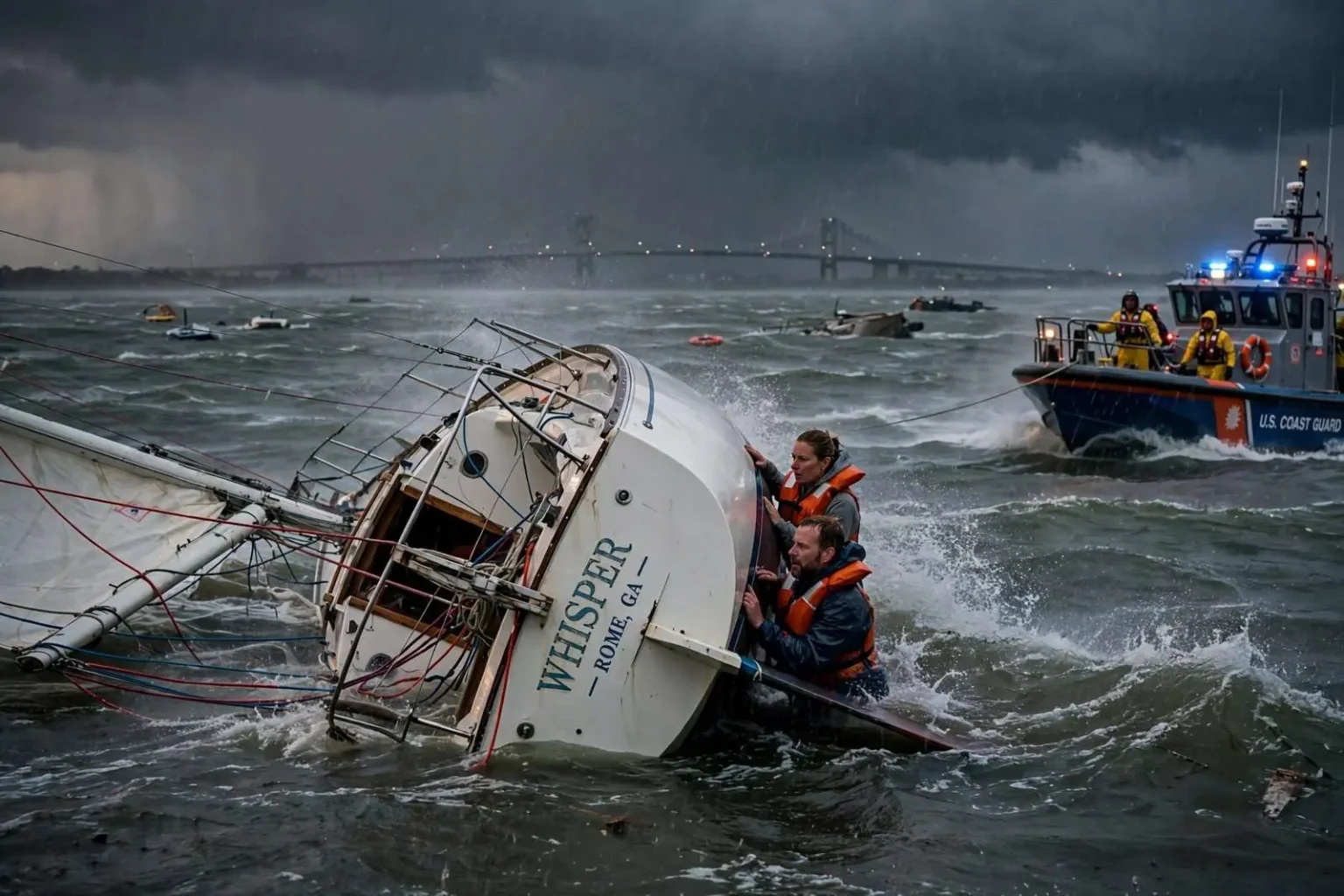
Among those who made it back safely were Randy Rutledge and Rhonda Morgan Gilreath, who had traveled from Rome, Georgia, for the race. The pair were roughly 15 minutes from the finish near the Dauphin Island Bridge when conditions deteriorated. Their 23.5-foot boat sank, as did a nearby vessel belonging to friends also from Rome — two crews from the same north Georgia town, thrown into the same bay within sight of the finish line.
Gilreath said the waves were unlike anything she had experienced, battering the boat from every direction. The two spent about two hours in the water before rescuers reached them, an interval shaped by water temperatures that turn a survival story into a race against exposure as much as against drowning.
Another sailor, Robert Luiten, was aboard a 24-foot boat with a five-person crew, including his 18-year-old son, when the storm overturned the vessel and threw everyone into the bay. Luiten and another crew member were rescued relatively quickly, but it took roughly six hours before his son was located in waters off the north side of Dauphin Island. Two other crew members remained unaccounted for even after the family’s reunion, tempering their relief.
The storm’s reach extended well beyond the racecourse, cutting power to roughly 23,000 customers along the Alabama coast and leaving parts of Dauphin Island dark into the evening. Several competitors described being blown far off course as the system rolled through with little warning, scattering boats across the bay and complicating the rescue picture by spreading the emergency over miles of open water.
The 57th annual regatta, an 18-mile race that rotates among Mobile Bay’s yacht clubs each year, has long been considered a rite of spring for area sailors. This year’s edition instead became one of the deadliest days in the race’s long history — a reversal that stunned a sailing community that had run the event for generations without a catastrophe of this scale.
A Bay That Turns Quickly
Mobile Bay’s geography helped write the day’s danger. The bay is broad but shallow, with miles of open water that let wind build steep, closely spaced waves quickly — conditions that turn treacherous faster than the deep water of the open Gulf. When a strong line of wind sweeps down the bay, sailors have little room to run before the next shoreline, and small keelboats can be knocked down or swamped before crews can shorten sail.
Spring on the northern Gulf Coast is squall season. Fast-moving lines of thunderstorms can race across the region ahead of cold fronts, and the worst of them can compress a forecast’s worth of wind into a few minutes of violence. Saturday’s system behaved exactly that way, arriving over the course with little of the gradual buildup that lets a race committee recall a fleet — and with dozens of small boats spread across miles of open water when it hit.
The regatta’s scale multiplied the challenge for rescuers. Unlike a single distressed vessel, a fleet-wide emergency puts dozens of crews in the water at once, some alongside capsized boats, others clinging to hulls, a few adrift after their vessels sank entirely. Responding agencies must sort reports of people in the water from reports of boats simply blown off course, a triage job made harder by downed communications and a bay suddenly full of debris.
The response drew on the network that guards the bay in every emergency: Coast Guard boats and helicopters, state and local marine units, and good Samaritan boaters who turned toward trouble instead of away from it. Those improvised rescues — sailors pulled from the water by fellow competitors and nearby vessels — accounted for many of the day’s saves before organized crews could reach the far corners of the course.
A Community in Shock
Back on shore, the makeshift shelter where families gathered became the race’s other center. Volunteers brought food and dry clothes; officials posted updates as boats and crews were accounted for one by one; and the list of the missing shrank or failed to as the night went on. For a community that measures its year by the bay’s events, the vigil was an unfamiliar and unwelcome role.
The regatta’s own traditions sharpened the sense of loss. An 18-mile course rotating among the bay’s yacht clubs draws sailors of every description — families aboard cruising boats, seasoned racers on trimmed competitors, friends visiting from out of state for what is as much a social fixture as a competition. The race has been a fixture of the bay’s spring since its first running, and the calendar of Gulf Coast sailing has long bent around its date.
For sailors who survived, the accounts shared in the days that followed carried a common shape: warning signs that came too late or were read too optimistically, a collapse of conditions measured in seconds, and the abrupt decision every offshore sailor dreads — abandon the boat, or stay with it. Flotation, life jackets and the luck of proximity to other boats separated survivors from the missing, and small choices made hours earlier — a jacket zipped, a hatch secured — became decisive.
The disaster prompted the questions that follow every regatta tragedy. How much notice does a race committee need, and what technology could provide it? Should weather thresholds automatically suspend a start? What equipment should small-boat crews carry in a bay race — radios, GPS beacons, strobes — that many take for granted on bluewater passages but leave ashore for an afternoon sail? Racing organizations across the country revisited their own rules as the details of the bay’s storm circulated.
The storm’s other toll — the outage that darkened roughly 23,000 coastal customers — faded within a day, but its scope illustrated how broad the system’s path was. A squall strong enough to flatten a race fleet on open water was also strong enough to take down lines on shore, and utility crews worked through the evening while rescue boats were still searching the bay.
What remained after the search crews stood down was a community reckoning with the arithmetic of an afternoon: a beloved race, generations old, undone in minutes by a line of weather that had crossed the horizon like any other. The 57th regatta would be remembered not for who crossed the line first near the Dauphin Island Bridge, but for the sailors who never did — and for the crews, rescuers and strangers on the water whose speed made the difference between the lists of the rescued and the lists of the lost.
The bay’s sailing community also leaned on its own network in the aftermath. Yacht clubs that had organized the race became information centers, tracking which boats had been recovered and which crews had checked in, while experienced sailors helped officials map where boats had last been seen relative to the storm’s track. That local knowledge — of currents, shallows and the way wind funnels down the bay — proved useful to searchers working unfamiliar water.
Weather aftermath aside, the regatta’s casualty count was shaped by the boats themselves. The vessels that sail the regatta are day-sailors and small racers, open enough to be fast and manageable, without the watertight compartments or heavy displacement that might have shrugged off a knockdown. In gusts near 60 miles per hour, the difference between a boat that can be righted and one that floods and sinks can be a matter of seconds and a single wave, as the crews who lost their vessels discovered.
The stories of those rescued underscored the thin margins. Rutledge and Gilreath, minutes from a finish line they had crossed in previous years, spent two hours in the water waiting for a rescue that came because someone saw them or heard them — a reminder that on a bay crowded with a regatta fleet, the nearest help is often another competitor, not an agency. The Luiten family’s six-hour wait for a son located on the north side of the island showed the other side: a bay several miles wide can hide a person in the water indefinitely, even with aircraft overhead.
The week that followed brought the harder conversations — about the families still waiting for word, about the boats that could be recovered and the ones that could not, and about whether and how the race would sail again. Gulf Coast sailors have a long habit of returning to the water after loss; the question that hung over the bay’s clubs was what to change before they did.
For now, the regatta’s survivors, rescuers and volunteers had done what communities on the bay have always done after storms: pulled neighbors out of the water, counted everyone twice, and started making sense of a day that no forecast had quite prepared anyone for.