Timber Deal, Bounced Checks Take Center Stage in Hastie Tax Evasion Trial
Testimony on the second day of a federal tax evasion trial focused on a timber deal tied to Mobile County License Commissioner Kim Hastie's family.
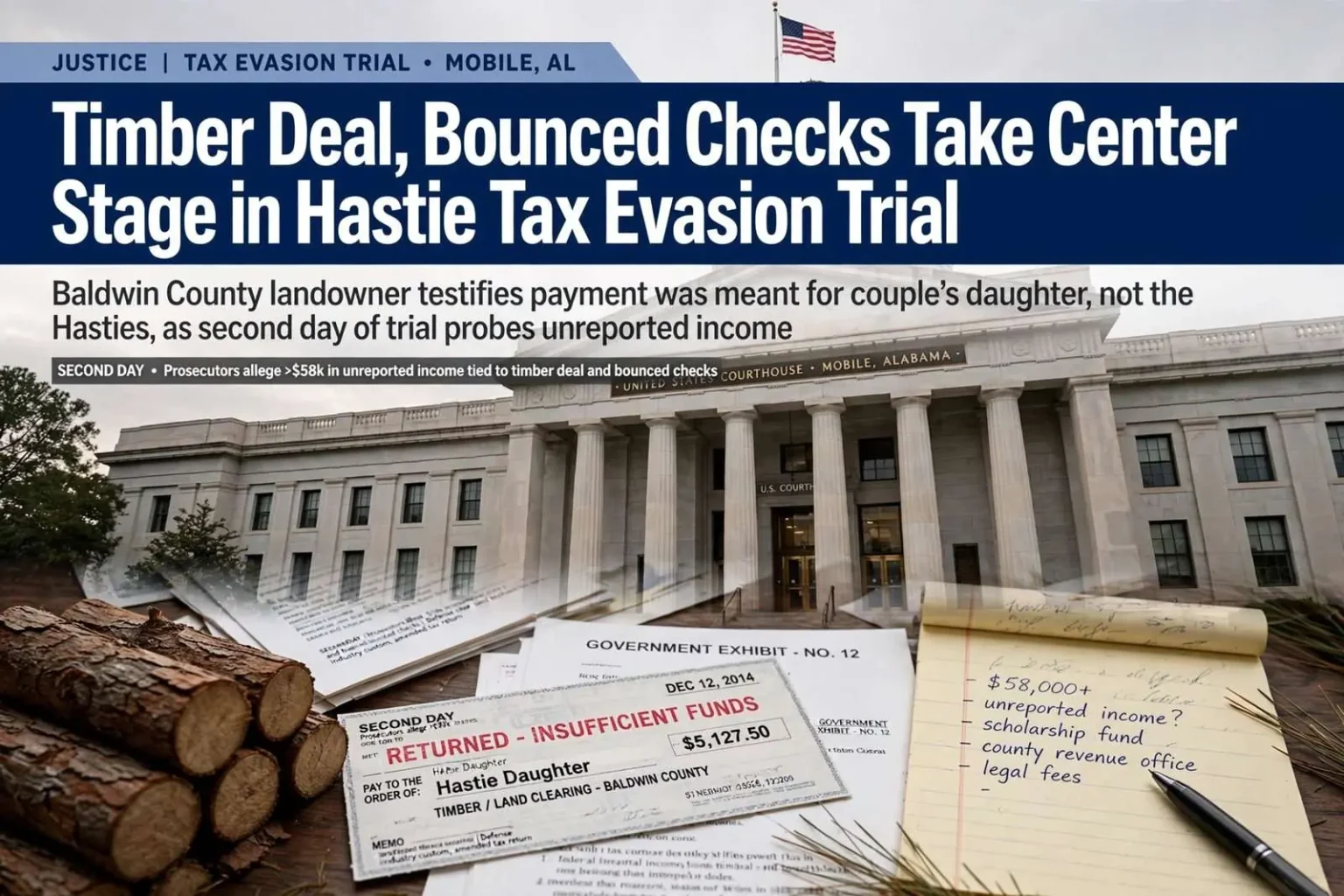
A Baldwin County landowner testified in federal court in Mobile that a timber deal he struck with the husband of Mobile County License Commissioner Kim Hastie was meant to help the couple’s daughter, not the Hasties themselves, as prosecutors pressed forward on the second day of the couple’s tax evasion trial. The testimony went to the heart of the government’s case: whether money that moved through the couple’s orbit was income they hid, or assistance that belonged to someone else entirely.
The landowner said he needed timber cleared from his property and turned to John Hastie, his distant relative, who worked for a forestry and land-clearing firm. Under the arrangement struck in December 2014, the firm agreed to purchase the wood, with a check for just over $5,000 written directly to the Hasties’ daughter rather than to the landowner. “I would have helped anyone if I could have, but I wasn’t helping them,” the landowner testified, referring to the couple’s ongoing legal troubles. “I was helping her.”
The witness’s framing — a favor flowing downward, not sideways to the defendants — was the defense’s most valuable testimony of the day, and it came from a witness prosecutors called. Cross-examination probed the relationship and the timing, but the landowner held to his account: he had standing timber, a need for cleared land and a relative in the business, and the destination of the firm’s check was never his decision.
The distinction mattered because of the charge itself. Prosecutors were not alleging that the timber deal was illegal — deals like it close across Baldwin County every week — but that the income it produced went unreported to the IRS while the couple’s finances were under strain. A check written to a third party, in the government’s telling, was a way of moving money where it was needed without it ever appearing on a tax return.
Prosecutors argued the arrangement was less about generosity and more about necessity, telling jurors the couple needed the cash infusion to avoid bouncing checks tied to a scholarship organization, a county revenue office and legal fees for Kim Hastie’s defense attorney. The payment, prosecutors said, was part of more than $58,000 in unreported income tied to land brokering and timber-clearing work that the couple failed to report to the IRS. The bounced-check thread — obligations to a scholarship fund and a county office among them — gave jurors a picture of finances stretched to the point of breaking at precisely the moment the timber money arrived.
The timeline sharpened the prosecution’s argument. December 2014 — the month the deal closed — fell between the first allegations against Kim Hastie and the indictment itself, a stretch when legal bills were mounting and public attention was fixed on the couple’s affairs. Money that arrives during such a stretch, prosecutors suggested, doesn’t disappear quietly; it goes somewhere, and the government’s exhibits traced exactly where this one went.
The defense answers with industry custom
Several colleagues of John Hastie from the forestry firm testified in his defense, telling jurors it is common practice in the timber industry for payment to go to someone other than the landowner. One executive testified he authorized the check to the Hasties’ daughter and said it was not his place to question who received payment on a land deal. The testimony aimed to drain the arrangement of its suspicious framing: in an industry built on handshake custom and middlemen, payees shift for reasons that have nothing to do with concealment.
The industry-custom defense carried a practical logic. Timber deals routinely involve brokers, crews and intermediaries who are paid directly from the proceeds, and a buyer’s check often follows instruction rather than title. If the firm’s witnesses were believed, the December 2014 check said little about the Hasties’ intent — it reflected how the wood business moves money, with the buyer paying whoever the seller directs and asking no questions.
An accountant testified that she filed an amended tax return for the Hasties earlier this year showing a previously unreported land-deal payment from several years earlier, after being contacted by John Hastie’s defense attorney, who also happened to be her client. She said the couple now owes back taxes to both state and federal authorities as a result. The admission cut both ways: it conceded that income had gone unreported, but it framed the omission as an error corrected voluntarily — through an amendment sought by the defense — rather than a scheme.
The accounting witness’s dual role — tax preparer to the defendants and client of John Hastie’s defense attorney — drew careful questioning from prosecutors, who explored whether the amendment reflected independent judgment or advocacy. She testified that her work followed standard practice: the attorney contacted her, she reviewed the underlying records, and the amended return reported what the records showed. Back taxes now owed to both the state and federal governments, she acknowledged, remain outstanding.
The custom testimony also expanded the trial’s cast. Colleagues from the forestry firm, some of whom had dealt with John Hastie professionally for years, walked jurors through the mechanics of a land-clearing deal — the survey of the timber, the agreement with the buyer, the cutting and hauling crews, and the settlement. Their account made the December 2014 transaction look ordinary from the firm’s side of it, a familiarity that undercut the suggestion of something specially arranged for the Hasties.
The amended return gave the defense a narrative to counter the government’s: a family in financial stress, a payment routed through a daughter for reasons the industry would recognize, and a tax accountant hired to make things right the moment the issue surfaced. Prosecutors, for their part, would remind jurors that the amendment came only after an indictment — that the return was fixed when fixing became unavoidable.
A quiet absence and a full gallery
Notably absent from the witness list was the Hasties’ daughter, whom prosecutors had earlier signaled they intended to call to testify but ultimately did not put on the stand. Her absence left the check in her name — the transaction at the center of the day’s argument — explained by everyone except the person who received it. Defense lawyers had no obligation to call her, and prosecutors evidently calculated that her testimony carried risks of its own; either way, jurors were left to weigh the payment without hearing from its named beneficiary.
The Mobile courtroom again drew a large crowd of the Hasties’ supporters, filling several rows of the gallery. Testimony grew tense at times, with attorneys sparring over witness credibility, and the judge intervened at one point to quiet the courtroom after commotion in the gallery interrupted proceedings. The visible support — family, friends and well-wishers returning for a second day — has been a feature of the trial since jury selection, and it has underscored the local roots of a case that has followed the couple from the courthouse to the community.
A juror was also dismissed earlier in the day after raising a personal conflict with the judge. The mid-trial subtraction trimmed the panel without delaying the schedule, but it added to the day’s churn — a witness list reshaped, a gallery scolded and a juror gone, all before lunch. Federal judges guard the integrity of a panel jealously in a case with this much local attention, and the quick resolution of the conflict avoided the complication of swapping in an alternate mid-testimony.
The trial, centered on allegations that the couple failed to report tens of thousands of dollars in income to the IRS, was expected to conclude with closing arguments the following day, after which the case would go to the jury. The single-count structure of the proceeding — the first of two trials facing the couple — meant jurors would decide a focused question: whether the timber money and the rest of the unreported income was willfully concealed or merely mismanaged.
For the government, the two days of testimony built a mosaic: a check to a daughter, bounced obligations to a scholarship fund and a county office, and a tax return corrected only under indictment. For the defense, the same record told of industry custom, family generosity and an accountant’s amendment offered before any jury was seated. Closing arguments would distill those competing stories into one instruction — and twelve Mobile residents would answer the question the government had pursued since the first indictment.
Whatever the verdict, the testimony offered the fullest public accounting yet of the couple’s finances, delivered under oath in a courtroom their supporters filled each morning. The landowner’s insistence that he was helping the daughter, the firm executives’ defense of timber custom and the accountant’s amended return now stand as the record from which the jury will decide whether the Hasties’ tax debt was an oversight — or an evasion.