
Is Mobile Business-Friendly? Developers Answered, on Condition of Anonymity
Promised anonymity, Mobile developers and executives delivered a blunt 2008 verdict on the city's permitting, its economic development effort and its habit of favoring public projects over private capital.
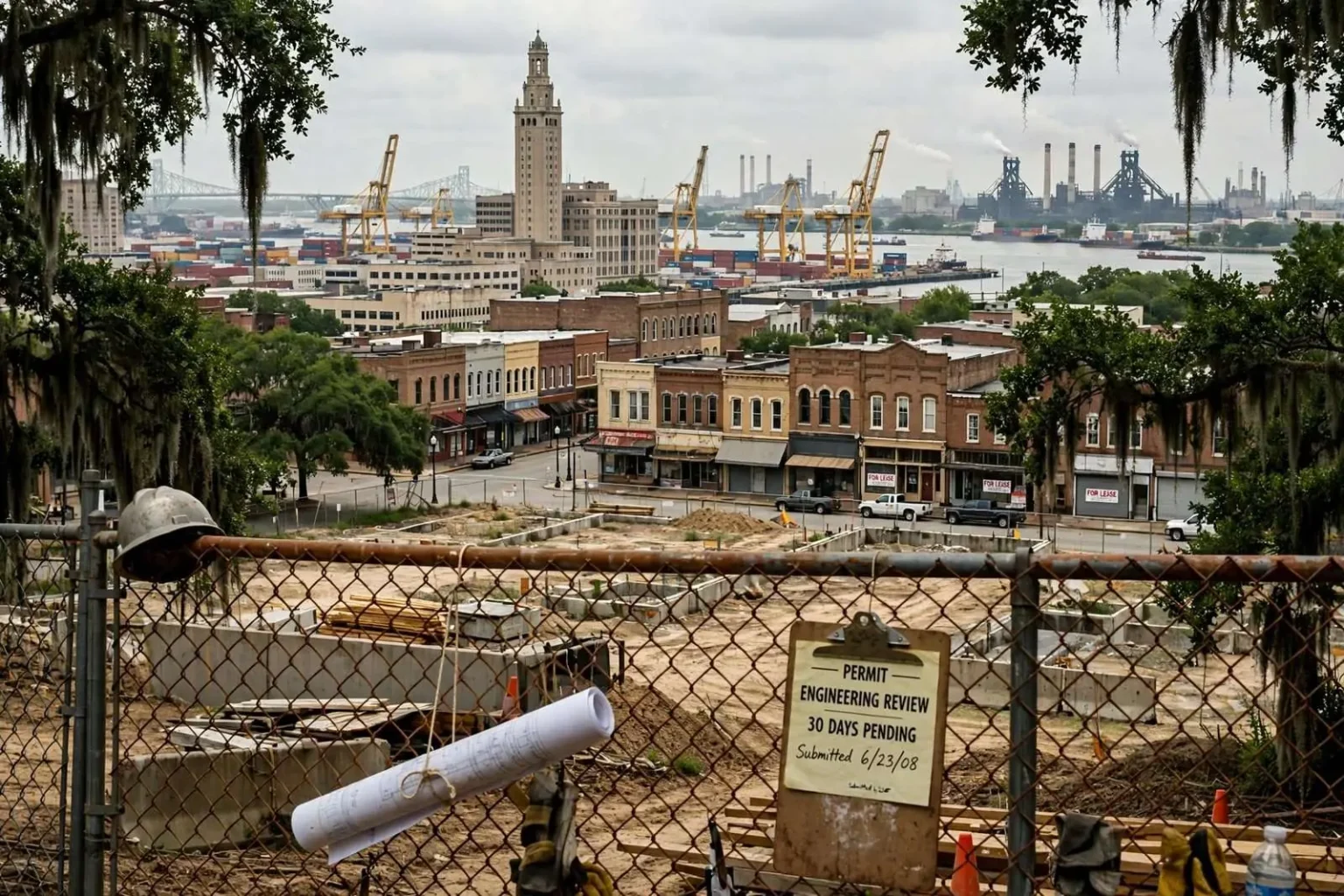
In the summer of 2008, with steel, aerospace and port announcements dominating the headlines, a simple question was put to a group of Mobile business owners, developers and executives: is Mobile business-friendly?
They were promised anonymity, and they used it. The answers, taken together, describe a city of two realities — a leadership layer that markets the city energetically and a regulatory layer that many builders experience as an obstacle course — and a community whose sharpest critics were also its most loyal residents.
The timing mattered. In mid-2008 Mobile was riding a wave of transformation announcements: the ThyssenKrupp steel mill upriver, the Airbus engineering center, the continuing build-out of the State Docks and the prospect of an aircraft assembly plant at Brookley. A city receiving that much national attention had every reason to ask whether its own house was in order — whether the everyday experience of opening a business here matched the sell being made to the world.
Yes, at the top
Several respondents drew a clean line between the city’s elected leadership and its bureaucracy. City government, one said, enthusiastically promoted business moving to Mobile, and the council generally worked as a team to sell the city despite its internal schisms.
He added a point that outsiders often missed: unlike many Southern cities, Mobile did not carry racial divisions that frightened prospective employers, and its history of relative racial reconciliation had to be counted as an asset even where its educational attainment was not.
The observation reflected Mobile’s particular political history. Through the 1980s and 1990s the city had moved, sometimes painfully, through school desegregation fights and biracial coalition politics that left it with an unusual arrangement — a city whose leadership, black and white, had learned to sell economic development jointly. Employers scouting the South in that era frequently weighed a community’s racial climate as a site-selection factor, and Mobile’s reputation for a politics that did not fracture along those lines was worth real points in those conversations.
Another, whose firm worked in 28 states, called Mobile a pleasure to work in, credited outgoing Mayor Mike Dow with being proactive, and said the next mayor’s job was to build on that record while keeping the focus on public schools.
The reference to schools appeared repeatedly, from people otherwise enthusiastic. Dow, mayor since 1989, had built the downtown redevelopment record and the national marketing of the city that every respondent took as the baseline, and he was leaving office in the 2009 election cycle. Whoever succeeded him, in the view of this respondent, inherited a sales operation that worked — and an education system that remained the city’s largest unsolved problem in attracting the families that industries bring with them.
No, at the counter
The developers were harsher. Ask a city staffer whether Mobile is business-friendly and the answer is yes, one said; ask a contractor and you get a different answer.
He complained of inconsistent code enforcement, slow plan review and a can’t-do posture from staff. Another said the planning staff and other permit grantors frequently made it costly, slow and sometimes nearly impossible to bring forward anything new, whether a subdivision, a drugstore or a commercial venture — and noted that west Mobile residents had used exactly that reputation as an argument against annexation into the city.
The annexation point deserves unpacking, because it converted an internal administrative failure into an external strategic cost. West Mobile’s unincorporated neighborhoods had resisted joining the city for years, and one of the arguments they used was precisely that the city’s permitting process was a burden they did not want. Every frustrating permit experience thus became evidence in a debate about the city’s growth boundary — meaning the reputational damage of a slow plan review office did not just delay projects; it kept taxable development and population outside the city limits altogether.
One respondent described a study of permit turnaround times, department by department. Traffic, urban development, forestry and the rest, he said, all came in within a reasonable window of seven to 10 days. Engineering took roughly 30.
“It’s gridlock,” he said. “It’s like they are scared to make a decision.”
The diagnosis embedded in those numbers is administrative rather than political: a department whose turnaround runs three times its colleagues’ is either under-resourced, buried in review standards no one senior has prioritized, or acting as the final checkpoint where every other department’s approval is quietly re-litigated. Whatever the cause, the effect is predictable — the site engineer whose traffic approval arrives in eight days and whose drainage approval takes a month schedules his crews around the slower office, and the project’s opening date slips with it.
Attitude, he argued, mattered as much as rules. Some Florida cities were far stricter and charged heavy impact fees, he said, but their message was still: we want you here.
The complaint about public money
The sharpest critique came from a respondent who answered the question with a jab. Mobile, he said, was absolutely friendly to government-supported business and development — the cruise terminal, the office tower built by the state pension fund with city help, the university research park, the master planning at Brookley.
For a private developer competing against a tax-exempt public investor with no profit incentive, he said, the picture looked different.
He ran the arithmetic on downtown office space: roughly a million square feet, with 700,000 occupied and 300,000 vacant, into which a new tower was adding 600,000 more. No private developer could have built that project, he said, and no lender would have funded it.
His prediction was that Mobile’s run-down downtown buildings would sit unrefurbished for years while capital chased the subsidized product.
The economics of his complaint were straightforward. A public investor — the Retirement Systems of Alabama, whose tower projects were financed on the pension fund’s balance sheet — could absorb occupancy rates and lease-up periods that would sink a private builder holding construction debt. The vacant 300,000 square feet already downtown was supply with no demand, and adding 600,000 more on public capital meant the marginal private dollar that might have renovated an older building went elsewhere. His forecast of deferred renovation and crowding-out is the standard consequence of subsidized competition in a small market.
The sales problem
Several respondents circled back to the same theme: Mobile did not sell itself.
One recalled a magazine feature that credited Alabama and singled out Cullman, Montgomery, Huntsville and Baldwin County without mentioning Mobile at all. Another said the city had lost its last nationally connected economic development professional in the 1990s and had been paying for it since, comparing the recruitment effort to a company that fields inside sales staff but never sends anyone out on calls.
The metaphor was precise. Site selection in the 2000s ran on relationships: state and regional economic development offices feeding projects to the communities that showed up in their network. A city without a national traveler — someone who knew the consultants, visited the prospects and cultivated the corporate real estate brokers — was invisible in the pipeline regardless of its merits. Mobile, by this account, was counting on its reputation reaching the market rather than carrying it there.
He recounted a corporate executive telling him the company wanted to extend its Mobile lease not for five years but for ten, because “we think Mobile is a well-kept secret.” His reaction was mixed. “Why are we a secret? Nobody knows we are here is the answer.”
Another respondent, comparing notes with a Birmingham businessman, said the region’s losses in paper and manufacturing explained part of the gap — but that petty politics in Montgomery over docks expansion legislation sent business exactly the wrong signal.
The docks fight was a live wound in 2008. Legislation tied to the State Docks’ expansion — including the governance and commitments Mobile needed to pursue a major aircraft assembly plant at Brookley — had stalled in the legislature amid intercity rivalries. Mobile’s business class read the delay as a message to site consultants that the city could not get out of its own way on its most important project.
Still home
For all the frustration, the criticism came wrapped in loyalty. Mobile, one of the sharpest critics insisted, was the best place to live, raise a family and be raised. His worry was narrower and, in 2008, entirely fair: his daughters wanted to come home, and he could not tell them where in Mobile to send a resume.
That closing note framed everything the survey had produced. The steel and aerospace announcements of that summer were supposed to answer exactly that question — to give the children of Mobile’s business families a reason and a place to come home. Whether the city’s regulation, its salesmanship and its politics could convert the headlines into payrolls was, for the people who had built the community and wanted to hand it to their children, the only version of “business-friendly” that finally counted.