Riley and Bronner Pressed Dow to Run Again, but Mobile’s Mayor Appeared Unmoved
Gov. Bob Riley and retirement systems chief David Bronner urged Mobile Mayor Mike Dow to seek re-election at a meeting shortly before Christmas 2004, but his backers conceded he was unlikely to be dissuaded.
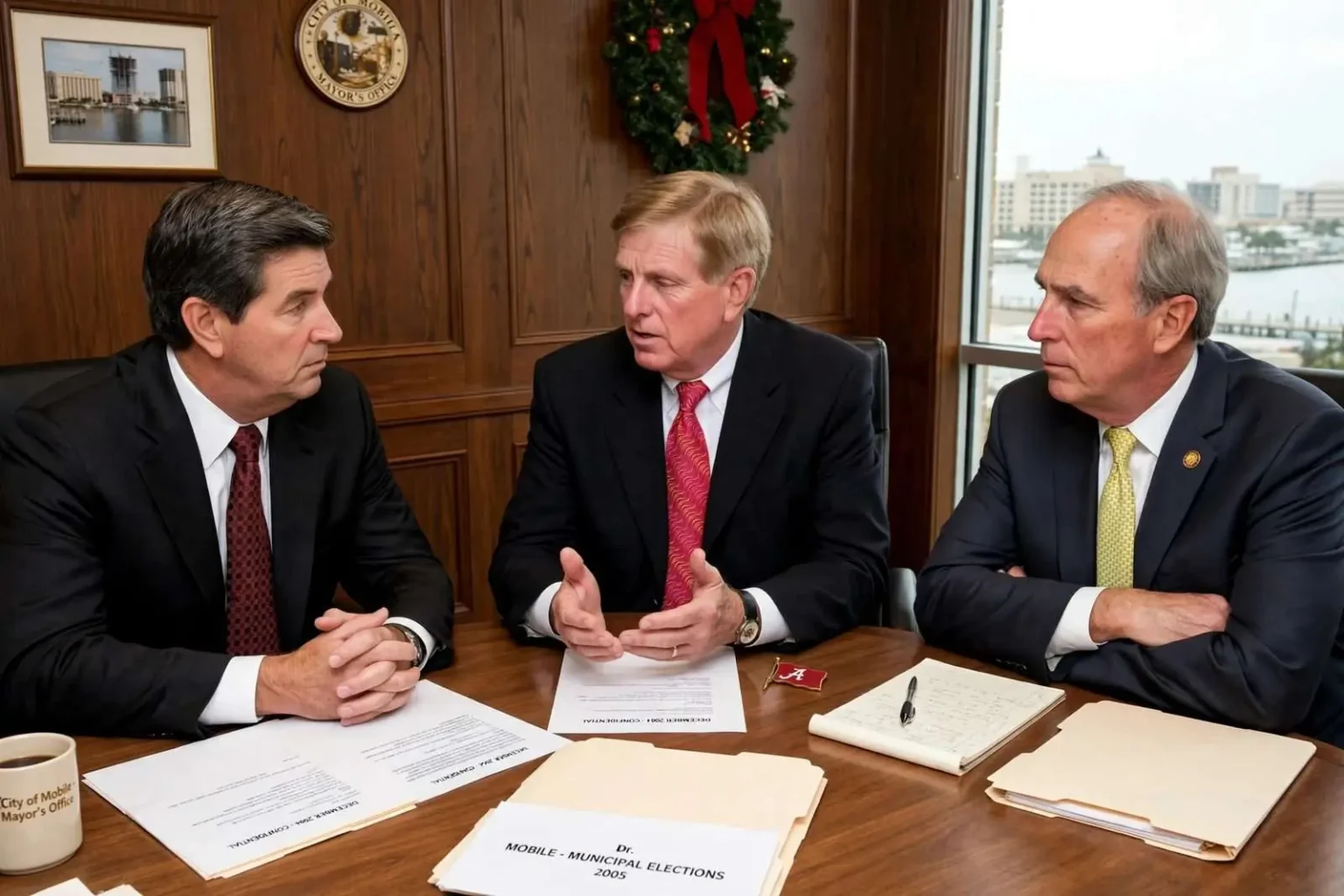
MOBILE — Gov. Bob Riley and Dr. David Bronner, the chief executive of the Retirement Systems of Alabama, met with Mayor Mike Dow in Mobile a few days before Christmas 2004 and urged him to seek re-election in the municipal elections scheduled for the following August. Dow, according to a number of supporters, associates and advisers, had already disclosed plans to leave public office that fall after 16 years, in favor of a more lucrative opportunity in the private sector. Publicly, he continued to say only that he was running for re-election until he said he wasn’t.
An adviser to both Dow and Riley confirmed the meeting. Attempts to obtain further details from participants were not immediately successful. A local ally of the governor cast Riley’s role modestly, describing him as a supporter of the city and its progress who had worked well with Dow, but who believed the mayor’s plans were properly a matter for Dow himself and the voters of Mobile.
Why the governor and the RSA chief cared
Sources close to the situation suggested that a major motivation — though not necessarily the only one — was a desire to avoid a municipal election that could be interpreted as a racial conflict. The scenario feared by political observers ran as follows: with Dow gone, the leading Black candidate would likely top the field in the primary, only to lose to the leading white candidate in a runoff. Whatever resentment lingered afterward could poison consensus-building in the new administration for years.
There was also a concern about how such a contest would be portrayed beyond Alabama. Mobile is the city where the last known slave ship to reach the United States, the schooner Clotilda, delivered its human cargo in 1860 — more than half a century after the importation of enslaved people had been outlawed. The Africans who survived and were freed founded the community north of downtown that became Africatown, and their descendants live there still, near Magazine Point. A racially polarized mayor’s race in that city, some feared, would be an irresistible national story — and one that could complicate economic development and investment recruitment.
Bronner’s concrete interest
Bronner shared those concerns, but he had more tangible reasons for wanting stability at City Hall. The Retirement Systems of Alabama, through its affiliates, had invested heavily in the Mobile Bay area, including: The $162 million RSA Tower and Battle House Hotel project in downtown Mobile — a 250-room hotel restoration expected to open in March 2006, alongside a 35-story, 500,000-square-foot office tower that would be the tallest building in Alabama.
The RSA also held the 375-room Riverview Plaza hotel at Water and Government streets, formerly the Adam’s Mark; the $20 million cruise ship terminal downtown; a retirement community in west Mobile; Robert Trent Jones golf facilities at Magnolia Grove in Millers Park; and the Grand Hotel and Resort in Point Clear. The portfolio ranged from office towers to golf fairways to a shuttered grand hotel on the eastern shore, and every piece of it depended on Mobile continuing the trajectory it had followed through the Dow years.
The RSA had, in other words, staked a substantial portion of its portfolio on the proposition that downtown Mobile was on its way up. A disruptive political transition was not in its interest. Bronner, who manages the pensions of hundreds of thousands of Alabama public employees, has built RSA’s reputation on big bets on the state’s cities, and his willingness to press a mayor privately was consistent with the way he has always guarded those investments.
Dow did not melt
By all indications, the entreaties failed. Dow did not yield to Riley and Bronner, and by early January at least a few of his leading backers were conceding that it was increasingly unlikely he could be dissuaded from returning to private business.
The pull was familiar. Dow, 58, and his brother-in-law Jim Busby had built Quality Micro Systems (QMS) into a publicly traded success. Busby had since developed CentraLite Systems, a home automation venture with broad commercial potential, and Dow’s skills in sales and marketing were seen as central to scaling it. The opportunity represented both a financial step up and a return to the business world where Dow had made his name before ever seeking office.
Dow had first won the mayor’s office in 1989 in a startling political debut, unseating incumbent Arthur R. Outlaw, a Republican bellwether and for years a major force in local, state and national politics. Few outside his own circle had given the political newcomer much chance against a fixture of Mobile government; the upset established Dow as a politician capable of outselling an opponent, and he had used that skill for 16 years to sell the city itself — to employers, to investors and to state government.
A long list of suitors for the seat
The vacuum created by his expected exit filled quickly with speculation. Among those mentioned as potential mayoral candidates at the start of 2005 were: Mobile County Commissioner Sam Jones; District 7 City Councilman John Peavy, co-owner of Peavy Construction Co.; former state Sen. Ann Bedsole; District 3 City Councilman Clinton Johnson, pastor of Shiloh Baptist Church; District 4 City Councilman Ben Brooks, an attorney; County Commissioner and former councilman Stephen Nodine; former District 6 Councilwoman Bess Rich; David Cooper, president of Cooper/T. Smith Inc., one of the oldest and largest stevedoring firms in the country; Karen Outlaw Atchison, an interior design consultant and daughter of the late Mayor Outlaw; commercial real estate executive Richard Weavil; Ralph Buffkin, an unsuccessful County Commission candidate; and Al Stokes, Dow’s chief of staff.
The list cut across every corner of Mobile’s political geography: the city council’s districts, the county commission, the business community, the clergy and the families of past administrations. Some held elective office, some ran companies, some carried famous surnames, and none could be ruled a certain non-candidate in a field this open.
Most would never file. But the length of the list was itself the story: after 16 years in which one man had defined Mobile City Hall, the field was suddenly, and unnervingly, wide open. Names that would never have surfaced against an incumbent suddenly carried weight, and every person on the list had to decide whether 2005 was the moment to step into a citywide race with no incumbent to run against — an opportunity that would not come again for years.
The speculation also carried risks for the city itself. With the mayor’s plans unannounced and the field unsettled, potential employers and downtown developers watched to see whether Mobile’s leadership would change course or simply change faces. The uncertainty lasted from the first December whispers until Dow’s own announcement finally fixed the field — and even then, only the qualifying deadline in July would settle who was actually in.
The Christmas-season appeal to Dow reflected how differently the stakes looked from inside the RSA’s portfolio than from the mayor’s office. To Bronner, the Battle House restoration and the RSA Tower were long-gestating commitments whose returns depended on downtown’s momentum continuing — momentum that a bruising, racially framed municipal election could interrupt at exactly the wrong moment. Construction schedules, hotel bookings and tenant recruitment all assumed a City Hall that kept the same direction regardless of who occupied it.
To Riley, the calculation was political as much as economic. As governor, he had no formal role in Mobile’s municipal elections, but a divisive contest in the state’s second-largest city would color his own relationships with the city’s next leadership and with the business community that backed both men. The modesty of his public posture — deferring to Dow and the voters — matched the limits of what a governor could properly do in a city race.
The episode also illustrates a quieter feature of Alabama public life: the RSA’s reach. Bronner’s investments have given the state’s pension fund a direct stake in the fortunes of Montgomery’s skyline, Gulf State Park, Robert Trent Jones golf courses across Alabama and the Mobile Bay hotels and towers listed in this story, and city halls across the state have learned that RSA money arrives with RSA expectations.
Dow’s resistance to the combined pressure of a governor and the state’s most powerful institutional investor told the room everything it needed to know. Whatever the private-sector offer was worth — and his associates suggested it was worth considerably more than the mayor’s salary — the decision had already been made by the time the two men came to town. The meeting, confirmed but never detailed publicly, stands as one of the most consequential private conversations in modern Mobile political history: two of the state’s most influential figures tried to keep a mayor, and the mayor chose to go.
What followed — the crowded field, the scramble to replace him and the money that poured into the race — played out over the months ahead. But it began here, in a room a few days before Christmas 2004, when Mobile learned that no amount of persuasion could keep a politician who had already decided to leave.