A Warning Beneath the Cheering: Scientists Questioned the Cost of Mobile’s Growth
As Mobile celebrated steel plants and tanker contracts in 2008, retired Dauphin Island Sea Lab director George Crozier warned that unmanaged growth could undo 40 years of hard-won water quality gains.
In the summer of 2008, while the Mobile area was congratulating itself on the biggest industrial haul in its modern history, a retired marine biologist was going around town making himself unpopular.
“We may see an economic boom, but I’m afraid we may flush the goose that laid the golden egg right down the toilet,” said Dr. George Crozier, who had recently stepped down as executive director of the Dauphin Island Sea Lab. “There is great jeopardy here in terms of our quality of life, and it worries me greatly.”
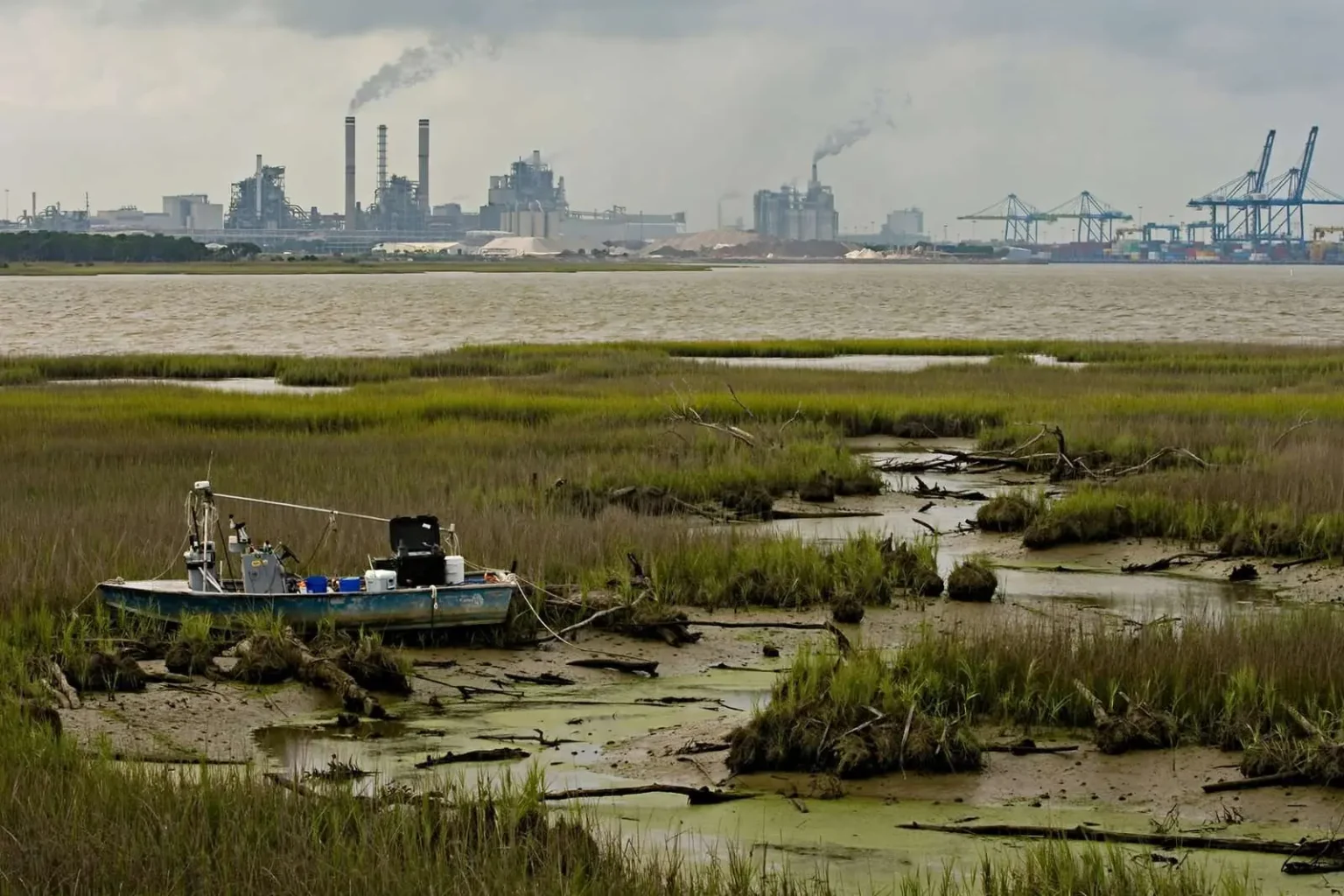
The boom Crozier was warning about was not abstract. The region had just landed the steelmaking megaproject taking shape in north Mobile County, the largest single industrial investment in Alabama’s history, and downtown Mobile was adding a container terminal capacity that would remake the port’s place on the Gulf. Civic Atlanta-style boosterism was running high: jobs, tax base, growth. Crozier’s counterargument — delivered at civic forums and to anyone who would listen — was that the estuary underneath all of it was the region’s original economic engine, and that nobody had written a plan to keep it healthy while the boom proceeded.
He was, by training and temperament, the right messenger for the warning. The Dauphin Island Sea Lab, which he led for decades, is the state’s marine science consortium — a campus on the eastern tip of Dauphin Island where Alabama’s public universities pool their ocean and estuary research and where generations of the state’s teachers and students have been trained. Its director is one of the few positions in Alabama whose job description is, in effect, the health of Mobile Bay and the waters around it. Crozier had spent a career watching the bay absorb everything southwest Alabama did to it.
Forty years of progress, flattening out
Crozier’s argument was not that industry should stay away. It was that Mobile and Baldwin counties, and the municipalities within them, had no shared strategy for managing what was coming.
He said the two counties needed to sit down together and develop an approach to growth management — a phrase he acknowledged landed among local officials like a curse. In Alabama’s political culture, “growth management” reads as a synonym for regulation, and no Mobile-area government had ever adopted a coordinated, bi-county framework for deciding where development would go and what its cumulative effect on water would be. Each city annexed, zoned and permitted on its own, and the estuary received the sum of all those local decisions at once.
He pointed to the record. Since the Clean Water Act, he said, state monitoring data had shown gradually improving water quality across the region, with rising dissolved oxygen in Chickasaw Creek, in Bayou La Batre and in the Tensaw River.
That improvement was the environmental movement’s success story in miniature. Before the federal Clean Water Act, the region’s creeks and rivers absorbed untreated sewage and industrial discharge with little restraint; the law’s permitting and treatment requirements, enforced over three decades, had pulled dissolved oxygen levels back toward the ranges that support fish and shellfish. The monitoring stations in Chickasaw Creek, around Bayou La Batre — the seafood town whose waters support a fleet still rebuilding from repeated storms — and along the Tensaw River in the Mobile-Tensaw delta recorded that recovery year by year.
But the curve, he said, had already flattened, and that was before the new plants opened.
The mechanism he described was familiar to anyone who has watched a coastal county fill in: a subdivision goes up on septic tanks; the septic tanks eventually fail; a sewer system is built; the sewer system invites more rooftops; habitat disappears and water quality slips again.
The cycle is self-reinforcing, and Mobile and Baldwin counties had run it for decades. Baldwin County in particular had grown on septic systems spread across sandy soils far from municipal sewer lines, and failed tanks — which discharge nutrients and bacteria to groundwater and ditches — were a chronic, diffuse pollution source that no single permit could fix. Building sewers solves the septic problem and simultaneously opens the land to denser development, which brings more rooftops, more pavement, more runoff, and more of the pollutants that treatment plants and storm drains deliver to the bay. The delta and its tributaries sit at the receiving end of all of it.
Nitrogen and phosphorus loading, he added, does not come only from lawns and farms. A great deal of it falls out of the air, and the source is automobiles.
That point was the least intuitive and most consequential in his case. Nutrient enrichment — the excess nitrogen and phosphorus that fertilize algal blooms, strip dissolved oxygen from water and stress the estuary’s food web — is usually blamed on fertilizer and wastewater. But combustion engines emit nitrogen oxides that settle onto the landscape and into the water with rainfall, meaning that traffic volume itself is a water-quality variable. A region that doubles its vehicle-miles does not just add congestion; it adds nutrients to the bay from the sky. The cleaner cars of recent decades reduced the rate, but growth in driving could offset the gains — which is why Crozier’s next subject was roads.
Roads, bridges and buses
That led Crozier to the most contrarian part of his case. He said he disliked the proposal for a new Interstate 10 bridge over the Mobile River and the widening of the Bayway, and he argued the region had to stop trying to pave its way out of congestion — a 1950s mentality, in his view.
The proposed bridge — a new interstate crossing of the Mobile River connecting the bankhead tunnel and Wallace Tunnel corridor with the growing western suburbs — had been discussed in various forms for decades as the solution to the tunnels’ chronic bottleneck. The Bayway widening addressed the elevated interstate stretch across Mobile Bay, one of the region’s most-traveled and most accident-prone segments. To planners, both projects were obvious capacity fixes; to Crozier, they were the reflex that had produced every congested American metro since midcentury: build lanes, induce traffic, build more lanes.
His objection was layered. More roadway capacity would accelerate the eastward and westward suburban sprawl that generates the air-deposited nutrients he had just described, and it would do so across some of the most sensitive terrain between the two counties — the delta fringe and the tidal margins of the bay. A region that answered growth with pavement, he argued, would end up with both the pavement and the congestion, and a degraded estuary as the bill.
The alternative he pointed toward was the one every growing American region had eventually been forced to debate: transit, coordinated land-use planning and growth redirected toward existing infrastructure rather than outward across open land. None of it was popular in a metro built around the private car, and Mobile’s transit system was modest at best — but the arithmetic of air quality and runoff, he argued, did not care about the politics.
The boom’s other side
The steel project and port expansion that framed the summer’s optimism were precisely the pressures Crozier wanted managed. Heavy industry brings water intake, discharge permits, rail and truck traffic, dredging and dredge disposal — each a direct interaction with the estuary the region markets to tourists and fishermen. Port growth multiplies ship traffic through Mobile Bay, with the ballast, wake erosion and channel-deepening questions that follow. None of these impacts is necessarily fatal to the bay; the issue Crozier raised was cumulative, uncoordinated growth — the sum of impacts nobody was adding up.
The Mobile Bay estuary is one of the most productive systems on the northern Gulf Coast. Its waters support a commercial and recreational fishery, an oyster industry, the seafood towns of the western shore and a tourism economy on both sides of the bay, and the delta upstream is one of the largest river deltas in the country. The “goose that laid the golden egg” in his metaphor was that system itself: the water quality, the fisheries and the landscape that made people want to live on Mobile Bay in the first place. An economy that grew by degrading it would, in his telling, be selling the asset that funded the growth.
What he was asking for
Crozier was not proposing a moratorium. His ask — a bi-county growth-management framework — was the institutional plumbing that fast-growing American regions put in place sooner or later: shared standards for where development goes, how stormwater is treated, when sewer replaces septic and how transportation investment is sequenced. The obstacle was governmental: Alabama’s cities and counties are jealous of their zoning and permitting authority, and Mobile County’s municipalities had never ceded any part of it to a regional body.
His timing was deliberate. The megaproject’s environmental reviews, permits and construction schedules were all still in motion, and the container terminal’s expansion was before regulators. Decisions made in the next few years — about channel depth, discharge limits, road alignments and sewer extensions — would set the region’s pattern for a generation, the way decisions made in the 1950s and 1960s had produced the geography everyone now had to work around. Waiting for the boom to finish before writing the plan, he argued, meant writing the plan for a landscape that had already changed.
The warning landed, as he expected, with limited enthusiasm. Growth was the region’s consensus goal, and the officials celebrating the steel plant were not eager to hear that the celebration carried an ecological price tag. But the argument he made that summer — that Mobile Bay’s health and the region’s economy were the same asset, and that managing growth was how a community keeps both — was the question the two counties would have to answer eventually, boom or no boom.