Byrne Amendment Blocks VA From Diverting Veterans Choice Program Funds
Rep. Bradley Byrne won House approval of an amendment shielding the Veterans Choice program, citing gaps in VA care access around Mobile.
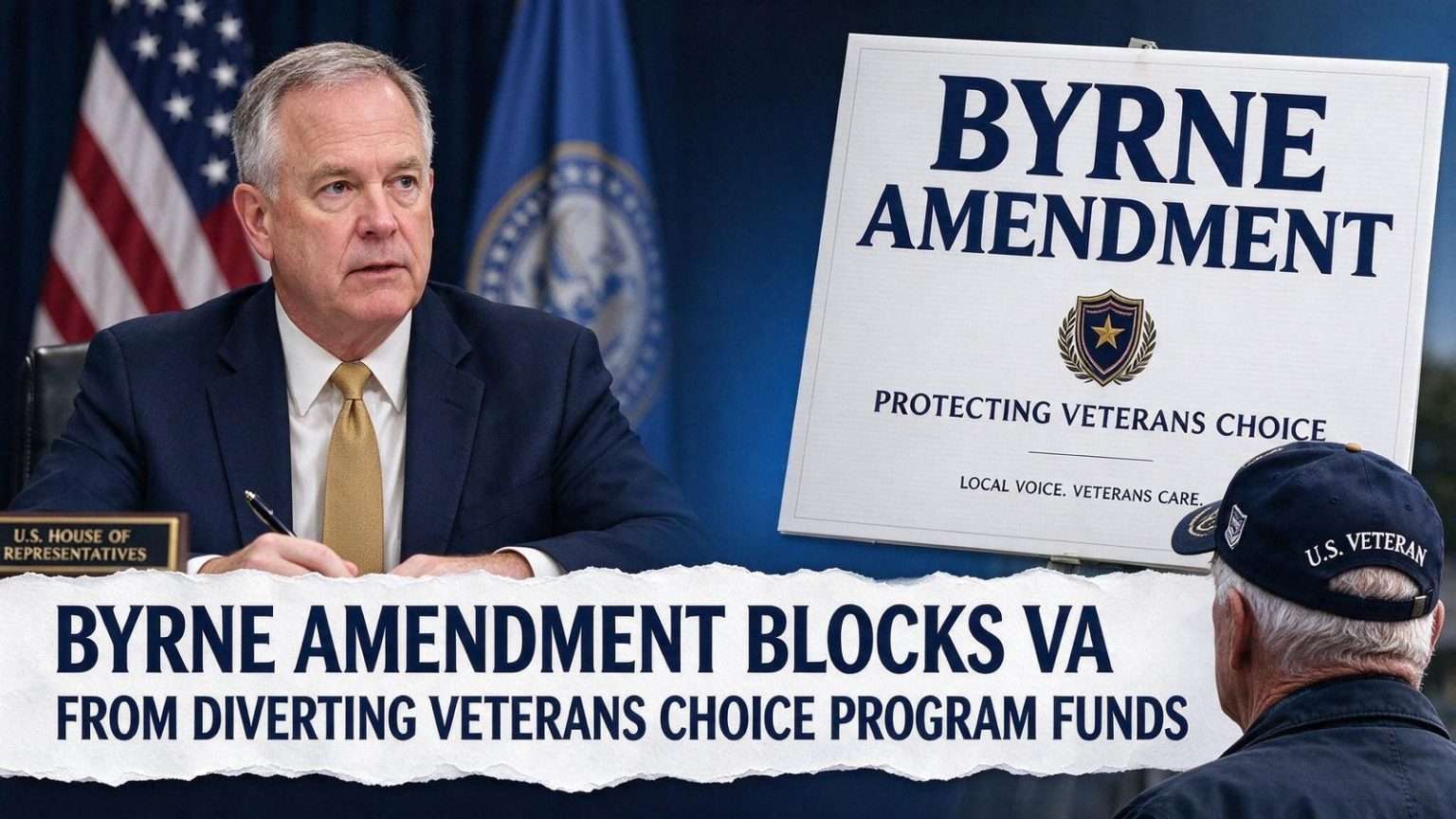
The U.S. House of Representatives approved an amendment from U.S. Rep. Bradley Byrne, R-Fairhope, this week that would block the Department of Veterans Affairs from shifting money out of the Veterans Choice Card program and into other accounts. The amendment passed on a voice vote as part of a larger bill funding the VA and military construction projects.
The Veterans Choice Card program was one of the most closely watched reforms to emerge from the scandals that rocked the VA in 2014, when investigations revealed that employees at VA medical centers had falsified appointment records to hide long waits while veterans died waiting for care. Congress responded with a temporary emergency measure that eventually became the Choice program, giving eligible veterans a plastic card they could present to private doctors. For veterans in rural parts of south Alabama, where VA facilities can be hours away, the program represented the first realistic alternative to long drives for routine care.
Byrne, who represents Alabama’s 1st Congressional District covering Mobile and Baldwin County, said he introduced the amendment after VA Secretary Robert McDonald asked Congress for authority to redirect funds away from the Choice Card program. The program, established the previous year, was designed to let veterans see private doctors if they had waited more than 30 days for a VA appointment or lived more than 40 miles from a VA facility. Byrne argued that pulling money from a program still in its early stages would undercut veterans before it had a chance to work as intended.
The funding fight reflected a broader dispute inside Washington about the program’s design. The Choice program was created with a $10 billion emergency allocation and a two-year lifespan, and critics within the administration argued that money spent on private care should instead flow into rebuilding the VA’s own capacity — hiring more doctors, opening more clinics and shortening internal wait lists. Supporters of the program, including many veterans’ groups and Republicans like Byrne, countered that shifting funds away from Choice would strand veterans who still could not get timely appointments, and that the VA’s capacity problems would not be solved quickly enough to justify pulling the plug on private-care access.
Byrne was also critical of how the VA had been interpreting the 40-mile distance rule, which the agency initially measured as a straight line rather than actual driving distance. While the VA later agreed to correct that calculation, Byrne said the agency’s broader interpretation of the rule still shortchanges veterans in his district.
He pointed to Mobile as a clear example of the problem. The area has a VA outpatient clinic, but Byrne said the facility offers only limited services. Because the clinic technically exists within the mileage threshold, the VA has treated nearby veterans as ineligible for private care even when the specific treatment they need isn’t offered there.
The Mobile VA clinic serves thousands of veterans across Mobile, Baldwin and surrounding counties, offering primary care, mental health services and other routine treatment. But specialized care is another matter. Veterans who need procedures or specialty consultations not available at the clinic have historically been referred to the larger VA medical centers in Pensacola, Florida, or Biloxi, Mississippi — trips that can mean hours of driving for elderly veterans, many of them with service-connected disabilities that make long travel difficult. For a veteran in Bay Minette or Citronelle, a trip to Biloxi can consume most of a day.
Byrne noted that Mobile is home to several major hospitals capable of providing that care, yet the VA’s rule can keep veterans from using them. As an example, Byrne cited veterans needing orthopedic surgery who, under the VA’s current interpretation, would have to travel to Pensacola or Biloxi rather than use hospitals closer to home in Mobile.
The straight-line versus driving-distance question, which the VA eventually conceded, illustrated how a technical definition could have real consequences. Measured as the crow flies, a veteran might appear to live just inside the 40-mile radius of a facility; measured along the roads a veteran actually must drive — across the Bay, around the Bay, down rural highways — the same trip could stretch well past the threshold. Veterans’ advocates had complained about the discrepancy for months before the agency agreed to use driving distance, and Byrne pressed the issue in hearings and correspondence with department officials.
Even with that fix, the deeper problem remained: the rule looked at whether a facility existed nearby, not whether that facility could actually provide the care a veteran needed. Byrne argued that eligibility for the Choice program should hinge on the availability of the specific service, not the mere presence of a clinic building on the map. Under his reading, a Mobile veteran needing an orthopedic operation should be able to choose one of Mobile’s hospitals — institutions that perform such surgeries every day — rather than being routed to an out-of-state VA center simply because the local clinic’s address satisfied the mileage formula.
The Politics of the Amendment
The amendment’s adoption on a voice vote reflected the political difficulty of opposing anything framed as protecting veterans’ benefits. Voice votes allow the House to approve measures without recording individual positions, and measures concerning veterans’ health care routinely clear the chamber with broad bipartisan support. The larger challenge, as Byrne and other allies of the Choice program acknowledged, was the Senate and the administration: the VA sought flexibility to move money among accounts as its needs evolved, and appropriators have historically resisted handcuffing agencies with rigid funding restrictions. The amendment’s fate in the final version of the funding bill would be decided in negotiations still to come.
For Byrne, a former state senator who won the 1st District seat covering southwest Alabama in a 2013 special election, the issue fit squarely within the priorities of his coastal district. The region is home to a large veteran population, drawn by the military installations along the Gulf Coast and by retirement communities in Baldwin County, and VA issues rank among the most frequent concerns his office hears from constituents. His staff has worked individual cases involving delayed appointments and denied referrals, giving the congressman a steady stream of examples to cite on the House floor.
What It Means for Local Veterans
The practical stakes for veterans in south Alabama come down to time, distance and continuity of care. A veteran who can see a specialist in Mobile keeps appointments, follows up with the same physicians and avoids the disruption of traveling out of the area for surgery and recovery. One who must travel to Pensacola or Biloxi faces fuel costs, overnight stays in some cases, and the burden of coordinating records between providers. Veterans’ service organizations in the area have long argued that the shortest path to good outcomes is care delivered close to home, whether inside or outside the VA system.
The debate over the Choice program’s funding also foreshadowed the larger restructuring that Congress would eventually undertake. The program’s original two-year authorization and emergency appropriation were always understood to be temporary bridges, and lawmakers from both parties acknowledged that a permanent solution — whether built on private-sector partnerships, expanded VA capacity or some combination — would be required. Amendments like Byrne’s functioned as markers in that negotiation, signaling congressional insistence that no veteran lose access to private care before a replacement system is in place.
In the meantime, veterans in the 1st District continue to navigate the system as it exists: appointment wait times measured at the clinic door, mileage rules calculated from their driveways, and referral decisions that determine whether care happens in Mobile or across state lines. The House’s voice vote this week put Congress on record that the Choice Card program — still new, still uneven, still being interpreted by regulators — should not be quietly drained while those questions remain unresolved. For the veterans of Mobile and Baldwin counties who use the program, the amendment was a signal that their congressman intends to hold the department to the promise the card represents.
The amendment also tapped into a longer history of friction between Congress and the VA over how department money may be moved. Appropriations committees generally write funding bills with specific purposes attached, and agencies seeking flexibility must either persuade lawmakers to grant it or work through transfer authorities that require advance notification and, often, committee approval. When a cabinet secretary asks Congress for the authority to sweep money away from a marquee program created just a year earlier in response to scandal, members who represent districts with heavy veteran populations tend to react defensively. Byrne’s amendment converted that instinct into legislative language, attaching it to the very funding vehicle the VA needed to pass.
Veterans’ advocates in south Alabama watched the funding debate with a mixture of hope and caution. The Choice Card arrived with fanfare, but early implementation was rocky nationwide: processing backlogs at the VA’s third-party administrators delayed authorizations, some community doctors waited months for reimbursement, and eligibility denials tied to the mileage and wait-time rules frustrated veterans who believed they qualified. Those growing pains gave both sides of the argument their evidence — critics pointed to the administrative mess as proof the program was unworkable, while supporters argued the fix was to streamline the rules, not to starve the program of funds.
For now, the program continues to operate in the district as it has since its launch, and local VA officials continue to process community-care referrals under the existing rules. The House’s action this week does not change eligibility tomorrow; it changes the terms of the negotiation ahead. But for veterans who have spent years watching appointment wait times and mileage maps determine what care they can get and where, the amendment carried a familiar message from Washington — that the promise of the Choice Card will be defended, at least for now, by the members whose constituents actually depend on it.