Baldwin County Leaders Question Why Tax Revenue Isn’t Climbing Faster
Commissioners pressed officials on why Baldwin County property tax revenue lags population growth, as neighboring counties post larger gains.
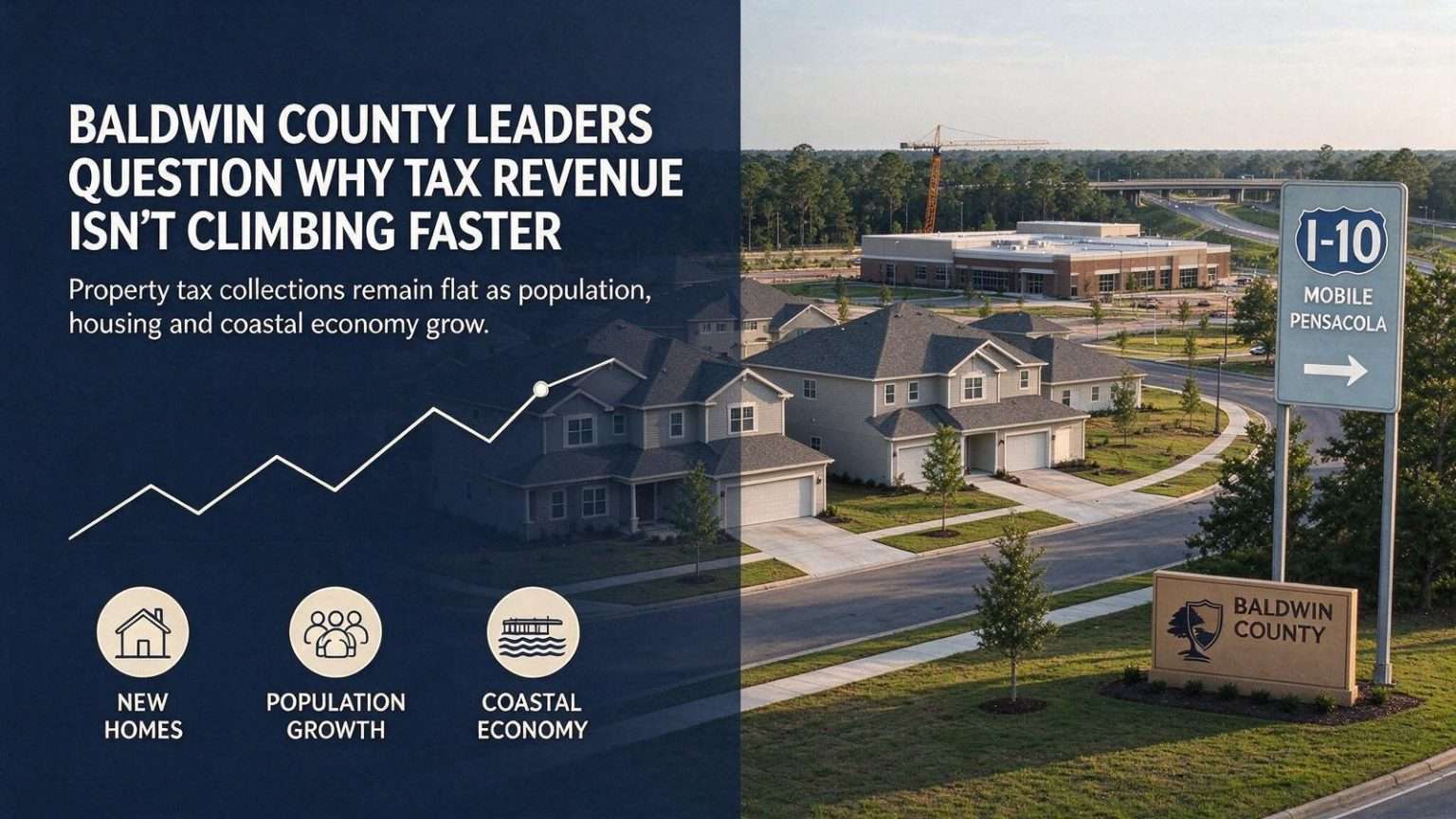
Baldwin County commissioners pressed county revenue officials this week over why property tax collections have not rebounded the way population growth would suggest. The exchange, played out in a public work session, put a number on a frustration that has been building in Alabama’s fastest-growing county for years: tens of thousands of new residents, thousands of new homes and a booming coastal economy — yet a General Fund that has barely moved since the recession.
During a commission work session, Interim County Administrator Ron Cink presented figures showing that while five other Alabama counties have seen climbing property tax revenue since the recession, Baldwin County’s take into its General Fund has stayed essentially flat. The comparison was the sharpest way to frame the question. Property values in Baldwin County have been rising visibly — new subdivisions across the Eastern Shore, expanding development corridors along Interstate 10 and Alabama 181, and a tourism economy that swells the county’s population every summer — yet the tax take has not followed.
Commissioner Tucker Dorsey asked why the fastest-growing county in the state wasn’t seeing that growth reflected in tax collections. Dorsey, whose district has absorbed much of the county’s residential boom, said the disconnect between growth on the ground and growth in the ledger demanded an explanation. The county has led Alabama in population growth for years, driven by the draw of its beaches, its schools and its comparatively affordable coastal lifestyle, and commissioners have repeatedly warned that infrastructure and services have not kept pace with the newcomers.
Revenue Commissioner Teddy Faust Jr. told commissioners he expects at least a 6 percent increase in the coming year, and defended his office’s property appraisal work. Faust’s office is responsible for valuing the county’s real property — a mammoth task in a county where tens of thousands of parcels have changed hands, been subdivided or been improved over the past decade. He pushed back against any suggestion that appraisals were lagging the market, while acknowledging the projection he could offer for the coming year.
Cink’s report showed Baldwin County’s property tax revenue into the General Fund peaked near $20.8 million in 2007 before falling sharply during the housing downturn. Collections crept up only slightly between 2012 and 2013, from about $16.04 million to $16.12 million, leaving the county roughly 22 percent below its pre-recession peak. Those figures trace the arc of the housing bust in one county’s budget: Baldwin County was among the state’s hottest housing markets in the mid-2000s, with condo construction along the coast and subdivisions spreading inland, and among the hardest hit when the market collapsed.
By comparison, counties such as Tuscaloosa and Lee posted far larger gains over roughly the same stretch, with Tuscaloosa County’s collections climbing 41 percent. Tuscaloosa’s growth has been powered by the expansion of the University of Alabama and the manufacturing plants drawn to the region, while Lee County’s has come from the Columbus, Georgia, market’s spillover development. Baldwin’s stagnation against that peer group is what turned a routine budget briefing into a pointed policy discussion.
Dorsey said the commission wants a clearer picture of where its revenue estimates come from and whether the county is missing opportunities to capture growth that has clearly occurred on the ground since 2011. The question has several layers: whether appraised values are keeping up with sale prices, whether exemptions and abatements are carving away more of the tax base than commissioners realize, and whether the county’s revenue forecasting methods are built for a county that is still growing quickly rather than one that has plateaued.
Why Baldwin’s Taxes Look Different
Part of the answer lies in the structure of Alabama property taxation itself, which is among the lightest in the nation. The state constitution caps millage rates and assessment ratios, and Baldwin County carries additional voter-approved homestead exemptions that shield many residents — particularly longtime homeowners, seniors and disabled veterans — from significant portions of their property tax bills. Those protections are popular with taxpayers in a county that has attracted thousands of retirees, but they narrow the base from which the county government can draw revenue.
The result is that Baldwin County funds its government far more heavily through sales taxes and fees than through property taxes, a mix that grows with tourism and retail activity but that rises and falls with the economy in ways property taxes do not. It also means that a growing population does not automatically produce proportional government revenue, because each new homeowner brings costs — schools, roads, sheriff’s patrols, solid waste — that the property tax structure was never designed to cover in full.
Commissioners have watched that arithmetic play out in concrete terms. The county has been extending utilities, widening roads and building sheriff’s substations across its growth corridors, and every capital project competes for the same General Fund dollars that have been stuck below their 2007 level. Meanwhile, the school system — funded largely through its own millages — has been growing by hundreds of students a year, making Baldwin one of the largest and fastest-growing school districts in the state.
The School Funding Defeat Looms
The discussion comes weeks after Baldwin County voters rejected a special property tax referendum that would have added 8 mills to fund a $350 million school expansion plan, and also voted down renewing an existing 4 mills that helps fund the school system, a defeat that could strip roughly $7 million from school coffers within a few years. The double rejection was a stinging outcome for school officials who had warned of overcrowded classrooms and aging buildings across a district that stretches from the Eastern Shore to Gulf Shores.
The referendum campaign had divided the county geographically and philosophically. Supporters argued that the state’s fastest-growing school system could not absorb thousands of additional students without new classrooms, and that the tax would cost most homeowners relatively little. Opponents countered that the board had not earned the money, pointing to past construction spending, and that in a county already straining under the cost of growth, higher taxes were the wrong answer. The margins told the story: the measures failed badly in precincts across the county, not narrowly in a few.
County and school officials have scheduled the first of several public meetings on the school funding question at the commission’s Robertsdale annex, aiming to explain the financial stakes to residents ahead of any future funding proposals. The choice of Robertsdale, in the county’s central farming corridor, signaled an attempt to reach voters beyond the Eastern Shore communities where school support has historically been strongest. Officials described the meetings as an effort to rebuild trust and explain, in plain figures, what the failed millages would and would not have done.
The failed referendum also reframed the commission’s revenue discussion. If voters will not approve new property taxes, and if property tax collections are lagging even the modest natural growth the county expected, then the commission’s options narrow to efficiency, economic development that expands the sales tax base, or another appeal to voters once the sting of the referendum has faded. None of those options solves the underlying mismatch between a growing county and a capped revenue structure.
Commissioners did not set a timeline for revising revenue projections but asked staff to continue comparing Baldwin County’s performance against similarly situated counties. The directive was modest but pointed: before the next budget cycle, commissioners want to know why peer counties recover and Baldwin does not, and whether anything in the county’s own assessment, exemption or collection practices explains the gap.
What is at stake is more than a line item. A county that cannot grow its General Fund alongside its population will face the same squeeze every year — more residents, more students, more cars on two-lane roads, and a budget that starts each fall from roughly the same place it stood before the recession. Commissioners said the coming year’s 6 percent projected increase will help, but as Cink’s figures made plain, Baldwin County would need years of increases like that simply to climb back to where it stood in 2007.
The appraisal question Dorsey raised touches a recurring tension in fast-growing counties. Alabama assesses property on a cycle, and when sale prices rise faster than reassessments, the tax base drifts below the real market — a gap that grows in places like Baldwin, where waterfront and near-waterfront values have climbed steeply. At the same time, reassessments that catch up with the market trigger the complaints that revenue commissioners everywhere dread. Faust’s defense of his office reflected that reality: an appraisal system that follows the market honestly will always generate some unhappiness, and one that lags the market quietly costs the county money.
Commissioners also noted that the county’s budget pressures arrive just as several major capital needs have come due, including courthouse maintenance, road projects tied to the Interstate 10 corridor and the widening of farm-to-market roads in the county’s agricultural interior. Each of those carries a price tag that a flat General Fund struggles to absorb, and each competes for the same revenues the county uses for day-to-day operations. The 6 percent increase projected for the coming year, commissioners observed, amounts to less than a single mid-sized road project.
For Baldwin County taxpayers, the work session offered a candid accounting of where their county stands. The numbers Cink presented — a 2007 peak of about $20.8 million, collections stuck near $16 million, a 22 percent hole to climb out of — will frame the debate the county expects to have again when school funding returns to the ballot. Whether voters who rejected the millages hear those numbers as evidence of need or as evidence that government must live within its means will shape what commissioners can accomplish in the budget cycles ahead.