Foley Police Search for Owner of Runaway Utility Spool That Hit Cars
A 12-foot utility spool blown by high winds struck three vehicles on the Foley Beach Express, and police are still hunting for its owner today.
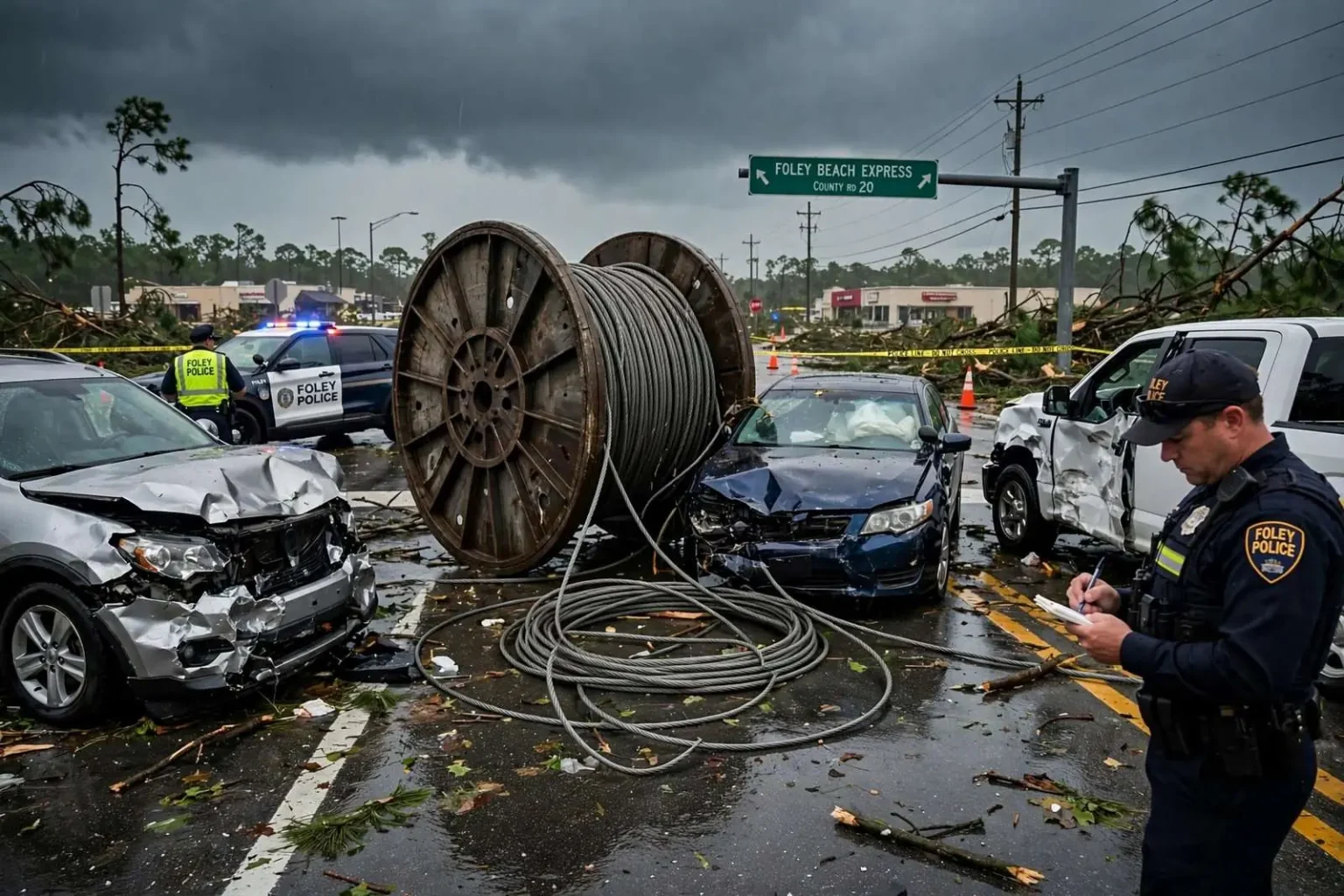
Foley police are still trying to track down the owner of a runaway cable spool that went airborne during a violent storm and slammed into three occupied vehicles on the Foley Beach Express, damaging cars but leaving everyone inside unharmed. The roughly 12-foot-tall, 200-pound metal spool was sent tumbling by winds estimated at 50 mph or higher during a powerful storm system that swept through the area. What could have been a deadly incident instead became a strange story of survival, caught on video and shared across the Gulf Coast within hours.
According to Foley Police Capt. David White, the spool rolled out of control and struck three vehicles that were stopped at the intersection of the Foley Beach Express and County Road 20. The intersection is one of the busier junctions on the north end of the corridor, where beach-bound traffic funnels toward the coast. Drivers stopped at the light had no way to see what was bearing down on them from up the road, and the fact that all three vehicles were occupied yet produced no injuries struck investigators as remarkably fortunate.
The same storm system caused far more serious consequences elsewhere in the region that day, generating hurricane-force gusts that capsized boats participating in the Dauphin Island Regatta in Mobile Bay. White noted the storm was destructive all over the county as well as Mobile County, underscoring just how severe the weather event was across South Alabama that weekend. What began as a routine spring squall line turned into one of the more damaging wind events in recent local memory, with downed trees, power outages and scattered property damage reported from the bay to the beach.
Dramatic video of the spool crashing through traffic quickly circulated online after it was captured on a cellphone by Troy Frady, a charter fishing captain based in Orange Beach. Frady told local media he grew concerned the spool was heading straight for him as he sat in his vehicle, so he began recording as it rolled toward the line of cars at more than 30 mph. The footage — a two-ton piece of industrial equipment bounding down a highway like a tumbleweed — gave viewers a visceral sense of the storm’s power and made the incident a topic of conversation far beyond Foley.
Tracking down an owner
Investigators have not been able to determine where the spool came from or who owns it. Foley Mayor John Koniar said he reviewed footage of the incident but could not identify its origin, though he expressed confidence it would not be too difficult to eventually track down the responsible party, noting that most contractors are careful to secure equipment and post warning barricades specifically to avoid liability. The spool bore no immediately visible markings that identified a utility or contractor, and no company had come forward to claim it in the days after the storm.
Foley, a city of roughly 15,000 residents straddling Highway 59 a few miles north of the beach communities, has watched its stretch of the corridor grow busier each year as Baldwin County’s tourism economy expands. The Beach Express, built as a toll shortcut to the coast, carries a heavy mix of local commuters, construction traffic and out-of-town visitors, particularly on weekends and holiday weeks. An object loose on that roadway endangers not just the vehicles it hits but everyone else navigating around the aftermath.
The spool itself told part of the story. Its size and construction — heavy steel, built to wind hundreds of feet of cable — pointed to serious utility or construction work rather than a homeowner’s project. Spools that large typically arrive by truck and are unloaded with equipment, meaning someone had staged it deliberately at a work site near the corridor. Recovering it upright but wind-thrown, investigators began the unglamorous work of canvassing nearby parcels, checking permit records and asking area crews what had been in progress when the storm hit.
White said the spool likely would not have moved at all if it had simply been laid on its side rather than left standing upright, and that securing it with straps or stakes would have prevented it from becoming a hazard. The observation turned the case into an object lesson in job-site housekeeping. A cable spool standing on its rim in open wind acts like a wheel waiting for a push; laid flat and tied down, it is as inert as any other stack of construction material.
Investigators followed up with Riviera Utilities, the region’s electric provider, but a company spokesman said the spool was not associated with any of their crews and that no employees had been working near County Road 20 around the time of the storm. The utility’s clearance narrowed the field but did not close the case — cable and fiber contractors, fencing companies, and telecom crews all use spools of similar size, and the Foley Beach Express corridor has been a busy construction zone as growth pushes utility work south toward the coast.
Police say they have not ruled out any possibilities as they continue trying to identify the spool’s owner, noting that unsecured equipment becoming a road hazard during high winds is an occasional but serious problem, especially along a well-traveled corridor like the Foley Beach Express that connects Highway 59 traffic to the beaches. The toll road has become the principal artery for visitors driving to Gulf Shores and Orange Beach from the north, and its shoulders and adjacent parcels host everything from utility staging areas to commercial construction as the Foley area continues to expand.
A storm Gulf Coast residents remember
The regatta capsizing gave the storm a somber footnote well beyond Foley. The Dauphin Island Regatta draws hundreds of sailors to Mobile Bay each spring, and the same wind field that sent a spool bouncing down the beach highway turned the bay into a chaos of overturned hulls and rescues. Boaters and drivers caught in the same weather system experienced it from different vantages, but the common thread was the speed with which conditions deteriorated — clear skies and a mild afternoon giving way to a wall of wind with little warning for anyone outdoors.
Meteorologists noted that spring storm systems along the Gulf Coast regularly produce damaging straight-line winds capable of moving unsecured objects of surprising size. The National Weather Service issues severe thunderstorm warnings based on gusts of 58 mph or greater — the same threshold police cited in estimating the winds that moved the spool. For coastal Alabama, the episode reinforced a familiar lesson: severe weather season brings winds strong enough to turn careless staging into airborne hazards.
For the drivers at County Road 20, the storm’s aftermath included insurance claims and a story unlikely to be believed without the video. Police asked anyone with information about the spool’s owner or origin to come forward, and the department’s openness about the investigation kept the case in the news as viewers shared the footage and speculated about where the giant spool had started its journey. No citations or charges had been announced as of this report, and authorities say the investigation remains open while they work to identify who was responsible for leaving the spool unsecured.
The case also illustrates a quiet corner of the law that most drivers never think about. Property owners and contractors in Alabama bear responsibility for hazards that escape their control and cause damage, and an unsecured spool that becomes a projectile on a public road can expose its owner to liability far beyond the value of the vehicles it struck. That exposure is precisely why, as Mayor Koniar observed, most professional crews stake, strap and barricade their staged equipment — and why investigators were confident someone, somewhere, knew exactly what had gone missing on the day of the storm.
Storm debris of every description litters the aftermath of Gulf Coast wind events — shingles, signage, tree limbs, trash cans — but heavy industrial equipment moving at 30 mph through a signalized intersection is in a category of its own. Traffic engineers describe the danger in simple terms: a 200-pound object moving at highway speed carries more momentum than the vehicles it strikes, and its path is impossible to predict. The three drivers stopped at County Road 20 had no opportunity to avoid it, and their survival without injury came down to timing and chance.
In the weeks that followed, the video continued to circulate as a storm-season warning across South Alabama social media: secure your equipment, check your surroundings when severe weather threatens, and remember that the wind is strong enough to move nearly anything left standing in its way. Foley police kept the file open, waiting for the call — from a contractor taking inventory, a utility crew reviewing its staging logs, or a tipster who recognized the spool — that would finally tell them where the runaway began its ride down the Foley Beach Express.