B.C. Rain High School Receives Donated Boeing 727 Engine for Aviation Academy
B.C. Rain High Schools Aviation and Aerospace Academy received a donated Boeing 727 engine to give Mobile students hands-on training experience.
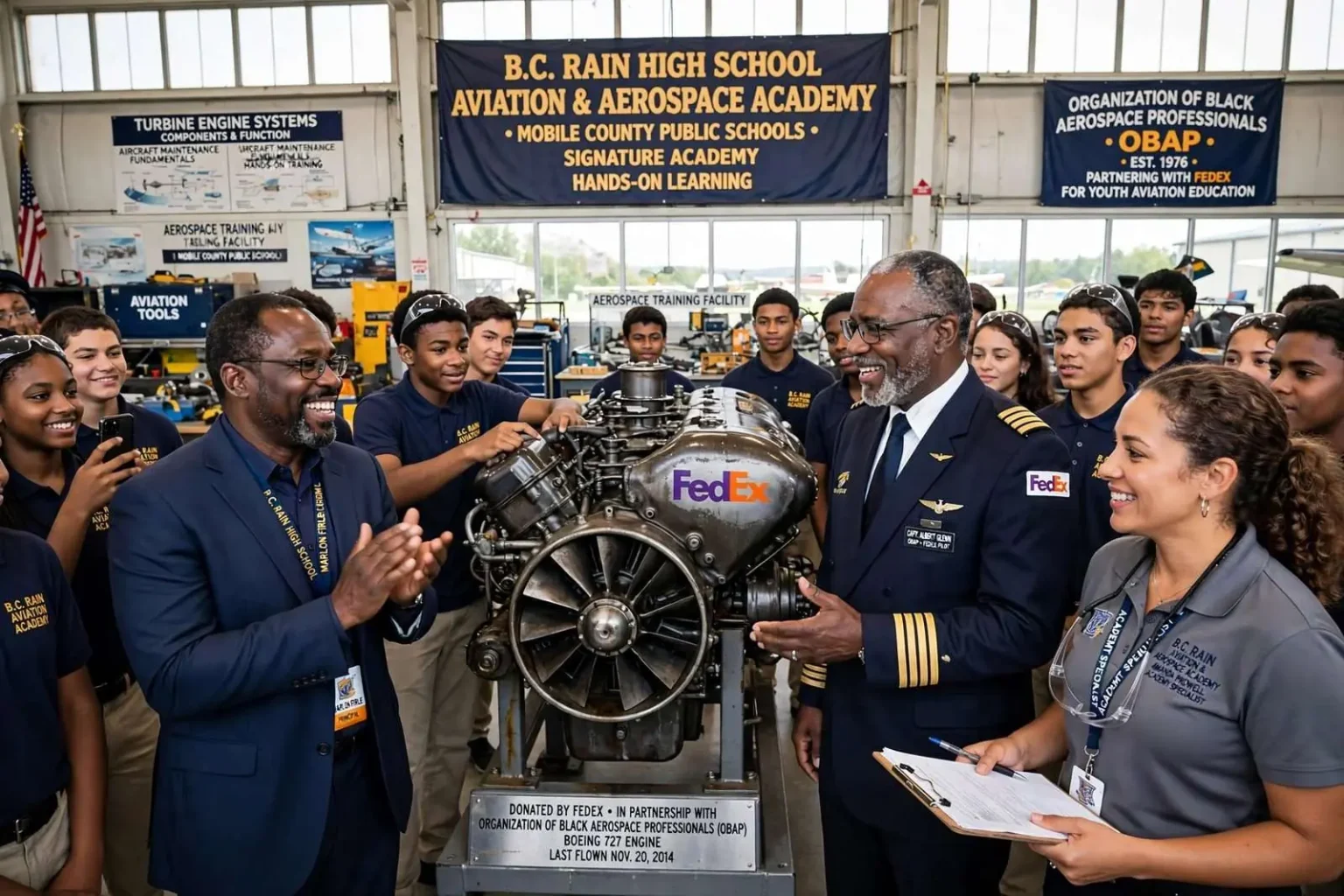
Students in B.C. Rain High School’s Aviation and Aerospace Academy got a hands-on addition to their classroom this week: a retired Boeing 727 engine that once powered a FedEx cargo plane, unveiled during a ceremony at the Mobile school system’s Aerospace Training Facility. The donation gives the academy’s students a full-sized piece of commercial aviation hardware to study, disassemble, and understand — an asset most high school programs can only describe in a textbook.
“It’s a great day at B.C. Rain High School anytime we have an opportunity to have additional resources for our children to be successful and engage themselves in hands-on experiences,” said Principal Marlon Firle. For a signature academy built around aviation, equipment is the difference between simulating work and actually doing it, and school leaders have consistently pressed for real-world training tools.
The engine previously flew aboard a FedEx aircraft before the shipping company began retiring older planes in favor of more fuel-efficient models. The engine last flew on Nov. 20, 2014, according to signature academy specialist Amanda Prowell. That service history makes the engine a genuine artifact of modern aviation — the Boeing 727 was a workhorse of American air travel and air freight for decades, and thousands of pilots and mechanics learned their trades on its systems.
“The kids are so excited,” Prowell said. “With hands-on training they get to learn about different parts and physically touch them. It’s not just a wasted experience.” Students in the academy rotate through coursework covering aircraft systems, maintenance fundamentals, and aviation careers, and a working turbofan of this vintage lets instructors move lessons from diagrams to physical reality.
How the Donation Came Together
The engine donation came together through a partnership between FedEx and the Organization of Black Aerospace Professionals, known as OBAP. The two organizations have a long shared history of supporting aviation education and expanding access to aerospace careers for young people who might never otherwise see the inside of the industry. FedEx, whose air network moves a massive volume of the nation’s overnight freight through its Memphis hub, retires aircraft and engines on a regular cycle, making it a natural source of training equipment for schools.
FedEx pilot and former OBAP chairman Capt. Albert Glenn addressed students and staff gathered for the unveiling, describing the retired engines and aircraft the organization has donated over the years as a way to spark interest in aviation careers among young people who might not otherwise picture themselves in the field.
“Exposure to students provides the opportunity for them to see and have a vision about what they want to do,” Glenn said, adding that the equipment given away by FedEx has helped foster that kind of thinking among students across multiple school partnerships. The approach is simple and deliberate: put real hardware in front of students, and some of them will decide, on the spot, that aviation is for them.
A Pilot’s Origin Story
Glenn spoke from experience: he said his own fascination with flight began at age 3, when he broke away from his mother during his first plane flight simply to get a closer look at the aircraft. He still keeps the wings pin he received on a 1956 Pan Am flight, which he calls the beginning of a path that led him into a career as a commercial pilot starting in the 1970s.
That story — a small child transfixed by a machine — is exactly the moment Glenn and his fellow OBAP members try to engineer for the students they visit. A wings pin, a cockpit visit, or a retired engine on a school floor can redirect a young life, and pilots of Glenn’s generation have made a point of paying that experience forward. OBAP, founded in 1976, has spent decades building pipelines into commercial aviation for Black pilots, mechanics, air traffic controllers, and aerospace engineers, through scholarship programs, flight academies, and school partnerships like the one that delivered this engine to B.C. Rain.
The need for that pipeline is real. Airlines and cargo carriers have projected years of demand for new pilots and maintenance technicians as an aging workforce retires, and the industry has increasingly looked to high school academies to broaden its recruiting base. Programs like B.C. Rain’s give students a head start on the certifications, technical vocabulary, and discipline the field demands — and a tangible sense of what the work actually looks like.
Mobile’s Place in Aerospace
The donation also fits Mobile’s growing aerospace profile. The city is home to the Airbus final assembly line at Brookley Aeroplex, a growing cluster of aviation suppliers and maintenance operations, and a long military aviation presence through the region’s bases. For Mobile County Public Schools, which has organized its high schools around signature academies that pair classroom learning with industry partnerships, an aviation academy at B.C. Rain connects students to employers in their own backyard.
B.C. Rain, located in the Toulminville area of Mobile, has built its academy around exactly that connection, working with industry and military partners to align coursework with real hiring pipelines. Students who come through the program can move toward two-year technical degrees, four-year engineering programs, military aviation, or direct entry into maintenance careers — and every one of those paths starts with understanding how an engine like the one now sitting in their facility actually works.
From Ceremony to Classroom
The unveiling ceremony was the beginning, not the end, of the engine’s purpose. In the weeks ahead, instructors will fold the hardware into lessons on turbine systems, thrust, and maintenance procedures, and students will trace components they have previously only seen in illustrations. The Boeing 727, with its three engines and rugged design, remains one of the most instructive airframes ever built for teaching purposes precisely because its systems are visible and accessible.
For the students who gathered for the ceremony, the message from Glenn, Firle, and Prowell added up to the same thing: aviation careers are open to them, the training can start now, in their own school, and the machine in their facility is proof that the industry is willing to invest in Mobile’s young people. An engine that flew cargo across the country for years will now fly students toward careers — no runway required.
Why Real Equipment Matters
There is a reason aviation educators prize retired hardware so highly. Aircraft systems are three-dimensional, interconnected, and physical in ways no diagram or computer module fully conveys. Students who can put their hands on a turbine case, trace a fuel line, or identify a component by sight build the kind of mental map that later makes technical school, military training, or airline apprenticeships far easier. Instructors call it tactile learning; mechanics call it the only way to really learn an engine.
High school programs with real equipment also send a signal to parents. Families weighing whether a signature academy is worth the enrollment effort look for evidence that the program produces genuine opportunity, and a donation from a global company like FedEx — delivered through a respected national organization like OBAP — is exactly that kind of evidence. It tells a parent that the school’s industry partners are engaged and that the equipment on campus reflects the real world students are preparing to enter.
The Broader Academy Model
The engine arrived as part of a much larger strategy. Mobile County Public Schools has reorganized its high schools around signature academies — career-themed programs in fields such as health care, engineering, maritime, hospitality, and aviation — that pair standard academics with industry-specific coursework and partnerships. The model asks employers to help shape curriculum, donate expertise and equipment, and eventually hire graduates, and it asks students to choose a focus while still earning a full high school diploma.
For the aviation academy at B.C. Rain, the approach has produced a steady stream of experiences: facility tours, guest speakers, flight simulations, and now a full jet engine. Each addition compounds the last. A student who hears a FedEx captain describe his career, then studies the same company’s hardware in class, sees the industry as something reachable rather than distant — and that shift in perception is precisely what donors like Glenn say they are buying with their time.
The Boeing 727’s own history gives the lesson extra depth. First flown in the 1960s, the trijet dominated American airports for a generation and became the backbone of early overnight freight operations before newer, quieter, more efficient aircraft displaced it. An engine from such an airframe connects today’s students to nearly six decades of commercial aviation — a physical link between the pioneers who flew the type and the graduates who will maintain and fly whatever comes next.
For now, the engine sits where it was meant to sit: at the center of a working classroom in Toulminville, surrounded by students who were told, plainly and by people who have flown for a living, that the sky is a workplace they can join. Mobile’s aviation industry is growing around them; the academy’s job is to make sure they are ready for it. This week, at least, the readiness got a significant push forward.