Governor, Four Congressmen Set to Dedicate New Fairhope Aviation Academy
Alabama's governor and four current and former congressmen are set to dedicate a new $2.7 million aviation training academy in Fairhope this weekend.
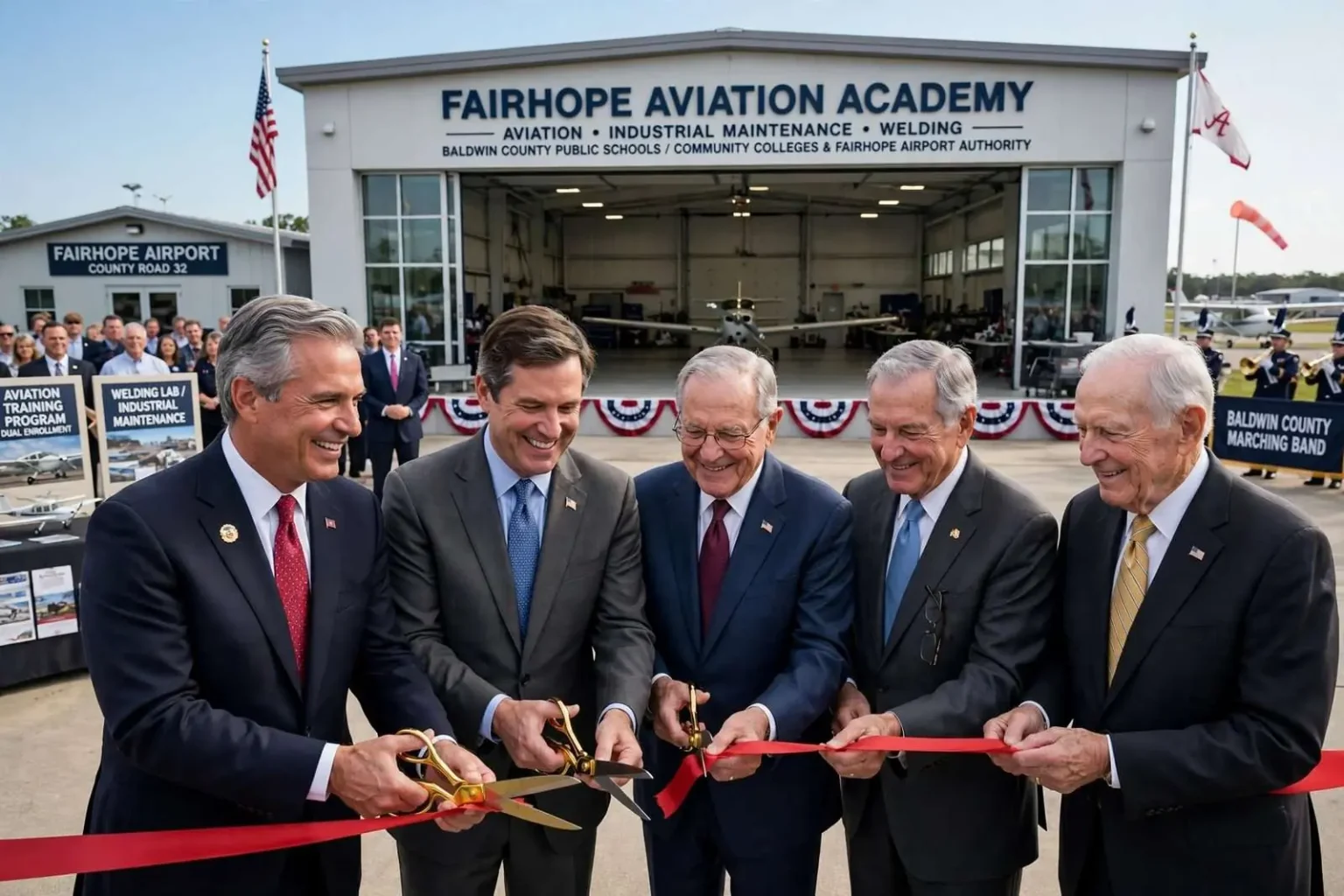
A rare gathering of Alabama political figures spanning nearly five decades of congressional service is set to converge on Fairhope this weekend for the formal dedication of a new aviation training academy at the Fairhope Airport.
Alabama’s governor and the current U.S. representative for the 1st Congressional District are scheduled to headline a ribbon-cutting ceremony and open house for the $2.7 million training facility, joined by three of the district’s previous congressmen, whose combined tenure in the seat stretches back to the mid-1960s.
The academy, built through a partnership between the Baldwin County Public School System, two community colleges and the Fairhope Airport Authority, has already been in use since January, when students began attending classes at the new 15,000-square-foot building located at the county’s airport off County Road 32.
The facility offers coursework in aviation, industrial maintenance and welding for both high school students and adult learners. High schoolers enrolled in the program take the classes as dual-enrollment courses, allowing them to earn college credit while still completing their secondary education, a feature school officials say has drawn strong early interest from students across the county.
A dedication decades in the making
Saturday’s dedication ceremony is scheduled to begin at 9:30 a.m. with remarks from the governor and the sitting congressman, followed by the official ribbon-cutting. Organizers plan to open the building for public tours immediately afterward, giving residents a chance to see the classrooms and hangar space where students train.
The event will also include a performance from a local college’s marching band program and an aviation-themed exhibition on display for attendees.
The guest list gives the ceremony unusual weight for a facility dedication. A sitting governor rarely appears at a county school system’s training center, and the appearance of three former members of Congress from the 1st District, alongside the current officeholder, amounts to a reunion of nearly half a century of the district’s representation in Washington. Their combined presence signals how broadly the project’s importance is understood, from the courthouse in Bay Minette to the statehouse in Montgomery.
For the 1st Congressional District, whose economy stretches from Mobile’s port and shipyards to Baldwin County’s fast-growing suburbs and the beach communities to the south, workforce training has been a consistent bipartisan priority. The presence of congressmen whose service reaches back to the 1960s underscores how long the region has worked to connect its young people to skilled industrial careers.
What the academy offers
The 15,000-square-foot building at the Fairhope Airport houses classrooms, lab space and hangar facilities designed around three program areas: aviation, industrial maintenance and welding. Each of those fields faces persistent demand for trained workers across the Gulf Coast, where aviation operations, fabrication shops, shipbuilding and heavy construction all compete for technicians.
Instruction is delivered through the partnership with the two community colleges, whose instructors and curricula give high school students access to college-level training without leaving the county. Adult learners can enroll in the same coursework, making the building a shared resource for the county’s workforce during the day and for career-changers in the evenings.
For high school students, the dual-enrollment structure is the draw. A Baldwin County teenager can finish high school with a transcript that already includes college credits in aviation maintenance or welding, at no cost comparable to what the same credits would require after graduation. School officials say that feature has generated strong early interest from students across the county, from Fairhope and Daphne to the county’s more rural northern districts.
Why Fairhope Airport
The location off County Road 32 places the academy at a working airfield, where students learn within sight and sound of actual aviation operations. A training facility on an airport ramp carries an authenticity that a classroom building across town could not: hangar doors that open onto taxiways, aircraft traffic overhead, and the daily rhythms of a general aviation airport all around.
The Fairhope Airport Authority’s participation made the site possible, joining the school system and the community colleges in a three-way partnership that has become a template for career-technical education in Alabama. Each partner contributes what it does best: the school system brings the students, the colleges bring the instruction and credentials, and the airport authority brings the physical setting.
The airport itself has long been part of the Eastern Shore’s infrastructure, serving general aviation for the Fairhope area and providing the kind of facility that aviation training requires. Locating the academy there also puts it within reasonable reach of students across southern and central Baldwin County, whose public school system is among the largest and fastest-growing in the state.
A workforce investment for a growing county
School officials have described the academy as a significant investment in workforce development for Baldwin County, aiming to prepare graduates for careers in aviation maintenance, welding and related industrial trades without requiring them to leave home or take on heavy debt to get started.
The county’s economy makes that mission urgent. Baldwin County has ranked among the fastest-growing counties in Alabama for years, its population fed by new residents drawn to the Eastern Shore and the coastal communities, and that growth has pulled a construction and trades workforce along with it. Employers in the region consistently report difficulty filling skilled positions, from welders to aircraft maintenance technicians, and training programs like the Fairhope academy are the pipeline those employers have asked for.
The aviation emphasis connects the county to one of the Gulf Coast’s strongest industrial clusters. The wider region’s aerospace footprint, anchored across Mobile Bay at the Brookley Aeroplex and extending along the coast through maintenance and manufacturing operations, continues to expand, and trained technicians remain its scarcest input. A Baldwin County student who completes the academy’s aviation track steps into a labor market that is actively looking for exactly those skills.
Welding and industrial maintenance, the academy’s other two tracks, serve the region’s broader industrial base: fabrication shops, shipyards, process plants and the construction trades that Baldwin County’s growth engine keeps busy. Adult learners in those tracks can reskill without relocating, a flexibility that local employers have long said the county needed.
The $2.7 million building
The facility’s $2.7 million price tag reflects the specialized nature of aviation training space, where classrooms must sit alongside hangar areas, tool storage and lab setups that can accommodate real aircraft components. Funding of that scale for a single career-technical building represents one of the larger recent investments in Baldwin County’s school facilities, and the partnership structure spread both the cost and the benefit across multiple institutions.
Since students began attending classes in January, the building has been running its first full semester, giving Saturday’s visitors a look at a working school rather than an empty showcase. The public tours planned immediately after the ribbon-cutting will take residents through the classrooms and hangar space where the county’s first academy class has spent the winter.
Dual enrollment and the changing shape of high school
The academy’s dual-enrollment model reflects a broader shift in how Alabama high schools prepare students for work. Instead of treating college preparation and career training as separate paths, the model lets a single student pursue both at once: a diploma from a Baldwin County high school and college credits toward a technical credential, earned simultaneously in the same program.
For families, the economics are straightforward. Technical credentials and associate degrees carry real costs when pursued after high school, but credits earned through dual enrollment arrive at little or no expense, which widens access for students whose families could not otherwise fund the first years of technical college. School officials have pointed to that accessibility as a key reason for the strong early interest across the county.
For employers, dual enrollment produces younger workers who arrive with verified skills and college transcripts rather than promises of future training. The community colleges’ involvement ensures that what students learn maps onto recognized credentials, which is what makes the credits portable into jobs or further education.
What Saturday means for the region
Dedications of this kind are as much about direction as about ribbon and scissors. The gathering of a governor, a sitting congressman and three of his predecessors at a county airport hangar sends a message to students, parents and employers that skilled-trades training now sits at the center of the region’s economic strategy, not at its margins.
The marching band performance and aviation-themed exhibition planned for the open house give the event a community flavor, inviting families who have no immediate connection to the academy to see what their public school system and its partners have built. Organizers expect the tours to show visitors a side of the Baldwin County schools that test scores and attendance zones rarely reveal: a working training floor where teenagers weld, study aircraft systems and earn college credit before they graduate.
With the building in use since January, the academy’s first class is already writing the proof that the investment works. The ceremony at 9:30 a.m. Saturday will formally christen the facility, but the real measure will come as its graduates move into aviation maintenance shops, welding floors and industrial sites across the Gulf Coast, carrying Baldwin County credentials and the credit hours to show for them. For the county’s students, and for the employers waiting for them, the doors opening at the Fairhope Airport open onto both.