Fairhope Enters National ‘America in Bloom’ Beautification Competition
Fairhope is competing in the 2015 America in Bloom program, hosting national judges who will tour the city's parks, gardens and historic districts.
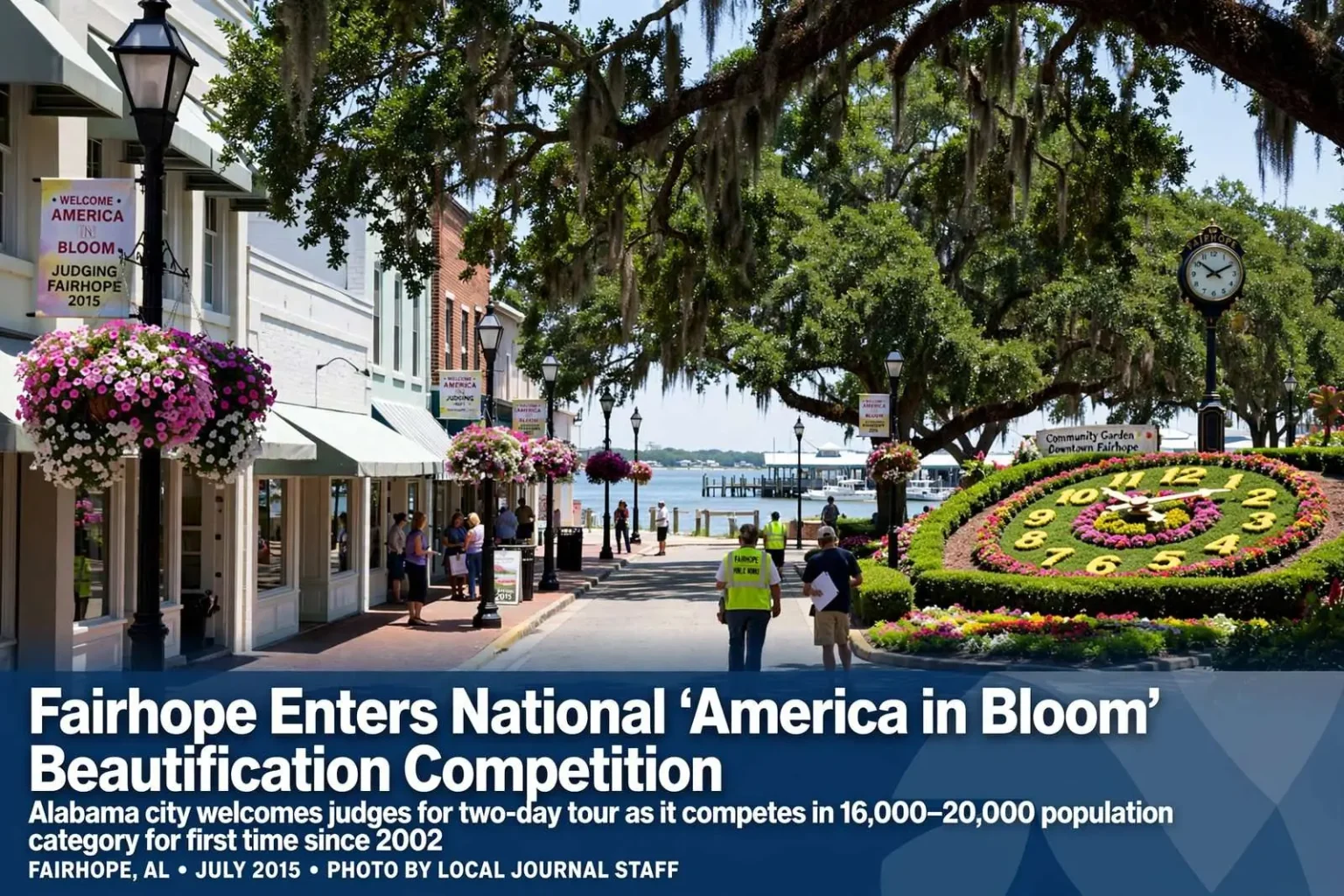
Fairhope, a city long recognized for its flower-lined streets and manicured public spaces, has entered the 2015 America in Bloom competition for the first time in more than a decade. The national program evaluates participating towns on categories ranging from floral displays and urban forestry to heritage preservation and community involvement. City officials say Fairhope last competed when the awards launched in 2002, earning recognition in its population category that year.
Sherry Sullivan, the city’s director of community affairs and recreation, said officials decided it was time to showcase years of civic improvement work. “We’ve done a whole lot in the past five to seven years, so we wanted to toot our own horn,” she said.
This year Fairhope competes in the 16,000 to 20,000 population category against Madisonville, Kentucky; Fairview Park, Ohio; and defending category winner Ottawa, Illinois. According to America in Bloom, Fairhope is one of 42 municipalities nationwide taking part in local revitalization efforts tied to this year’s program.
Two days of judging
Two out-of-state judges are scheduled to spend two days touring the city, assessing everything from downtown landscaping to environmental stewardship. Their itinerary includes a walking tour of the central business district alongside Mayor Tim Kant, Public Works Director Jennifer Fidler and Landscape Supervisor Paul Merchant, followed by stops at the Fairhope Museum of History, the Fairhope Public Library, the Eastern Shore Organic School’s historic Bell Building and the campus of a nearby college.
The tour also takes in several of the city’s green spaces, including a community garden, a downtown park and the bayfront, before wrapping up with visits to the city’s “Fruit and Nut” residential district, the well-known Floral Clock and other landscaped areas on the north side of town. Judges are expected to spend the night locally before continuing their evaluation the following day, which includes a stop to review an ongoing watershed restoration project.
The itinerary is designed to touch every category the program scores, from the flower beds and hanging baskets that define Fairhope’s downtown streetscape to the less visible work of tree planting, stormwater management and historic preservation. City staff have spent weeks preparing documentation, photographs and tours to make sure the judges see not just the finished landscapes but the volunteer labor and municipal planning behind them.
Fairhope’s landscape tradition
Few Alabama cities carry a reputation as closely tied to their landscaping as Fairhope. The Single Tax Colony founders who established the city on the bluff above Mobile Bay in the 1890s planned it around parks and public spaces, and that tradition shows today in the flower boxes of the downtown district, the oaks draped along the streets, and the Municipal Pier park that anchors the bayfront.
The “Fruit and Nut” district the judges will visit reflects that same heritage in a different form, a residential pocket known for its edible landscaping and decades-old pecan, citrus and fig trees planted in yards and along the streets. The Floral Clock, a downtown landmark tended by city crews, has become one of the photographed symbols of the town’s civic pride.
City officials say that pedigree is exactly why they entered. America in Bloom scoring rewards consistency and community involvement as much as showpiece plantings, and Fairhope’s network of garden clubs, volunteer planters and school partnerships gives it material to present in every category. The watershed restoration project on the second day of judging is intended to demonstrate the environmental side of that work, showing the judges that the city’s investment extends beneath the soil and into Mobile Bay.
Brewton competes again
Fairhope isn’t the only lower Alabama city vying for recognition this year. Brewton, competing for the second consecutive year in the 3,500 to 6,000 population category, earned special recognition last year but fell short of the top award. This year Brewton faces off against communities in Texas, West Virginia and New York, with its judging visit scheduled for the following month.
Brewton’s return to the competition reflects a strategy other Alabama towns have followed, entering repeatedly to build on judges’ feedback between years. Communities that earn special recognition in one cycle often use the notes from that visit to target weaknesses, from streetscape maintenance to volunteer programs, before the next judging tour arrives. Escambia County’s seat has invested in its downtown revitalization effort in recent years, and city leaders there have pointed to the America in Bloom process as a framework for that work.
The two Alabama entries this year also illustrate how the program tiers its competition. By grouping towns strictly by population, America in Bloom pits communities of similar resources against one another, so a Baldwin County resort town of nearly 20,000 and a rolling timber-town county seat of a few thousand each compete on their own ground.
The program’s reach
Since its founding, the America in Bloom program has worked with more than 240 towns and cities across 41 states, with organizers estimating more than 20 million people have been touched by local beautification efforts tied to the initiative. Category winners are also invited to compete internationally through a sister program based in Canada, giving top-scoring communities a chance to measure themselves against towns abroad.
The program’s scoring rubric goes well beyond flowers. Judges evaluate seven general categories, including landscaped areas, urban forestry, environmental efforts, celebrating heritage, and overall community involvement, and they reward evidence of planning, volunteerism and long-term maintenance rather than one-time plantings. Written feedback after each visit has become a tool municipal officials use to justify budgets and shape multi-year improvement plans.
Award winners across all population categories will be announced in late September at America in Bloom’s national symposium, held this year in Michigan. Fairhope’s delegation expects to attend, and city officials say regardless of the outcome, the judging visit itself offers a chance to highlight the volunteer efforts and civic investment that have shaped Fairhope’s public spaces in recent years.
Between now and the symposium, city crews and volunteers will keep up the standard the judges saw, from the hanging baskets downtown to the bayfront park. However the scoring lands in September, officials argue that the process has already paid for itself by cataloguing what the city has built and pointing to where the next round of work should go.
What the judges will score
America in Bloom’s judging visits follow a demanding rhythm, and Fairhope’s two-day itinerary packs in the full range of what the program measures. On the first day, the walking tour of the central business district puts the city’s signature streetscape on display, from the planters and benches along Section Street to the storefront facades preserved in the downtown core. The stops at the Fairhope Museum of History and the historic Bell Building speak to the heritage preservation category, where judges look for communities that protect and interpret their past rather than simply replacing it.
The green space stops carry equal weight. Community gardens count as evidence of resident involvement rather than purely municipal effort, and judges routinely credit towns whose gardens are organized, plotted and maintained by volunteers. The bayfront park, the city’s most visited public space, demonstrates how Fairhope pairs tourism pressure with upkeep, and the watershed restoration site on day two shows the environmental commitment the program added to its scoring as it matured.
The Floral Clock and the north-side landscaped areas close the tour on recognizable landmarks, but judges also evaluate what visitors see without a guide: entry corridors, parking areas, and the side streets between the showpiece locations. City officials have acknowledged that the unguided view is where most communities lose points, and Fairhope’s crews have spent the weeks before the visit on corridor mowing, litter patrols and mulch refreshes beyond the downtown core.
A civic habit decades in the making
Fairhope’s decision to re-enter after more than a decade reflects both the city’s growth and the maturing of its public-works ambitions. The population boom that pushed the city toward the top of its category brought new subdivisions, new traffic and new demands on the same bluff-top parks and downtown streets that earned the town its reputation. Officials say the competition gives them an outside, professional read on how well that growth has been absorbed.
Sullivan’s “toot our own horn” framing captures the dual purpose of the entry: winning matters, but so does the documentation. Compiling two days of tours forces each department, from public works to the museum, to catalogue its recent investments, and that record outlives the judging visit. The city intends to use the judges’ written evaluation, win or lose, as a checklist for the next round of capital and maintenance spending.
Local volunteers are also part of the presentation. Garden club members, master gardeners and school groups connected to the community garden and school stops have been asked to meet the judges, because the program’s community involvement scoring depends on seeing the residents behind the landscapes. In a city where much of the public planting has historically been done with volunteer labor, that showing may matter as much as any flower bed.
The results will be known when the national symposium convenes in Michigan in late September, and if Fairhope prevails in its category, it would join the roster of communities invited to international competition through the program’s Canadian sister organization, a level no Baldwin County city has reached before.