Sidewalks, Parks or Paving? Fairhope Asks Residents to Help Shape Its Next Five Years
With just six residents at its first session, Fairhope scheduled a second community meeting at the public library, hoping more people would help build the city's first strategic plan.
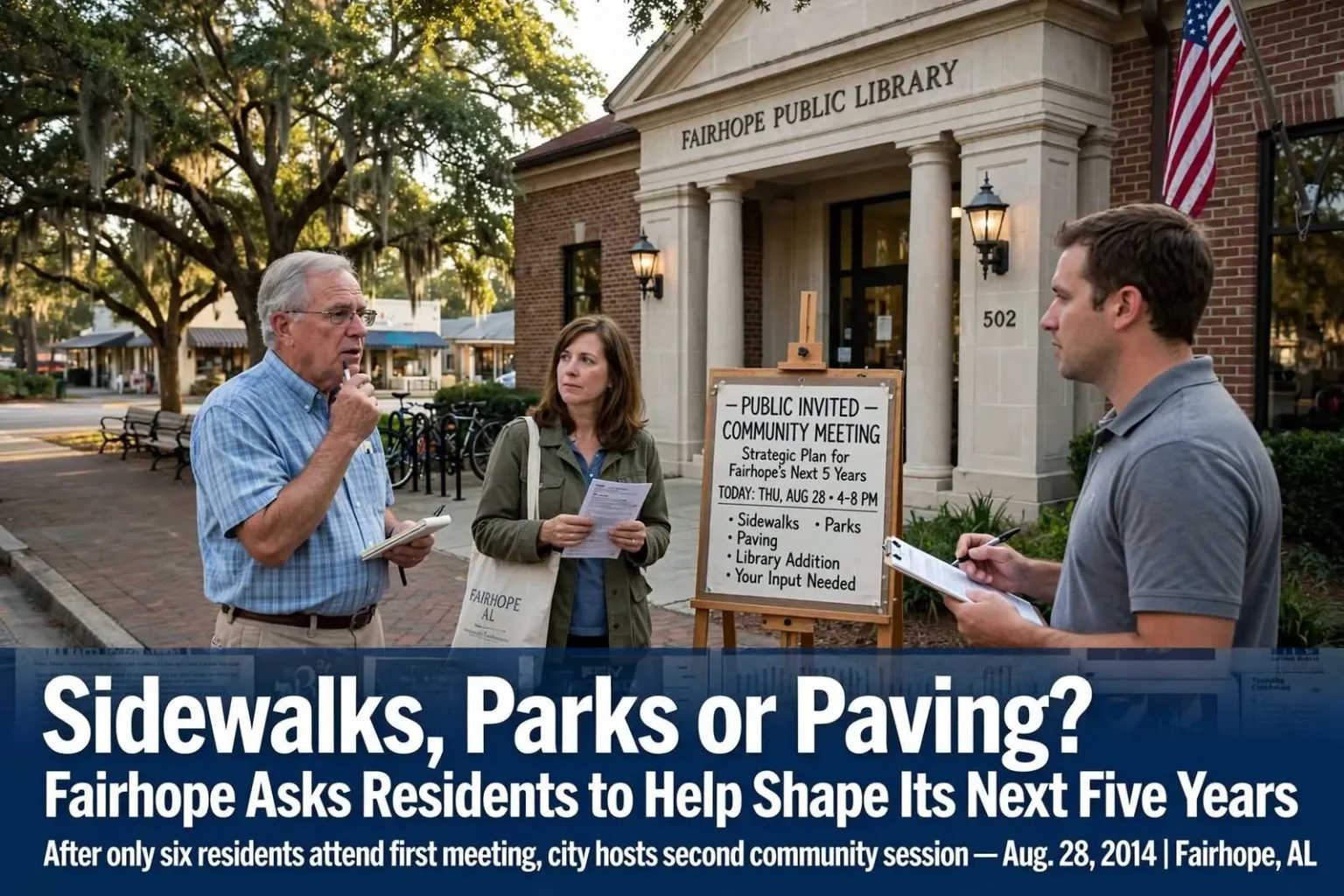
Fairhope’s leaders wanted their residents to take ownership of the city’s future, but when they first asked, hardly anyone came. After a sparsely attended initial session, the city scheduled a second community meeting and issued an open invitation, determined to gather the public input needed to build its first strategic plan. The follow-up meeting was set for 4 to 8 p.m. Thursday, Aug. 28, 2014, at the Fairhope Public Library on Fairhope Avenue.
A second chance to be heard
The city arranged the additional session for a simple reason: turnout at the first meeting had been almost nonexistent.
“We’re doing it because we only had six residents that showed up at the last one and there’s no way we can have input from the community with just six people,” Mayor Tim Kant said.
The effort was tied to Fairhope’s participation in the Alabama Communities of Excellence program, known as ACE, with the strategic plan serving as a key component of the initiative. Kant suspected many residents did not fully understand what the ACE program involved. He described it as an initiative that uses a comprehensive, three-phase approach to help participating communities plan and prepare for smart, sustainable growth.
Alabama Communities of Excellence operates as a nonprofit partnership that guides smaller municipalities through a structured development process, pairing community assessment and leadership development with the technical work of planning and implementation. Participating cities move through phases that assess local conditions, build leadership capacity and identify projects that position the community for growth. For a city of Fairhope’s size, the program offered outside expertise and a framework the city could not easily assemble on its own.
Two plans, two purposes
Part of the challenge was terminology. Kant said there had been confusion between the city’s comprehensive plan and the strategic plan it was now trying to assemble, and he drew a clear distinction between the two. The comprehensive plan represents a long-term vision of where the city hopes to go — the document that guides zoning, land use and the physical shape of the community across decades. The strategic plan is an action plan that officials commit to completing, a shorter list of priorities with timelines attached.
“This is just part of the ACE program and it’s about our strategic plan, which we’ve never had for Fairhope,” Kant said.
That absence was notable for a city that had built a national reputation as a distinctive bayside community. Fairhope’s single-tax heritage, its bluff-top parks and its walkable downtown had made it one of the Eastern Shore’s most recognizable places, but growth pressures — new subdivisions, rising property values and the steady migration of retirees and families to Baldwin County — were testing the infrastructure and character that drew people in the first place.
The questions on the table
Kant framed the meeting as a chance for residents to weigh in directly on how the city should spend its resources over the next five years. The list of possibilities he offered touched on the everyday concerns that shape life in a growing community.
“People need to come and tell us their concerns, whether it’s paving the streets or building more parks or putting in more sidewalks or adding onto the library,” Kant said. “All of those things need to be talked about and what we ought to be spending our resources on over the next five years.”
By putting choices such as street paving, park expansion, new sidewalks and a possible library addition before residents, the city hoped to turn abstract planning language into a concrete conversation about priorities. Each of the items Kant named carried a real price tag and a real constituency. Paving schedules determined which neighborhoods saw their roads rebuilt and which waited another budget cycle. Park expansion spoke to Fairhope’s identity as an outdoor community whose municipal parks drew residents and visitors alike to the bluff and the bayfront. Sidewalks tied together the walkability that defined the downtown and the older residential streets around it. The library, a civic anchor on Fairhope Avenue, faced the demands of a growing population and changing technology.
What attendees could expect
To make the second meeting more productive, the city brought in outside expertise to guide the discussion. The session was to be facilitated by economic and community development specialist Ephraim Stockdale of Alabama Power Company, and a light dinner would be served to those who attended. Residents with questions or seeking more information were directed to call the city at 251-990-0218.
The four-hour window, stretching from late afternoon into the evening, was designed to catch residents at different points in their day — after school, after work, before dinner. The library location put the meeting in the heart of the walkable downtown, and the facilitation by an outside specialist was intended to keep the conversation productive and to record input in a form the strategic plan could actually use.
The push reflected a broader truth about municipal planning: a strategic plan is only as strong as the community engagement behind it. With only six residents at the first meeting, the city risked producing a document that reflected the views of a handful of people rather than the community as a whole. A plan built on such thin input would have been easy for future councils to set aside, precisely because the public had never claimed ownership of it.
Why a small city’s plan matters
Strategic plans function as the bridge between a community’s aspirations and its budget. A council can hold hundreds of informal conversations about what Fairhope ought to be, but the strategic plan converts those conversations into a ranked list of projects that survive elections and staff turnover. Cities that maintain such documents tend to compete more successfully for grant funding, because state and federal programs routinely ask applicants to show that a requested project appears in an adopted plan and grew from documented public input.
That dynamic mattered for a Baldwin County city whose growth was outpacing its infrastructure. Baldwin was among the fastest-growing counties in Alabama during the years surrounding the meeting, and Fairhope’s schools, roads and utilities felt the strain of residential development that the city’s annexation and zoning decisions could shape but not stop. A five-year strategic plan gave the city a way to sequence its response — which roads first, which parks, which facilities — rather than reacting project by project as pressure arrived.
By trying again, and by spelling out exactly what was at stake, Fairhope’s leaders signaled that they wanted the plan to be genuinely shaped by the people who would live with its results for years to come. The mayor’s blunt description of the problem — six people cannot speak for a community of thousands — doubled as the invitation: the plan would be whatever residents made of it, and the door at the library would be open.
Learning from the first meeting’s failure
The near-empty first session taught the city something about how residents engage with planning. Municipal meetings compete with family schedules, school events and simple fatigue, and planning sessions in particular can strike residents as abstract — a conversation about documents rather than drainage ditches. Fairhope’s response addressed the problem on several fronts at once: a longer, more convenient time slot, a meal to remove one barrier to attendance, professional facilitation to make the evening worth the trip, and a mayor willing to say publicly that six people could not carry the weight of a community’s input.
The open invitation also carried an implicit promise. If residents showed up and said the priority was paving rather than parks, or sidewalks rather than a library addition, the plan would reflect what they said rather than a pre-written agenda. Cities that run engagement processes where the outcome feels predetermined tend to see attendance dwindle further; Fairhope’s leadership was betting that genuine openness would draw the opposite response.
Public libraries have historically served as natural venues for this kind of civic work. The Fairhope Public Library sat on Fairhope Avenue within easy reach of the downtown’s core, offered meeting space without the formality of council chambers, and embodied one of the very facilities the strategic plan might expand. Holding the conversation inside one of the candidate projects gave attendees a concrete example of the stakes.
Planning in a fast-growing county
Fairhope’s planning push unfolded in a Baldwin County that was absorbing growth at a pace few Alabama counties matched. The county’s population gains flowed steadily toward its southern and eastern shore communities, drawn by schools, beaches and the quality of life that municipalities like Fairhope, Daphne and Spanish Fort had cultivated. Each new roof added demand to the same roads, utilities and public facilities that the city’s budget had to maintain, and the costs of catching up grew with every year of deferral.
A strategic plan offered Fairhope a way to get ahead of that curve. By identifying the next five years of capital priorities — and backing them with public input — the city created both a roadmap and a record. When grant opportunities arose through state programs, federal infrastructure funding or the county’s own revenue streams, Fairhope could point to an adopted plan with documented community support. When developers proposed projects, the plan gave the city a stated basis for negotiating infrastructure improvements. And when residents asked why a particular road was repaved before another, the document supplied the answer.
The ACE program’s three-phase structure reinforced that discipline. Communities in the program work through assessment, planning and implementation with outside partners at each stage, and the strategic plan the city was assembling formed the backbone of its phase work. For Kant and the council, the meeting at the library was not an isolated exercise but a required step in building a document the city would actually govern by — the first strategic plan in Fairhope’s history, as the mayor noted, and one whose credibility would rest on how many residents walked through the door to shape it.